
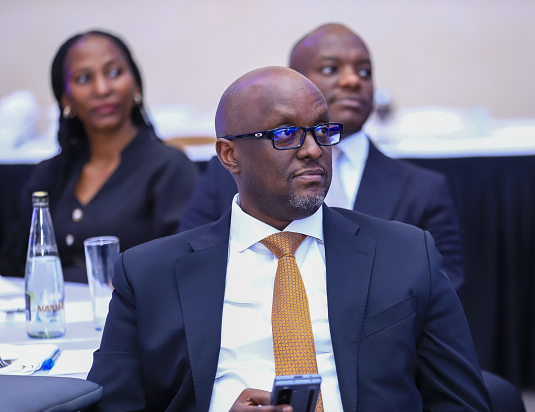
Dennis Kakonge, General Manager, Corporate Services at MTN Uganda, appearing before Parliament’s Finance Committee
Telecommunication giants, MTN Uganda and Airtel Uganda have asked Government to lower the tax on mobile money transactions from the current 0.5% withdraw charges to 0.25% and also have it capped at UGX5000 per transaction above UGX3M.
The request was made by Dennis Kakonge, General Manager, Corporate Services at MTN Uganda, and Japhet Aritho, Managing Director, Airtel Money, while appearing before Parliament’s Finance Committee on 15th April 2026, where they were presenting their views on the eight Tax Bill presented by the Ministry of Finance to fund the 2026/27 National Budget.
“…we would like this tax to be reviewed and dropped to 0.25% on mobile money transactions and capped at UGX5,000 per transaction (exceeding UGX3M). We are not asking that it is removed completely, we are cognizant that there is a need for Government to collect revenue. However, we are proposing that it is dropped to 0.25%, and if it is dropped, you will see that the transaction volumes will increase,” Kakonge said.
MTN Uganda defended its request informing the Committee that currently, the Excise Duty Act (Section 3(1) and Schedule 2, Part I) imposes 0.5% excise duty on cash withdrawal values, plus 15% on service fees (except for banks), thus, Uganda stands alone among comparable markets taxing transaction values as well as withdraw fees, levies the telecos argue make mobile money more expensive compared to other countries.
On what the expected outcomes will be if the tax is lowered, MTN revealed that the customer base will grow to 24.2 million by 2030, while Agent network will also grow to 424,000 by 2030 and the cash withdrawal transactions will rise to UGX63.39Billion by 2029/30.
Japhet Aritho, Managing Director, Airtel Money also asked Parliament to drop the 10% import duty on smartphones, saying doing so would lead to the growth in consumption arising from the number of users who will be included in the tax bracket.
“Then will offset significantly whatever waiver we have given, and then we’ll be able to even accelerate further after five years. We know that Government is already charging a 12% excise duty on data consumption, and 18% VAT as well. If we stimulate more people to have smartphones, the growth in the consumption can quickly offset the waiver of the 10% import duty within five years. Our proposal is specific to smartphones whose CIF value is below 500,000 because we want to encourage the people who are not digitally included today to be included,” Aritho said.
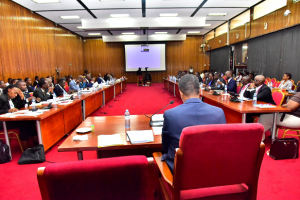
Paul Omara (Otuke County) concurred with the proposals fronted by the telecos, saying the taxing regime has left mobile money charges higher than the banking transactions, a trend he says is detrimental to financial inclusion.
“I think they have talked about financial inclusion, which is a big role they have played so far across the country. The challenge which I see as a bottleneck, which with additional taxes basically aggravates the situation, is that your rates, especially cash withdrawal rates, are extremely high. If you look at the banking industry, customers used to complain about cash withdrawals over the counter and things like that. The telecom companies have surprisingly exceeded banks in terms of the charges you people make,” he said.
Karim Masaba (Mbale Industrial Division) however disagreed with the proposal by the telecos to have the 0.25% imposed across banking and mobile money services, saying that this will worsen the challenge of limited financial inclusion.
“You are looking at it on your side, because banks and agent banking are substituting what exactly you do, and the argument is, most people now prefer to use the bank and agent banking because of that smaller fee, and then you had suggested to increase it on the agent banking and the banks as well. But once you put it across the entire sector from the banks, because there are people who are transacting in millions of dollars, so you will expect them to pay this 0.25% or 0.5%, it is quite huge. It is quite dangerous for the economy, it’s as if we are now telling our people to keep money home, not transact with banks,” said Masaba.
Amos Kakunda, Chairperson Finance Committee wondered why the telecos made no submission on the proposal to impose withholding tax on mobile money agents, wondering if the telecos are comfortable with the proposal, but also promised to have further engagements on the proposals made by the Telecos
“We are going to have an extra engagement, because whereas on the other side, maybe you can cap it to a certain amount, we see it detrimental, we also need to look at the financial inclusion on this side for our local ones. We are encouraging a cashless economy, and the cost of printing the notes is also high, Bank of Uganda is complaining. So, it is a delicate balance that we need to decide, and I want to assure you that this committee is well informed and knowledgeable,” remarked Kankunda.
In its documented research to the Committee, MTN Uganda informed the Finance Committee that Uganda’s approach of taxing cash on withdraw is out of step with regional and international best practice, with Kakonge revealing that Kenya taxes service fees at 15% but nothing on withdrawal values, yet, about 59% of Kenya’s GDP flows through M-PESA, over 86% of adults are financially included.
Kakonge also cited the example of Tanzania that charges 10% on service fees (lower than Uganda’s 15%) and a fiat levy of TZS 10-2,000 on transaction values far lighter than Uganda’s 0.5%, while in Rwanda, the country currently imposes no excise duty on mobile money (a 15% rate arrives in 2027/28).
From the East African region, MTN Uganda crossed over to West Africa noting that in Nigeria no excise duty is imposed on withdrawals, but rather, a flat N50 levy (about UGX130) applies to transfers of N10,000 or more the effective rate falls as transaction values rise. And to the southern part of Africa, MTN also indicated that South Africa imposes no excise on mobile money, while in Zambia, there is no excise duty on mobile money.
“Uganda is the outlier. Every comparable market supports digital services and smartphone adoption through lighter taxation and markets like Kenya and Nigeria have seen explosive growth in digital participation and the tax revenues that follow,” Kakonge explained.
The telecos also wondered why Uganda is still maintaining the 10% levy on smartphones yet the decision to have this dropped was already agreed between the East African Community partners four years ago, but Government has maintained it on Uganda’s tax register.