
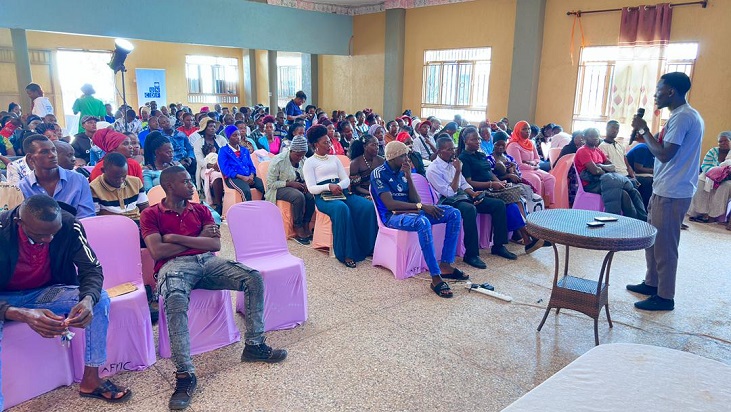
Entrepreneurs from Luweero attending the workshop
In Luweero, the mobile phone has long been part of everyday business. It connects customers, enables payments and keeps enterprises running. Yet for many small business owners, it has remained a tool for transactions, not transformation, even though it sits at the very centre of how business is done.
A new push by the United Nations Capital Development Fund (UNCDF), together with partners including Outbox Uganda and in partnership with Mastercard Foundation, is now working to change that narrative through a campaign dubbed “Business Ku Ssimu Yo”.
The campaign is part of the 10X programme that aims to accelerate the growth of youth-led micro, small and medium enterprises (MSMEs) through the digital economy. It helps young entrepreneurs operate more efficiently, access markets, and secure finance via digital platforms.
The programme targets financially disadvantaged young women, including refugees and persons with disabilities, across priority sectors such as trade and services, technology, agriculture, tourism, light manufacturing, fashion and design. Its goal is to reach 61,000 young women, with at least 34,000 gaining new, improved, or sustained work opportunities by 2027.
At the heart of the initiative, is a rethinking of what a mobile phone actually represents for a small business. It is no longer viewed only as a device for sending and receiving money, but as a working business system that can function as a shop, a record book and a gateway to financial opportunity when used intentionally.
Across Luweero, many entrepreneurs are already active on mobile money platforms. However, their usage often ends at completing transactions. The phone moves money, but it is not yet consistently used to organise, track, or reflect the story of the business over time.
Through the 10X Programme, UNCDF and its partners are working directly with entrepreneurs to shift this mindset. The focus is on helping business owners see that every transaction recorded on their phone is part of a broader financial identity that can strengthen their business visibility and future prospects.
The initiative encourages practical changes in how entrepreneurs interact with their phones as business tools. These include separating personal and business transactions, using mobile money more consistently for business activity, and reducing the immediate withdrawal of funds so that transaction histories remain intact and meaningful.
These shifts are becoming increasingly important as financial institutions move toward data-driven lending models. Transaction history, mobile money activity, and digital behaviour are now key indicators used to assess creditworthiness, especially for businesses that do not have traditional collateral.
As Uganda continues to expand its digital economy, the 10X programme is reinforcing a shift in perspective — from seeing the phone as a transaction tool to recognising it as the core infrastructure of a small business, where sales, records, and access to finance all begin.