
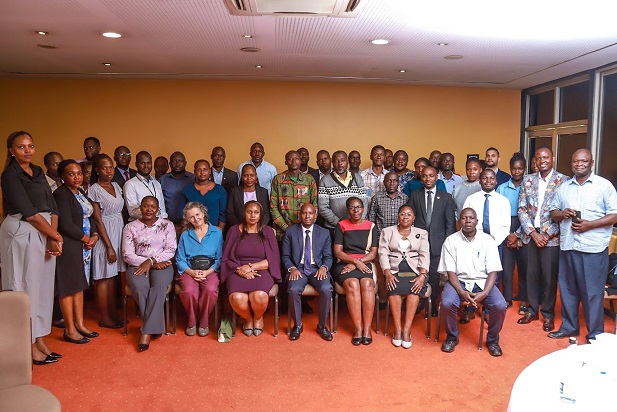
A group photo of participants who joined the Multi-Stakeholder Dialogue on Uganda’s coffee sector under EUDR framework
A group photo of participants who joined the Multi-Stakeholder Dialogue on Uganda’s coffee sector under EUDR framework
Civil Society Organisations have called on Government to consider investing in alternative coffee markets as the deadline for the European Union Regulation on Deforestation-Free Products (EUDR) looms, warning that any disruptions in Uganda’s exports would mostly affect small scale holder farmers yet these aren’t the main contributors to global climate change.
The appeal was made by Jane Nalunga, Executive Director, Southern and Eastern Africa Trade Information and Negotiations Institute (SEATINI) during a Multi-Stakeholder Dialogue organized by SEATINI Uganda and the Department of Coffee Development under the Ministry of Agriculture, Animal Industry and Fisheries (MAAIF) on 12th August 2025 at Kabira Country Club in Kampala.
“Another issue I think which we need to look at, not today but in the near future, is looking at alternative markets. We need to organise a meeting like this one to talk about alternative markets and they are there. We are not saying we do away with European Union (EU) because 70% is really difficult, you know, but it is also good for us because we can enter any other market, isn’t it?” remarked Nalunga.
She defended her proposal arguing, “Our challenge with the EU deal is an imposition. It’s a unilateral measure. But it’s unfair because it’s penalising the small-scale producer who never caused the climate crisis. We are in a crisis. The climate is in a crisis but now who is being penalised? It’s the small-scale producer because when you look at the entire compliance exercise, the multinationals, the big companies are in a better position. The small-scale producers are in a delicate position and you remember that we dismantled the cooperatives. Where do we start? How do we protect our small-scale producers? How do we protect our economy?”
The development comes at the time when on 22nd May 2025, the European Union officially categorized Uganda as a “Standard Risk” country under the EU Deforestation Regulation (EUDR) framework, a classification that now requires full due diligence by exporters, with activists warning that it comes with far-reaching implications for Uganda’s coffee exports, which form a core part of the country’s agricultural exports and foreign exchange earnings.
While the EUDR compliance deadlines have been extended to 30th December 2025 for large companies and 30th June 2026 for SMEs, Uganda faces notable challenges in meeting these requirements, including: limited farmer registration and land geolocation mapping, inadequate institutional coordination and compliance infrastructure and low awareness across value chain actors,
“So many it’s a lot of English, a lot of words, but what does it mean for us as Ugandans, for our small-scale producers and for the fact that coffee is our main export and the fact that our export to the EU is now almost 70%. So what does that mean? People in the villages are panicking. They are asking should we cut down the trees and start planting other things? What are we going to do? I think we need to organise more meetings up country at district level and sub- county level. Let us bring all those experiences, what’s happening on the ground. Sometimes, information which we get here, sometimes doesn’t reflect what’s really happening on the ground. So let us bring those experiences and let us chat our way forward,” Nalunga explained.
Reuben Keimusya, Assistant Commissioner Coffee Production at MAAIF revealed that although the deadline for the EUDR compliance has been earmarked for December 2025, Government has committed to ensure this is done by 15th October 2025, owing to the 45-60 days within which Uganda’s coffee takes to be transported from Mombasa Port to the European Market, so the new deadline is intended to ensure that exporters aren’t affected.
According to the Ministry of Agriculture, between June 2024 to June 2025, Uganda exported 7.8million bags of coffee, which accounted for US$2.2Bn (Shs29Trn), of which the European Union alone buys 65-70% of Uganda’s coffee, with 12.5million people in Uganda deriving their income through coffee value chain and Uganda is targeting to register 2.5-3million traceability coffee farm polygons, although only 1.5million of these have so far been registered.
“Uganda will have EUDR compliant data for 85% of its coffee farms. The EU exporters to be ready to attach compliance certificates for each batch to the EU destination by 15th October 2025. Our target is between 2.5 to 3million coffee farm polygons, but we expect that this is going to be more because as I have told you, 1.5 coffee farm polygons have been mapped so far, but when you go on the ground, you find that this is not actually even 50%. So, we have a lot of work to do and by the time we complete this process, God knows we might have 4 million coffee farm polygons,” said Keimusya.
The Ministry of Agriculture also highlighted a number of challenges faced during the compliance exercise amongst them which include the magnitude of the number of farmers to be registered as well as the absence of policies in the current laws to fact in the EU compliance requirements, with Keimusya arguing that the absence of such policies could explain why Uganda and Democratic Republic of Congo were lumped in the high risk category within the East African Community.
Keimusya explained, “The national law lacks the explicit EUDL compatible differentiation definition and EUDL requires that this should be put also in our national policies. Yes, Uganda has one of the best laws concerning climate, concerning forests, and all that but, you know, EUDL just came in 2023. Uganda has one of the best laws in Africa and actually globally that protects forests and on conservation, but still, we lack those clauses on EUDL. For example, on deforestation timelines to say that we consider you, like from 2020, you must not have cut down the trees since December 2020, that clause, is not there. So, we need to work with the different government agencies, departments, and ministries to ensure that we align them all.”
About the Author