

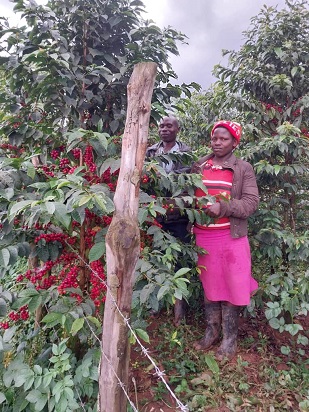
Farmers under Kikobero Coffee only harvest red cherries
Farmers under Kikobero Coffee only harvest red cherries
Ugandan coffee can achieve higher international prices if farmers adopt sound agronomic and post-harvest handling practices. Martin Nangoli, proprietor of Kikobero Coffee Company Ltd, proves this is possible—his premium-quality coffee can fetch double the market rate.
Nangoli has mastered the art of producing quality coffee so well that his brand has won Uganda accolades in international competitions. His latest achievement came in September 2025, when Kikobero coffee won a gold medal in Paris, France at the 11th International Contest of Coffees Roasted at Origin. His specialty Arabica was the only African coffee to win gold, beating competitors from Ethiopia and Kenya. Nangoli’s coffee scored a distinction, implying his score was about 90 according to the protocols.
Kikobero coffee takes its name from Kikobero village and parish in Masira Sub County, Bulambuli District, Eastern Uganda. The area is now known for high-quality, organic-certified Arabica coffee, thanks to Nangoli’s efforts to train smallholder farmers in good agronomic and post-harvest practices.
In an interview with Business Focus, Nangoli explained that when he founded Kikobero Coffee Company Ltd in 2006, coffee from his village and the wider Bugisu sub-region had lost market share due to poor quality—a situation that has since been transformed.
“Our quality has never gone down since we started, but rather continues to improve,” he says.
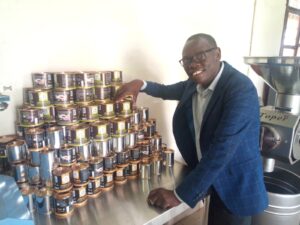
Traceability and Producing Quality Coffee
Nangoli began a coffee movement in his village over 20 years ago, educating farmers on the importance of producing high-quality coffee. He says Kikobero implemented a traceability system even before the European Union Deforestation Regulation (EUDR) law existed.
“When we started, I told farmers that if we produced quality coffee and sold our story—where the coffee comes from and how it’s grown—buyers would pay a better price. We began documenting our coffee story openly; the farmers weren’t afraid their coffee would be stolen because they trusted what I was doing, and they still do,” he says.
Nangoli works directly with 420 registered farmers, but even unregistered farmers in the area have learned better practices and now produce quality coffee as well.
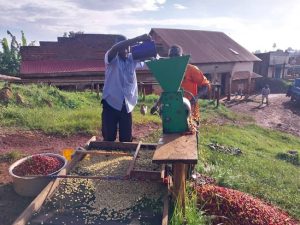
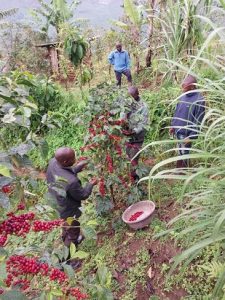
“Producing quality coffee is about passion and following the right procedures. When you process coffee, it tells you whether you followed the steps correctly. Picking unripe or overripe cherries compromises quality. You should float the coffee to separate good beans from defective ones, because insect-damaged beans make coffee sour. This applies to both Arabica and Robusta. Overripe coffee tastes sour. Many overlook such details. We only pick red cherries, and we sort carefully to remove any green cherries picked by mistake,” Nangoli explains.
He adds that he does not mix coffee from different altitudes.
“The reason I keep winning is that I only produce and process coffee from Kikobero parish. Through experience, I’ve also learned that mixing coffee from different villages within Kikobero is wrong due to altitude variations. When I present coffee, it’s from a specific area or village. That gives us uniformity,” he says. “For every coffee I submit for cupping, I score 10/10 on uniformity, sweetness, balance, and clean cup. Our coffee consistently scores between 87 and 89 internationally. This year, I’m preparing to present the best coffees. I want to have the highest award for all the three processes at the 12th International Contest of Coffees Roasted at Origin.”
He notes that while the Ministry of Agriculture has profiled coffee from different regions—a good start toward improving Ugandan coffee quality—it should be recognized that altitudes vary not just by region, but from district to district and village to village.
Agronomic Practices
“The secret to producing the best coffee is that we began with traditional coffee farmers. I told them, let’s return to the basics our grandfathers taught us about coffee production. That’s why we produce high quality coffee. We have traditional knowledge you can’t beat,” Nangoli says.
He explains that farmers primarily use traditional methods: applying manure and traditional pest control.
“We are developing a formula for organic pesticides using locally available materials. My coffee has never been found to contain foreign matter,” he says. “God gave Uganda wealth through coffee. Coffee can transform this country if we do the right things, because the market for quality coffee is huge. I don’t look for the market—it looks for me.”
Coffee has financially transformed his community, he adds.
“My sub-county was a dark place. Children didn’t go to school; we lived like animals. Today, every farmer in my village strives to send their children to the best schools. They have the money. Kikobero is the leading coffee producer in Bugisu, and perhaps in the whole country. This is because I taught people how to do it,” he says.
He continues: “When we started, you struggled to get one kilogram of cherries from a tree. We taught people Good Agronomic Practices. Now they can get 20 kilograms of red cherries from a single tree per season. You only need trees you can maintain properly. An acre of Arabica holds about 500 trees. People are earning much more now than before.”
He advises Robusta farmers to first profile their coffee if they want to produce fine coffees.
“When I say our coffee is grown on volcanic soil, I’m not just making a statement—the consumer understands what that means,” he says, stressing the importance of profiling, which includes analyzing the soil and other growing conditions.
Top Global Buyers Line Up for Kikobero Coffee
After the recent win, Nangoli says he has been contacted by many global buyers eager to pay a premium for Kikobero coffee.
“A company from the United Arab Emirates contacted me wanting 10 containers of specialty coffee. That’s a big deal. I told them I don’t have the capacity for 10, but I can supply three, which I’m working on. When I quoted my price of USD 12.20 per kilogram of green beans, they agreed. I read an article saying our coffee sells for about USD 6.60 per kilogram—that’s way too low. We must continue sensitizing farmers, because my approach is bottom-up, not the other way around.”
He also supplies 2,500 kilograms of roasted beans to Schengen countries every month.
Asked where his brand can be found locally, Nangoli said he mainly produces ground coffee for the Ugandan market—for individuals and companies—on order.
“We are working to establish dedicated Kikobero selling points across the country,” he says.
Winning on a global stage, he notes, makes Ugandan coffee more visible.
“These wins market Ugandan coffee. We are exposing it to coffee lovers worldwide. I’ve had buyers from China and Turkey express interest in Ugandan coffee.”
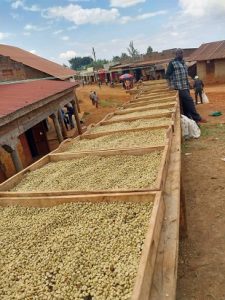
He adds that Kikobero is EUDR compliant, having been certified in October 2024 by Algrano, a top Swiss coffee sourcing company.
“This same company took Kikobero samples in 2022 to experts from six European countries, who all agreed our coffee isn’t ordinary—it’s specialty. That’s fundamental for us. They also asked us to submit data for EUDR compliance, and it was approved straight away.”
Challenges
“Our current challenge is having more buyers than we can supply. We have the coffee, but not the facilities or capital to process it all. We are seeking investors for a project to process the coffee our buyers want,” Nangoli says. “The coffee and the market exist, but I lack the infrastructure to process everything my farmers produce. I am trying to establish the best—not necessarily the biggest—coffee processing plant in the country. I only need to process at least 5% of their coffee. Setting this up requires USD 1.73 million,” he adds.
He currently operates a mini-processing plant that produces the high-quality coffee he sells and with which he wins awards.
“This facility can handle up to 100 tonnes, but I have a client who wants 10 containers, which I can’t manage now due to limited capacity. I can only supply three containers, equivalent to 56 tonnes.”
Data Protection
On the challenge of data protection as the government registers farmers for EUDR compliance, Nangoli acknowledges it remains an issue, but says registration is essential for continued access to European markets. He urges the government to use local individuals who know the farmers well to conduct registrations.
“Data can be misused, but relevant laws should help. People from the United Kingdom took my data and presented it as their own. We are now in court over this. They claimed they train my farmers after manipulating my staff to get the data. Unfortunately for them, they don’t know the original story. They have frustrated me, but I am hopeful I will emerge victorious,” he says.




It’s indeed a good and promising story
Great progress