

Cages in the Lake
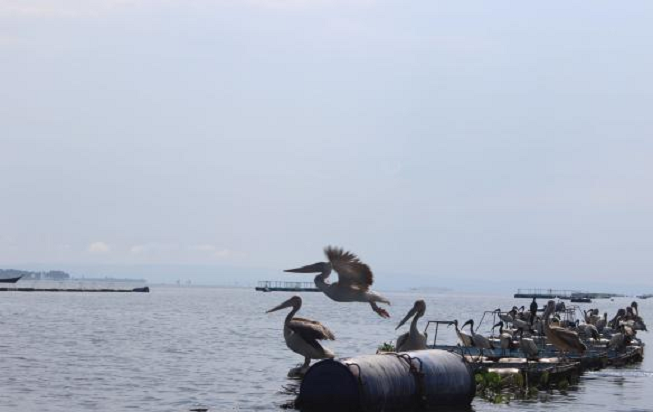
Scavenger birds fly from cages on Lake Victoria. Photo by Wambi Michael
At Masese landing site, on the Jinja side of Lake Victoria, the lake tells a different story from a decade ago. Where open waters once stretched uninterrupted, hundreds of floating cages now dot the surface as far as the eye can see.
Identified by green nets meant to keep scavenger birds away, the cages hold tens of thousands of fish beneath the water.
On the shoreline, blue plastic containers fitted with long metal frames are being assembled into new cages, ready to join the growing grid on the lake. Nearby lies an old wooden fishing boat, its faded paint suggesting abandonment.
A few metres away, men shovel sand from a large wooden vessel into waiting trucks, while others sit on the ground repairing torn fishing nets to prevent fish from escaping into the open lake.
This is the base of the Masese Cage Fish Farmers Cooperative, one of the fastest-growing cage aquaculture hubs on Lake Victoria.
From nets to cages
Magumba Majidu, the chairman of the Masese Cage Fish Farmers Cooperative, has worked on this lake for most of his life. He began as a fisherman in 1978 before transitioning to cage fish farming in 2008.
He says the idea was inspired by a Zimbabwean investor who established Sun Fish Farm in Buikwe district. “The government gave us two cages and fingerlings. From then on, we have been enjoying the fruits. About two hundred youths are employed here,” Magumba says.
For many at Masese, cage farming represents stability in a sector battered by declining wild fish stocks, strict fishing regulations, and dwindling catches. The cages, stocked mainly with Nile tilapia, promise predictable harvests and quicker returns. Yet beneath this promise, concerns are mounting.
The cost of feeding fish
On one side of the landing site sits a diesel-powered mill grinding locally made fish feed. Magumba keeps a close watch, chasing away free-range chickens and goats that might consume the feed. Feed, he explains, is the single biggest cost in cage fish farming. “Feed constitutes over 70 percent of cage fish farming operational costs. Some good-quality feeds are imported, but they are very expensive. We appeal to the government to come to our rescue,” he says.
While locally produced feed is cheaper, Magumba admits it has serious limitations. “That feed sinks very fast before the fish eat it. When you are many, it means it will affect the water down there,” he explains. Because of these concerns, the government has directed that cage farmers should shift to floating feed starting next year.
Floating feed allows farmers to monitor consumption and reduces waste sinking to the lakebed, but it is remarkably costly. “We shall be affected because we will spend more on feed,” Magumba says. “But floating feed is good. Each fish in the cage will be fed and will reach maturity faster.”
Fishers pushed aside
Out on the water, wild fishers are barred from casting their nets near the cages. Small boats, each carrying two people, are forced to operate farther offshore. Charles Kiku, a fisherman who has worked these waters for years, says native fish tend to congregate beneath the cages.
“There are many fish hiding under the cages because food escapes from there,” he says. Magumba partially agrees, describing the cages as a kind of informal hatchery. “Yes, there is a lot of native fish where cages are. The place is quiet, and the food can escape. But they don’t stay there forever. They move on,” he says.
The exclusion zones around cages, however, have effectively reduced fishing grounds for traditional fishers, raising questions about equity and access to the lake.
When farmed fish escape
Cage farming is an open system. Nets tear, storms strike, and fish escape. “Yes, fish can escape if the net develops holes. That is why you must make sure your net has no holes,” Magumba admits.
He also confirms that farmed fish have mixed with indigenous stocks over time. “There is no problem because the mother breed comes from this lake—either Lake Victoria or Lake Kyoga—and is taken to hatcheries,” he says.
Scientists, however, are not as relaxed
A growing body of scientific evidence suggests that cage fish farming may be degrading Lake Victoria’s fragile ecosystem. Earlier this month, the Executive Director of the National Environment Management Authority (NEMA), Dr Barirega Akankwasah, and six other experts published a review in the International Journal of Fisheries and Aquatic Studies titled “Environmental impacts of cage fish farming: A review.” The review warns that cage aquaculture presents serious environmental challenges, including eutrophication, disease transmission, altered aquatic biodiversity and degraded water quality.
“These issues threaten the ecological balance of aquatic ecosystems, which is important for the communities that depend on it,” the authors note. They argue that without advanced waste management and continuous environmental monitoring, the rapid expansion of cage farming could undermine both conservation and livelihoods.
Waste in the water
Fish farming, like other forms of animal production, generates waste. Uneaten feed and fish faecal matter break down in the water, releasing nitrogen and phosphorus. High nutrient loading can lead to eutrophication—characterised by algal blooms, oxygen depletion and the buildup of toxic ammonia.
In January 2021, residents around Bugonga, Kigungu, Wagagi Flower Farm and Lido Beach in Wakiso district woke up to hundreds of dead fish washed ashore.
While poisoning was initially suspected, scientists note that ammonia buildup and low oxygen levels are consistent with such mass fish deaths. Studies show that ammonia is toxic to fish even at low concentrations, damaging gills and internal organs and making fish more vulnerable to disease.
Evidence from Lake Victoria
A study by the Kenya Marine and Fisheries Research Institute titled “Cage fish culture in Lake Victoria: A boon or a disaster in waiting?” recorded ammonia levels of between 0.14 and 0.2 mg/L around cages. The researchers noted that unionised ammonia can depress appetite in tilapia at concentrations as low as 0.08 mg/L and becomes acutely toxic at higher levels. They documented fish kills worth about US$4,300 in 2016, attributed mainly to low dissolved oxygen, with ammonia likely playing a contributing role.
A genetic threat
Another major concern is genetic dilution. A separate review, “Nile Tilapia (Oreochromis niloticus L.) Cage Aquaculture in Africa: Potential Threats to Congeneric Fish Species and Advances to Detect Escapes,” published by researchers from institutions including Makerere University, NARO, NaFIRRI and BOKU University in Austria, highlights risks of simhybridisation between farmed and wild fish. The researchers warn that escaped farmed tilapia can interbreed with native species, leading to loss of local adaptations and long-term biodiversity decline.
They note that Uganda’s selective breeding programmes are largely uncoordinated, with hatcheries often relying on broodstock drawn directly from natural lakes. “It is evident that some wild O. niloticus stocks may have already been affected by escapees,” the authors conclude.
Industry defence: ‘We can coexist with the lake’
Robert Osinde, former managing director of SON Fish Farm—the pioneer of cage fish farming and breeding in Uganda—argues that the industry can coexist with the environment if properly managed. Newcomers often perform worse,” he explains. He insists that environmental monitoring is central to sustainable operations. “We do quarterly environmental monitoring. We look at what the quality of the water was before we started and what has changed—pH, dissolved oxygen and new organisms. We monitor dissolved oxygen and pH three times a day,” Osinde says. “If oxygen is depleted, other organisms cannot survive. That is how you know you are harming the lake.”
For Dr Eshete Dejan, IGAD’s Environment Programme Manager and Blue Economy Coordinator, cage farming’s appeal is clear. “You use natural water bodies and produce fish at lower cost,” he says, noting that land for ponds is scarce. But he cautions that poor practices could irreversibly damage the lake. “If we do cage fish farming badly, it can endanger our natural resources,” he warns, calling for strict environmental impact assessments before cages are installed. Robert Osinde, former managing director of SON Fish Farm and a pioneer of cage aquaculture in Uganda, agrees. “To be environmentally friendly, inputs must be well-regulated and floating,” he says. “You must plan, regulate, and monitor—so what you put in the lake does not destroy the ecosystem or water quality.”
Regulation lagging behind growth
Cage aquaculture was introduced to Lake Victoria around 2006–2010, amid public suspicion and rumours that the lake had been ‘sold off’. Today, the industry has expanded faster than regulation. While Uganda has fisheries and aquaculture regulations, enforcement remains weak. Zoning of the lake, waste monitoring and cumulative impact assessments are still limited. Scientists warn that without strong oversight, cage farming risks becoming “an environmental disaster in waiting.”
A lake at a crossroads
Back at Masese, the cages continue to multiply. For farmers like Magumba, they represent jobs, income, and hope. Scientists and traditional fishers raise red flags about pollution, exclusion, and irreversible ecological damage.
The question facing Uganda is no longer whether cage fish farming should continue—but whether it can be managed before Lake Victoria pays the price.
-URN
About the Author