
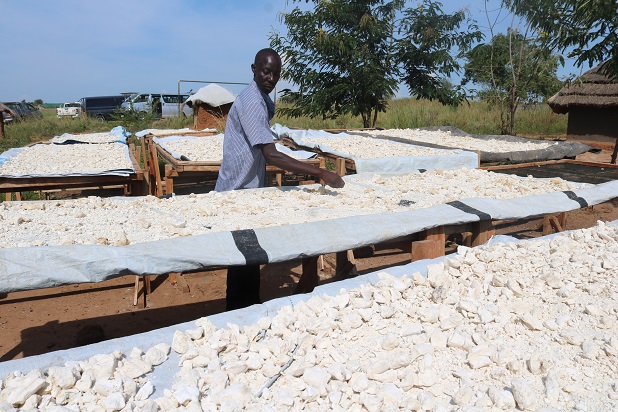
Onenchan sun-drying his cassava. Farmers in Buliisa are now adding value to their cassava
Onenchan sun-drying his cassava. Farmers in Buliisa are now adding value to their cassava
By Nelson Walozi
On the shores of Lake Albert, the sun does not just shine. It bakes. For the people of Buliisa, that heat used to mean dry soil and empty plates; today, if you walk past the home of Onesmus Onenchan in Kasenyi Village, Ngwedo Subcounty, you will see something different. Rows of wooden racks covered in bright white pieces of cassava, drying safely in the breeze.
For Onenchan and his neighbors, this is not just food. It is a sign that they are finally winning the fight against poverty.
“I used to plant and just hope for the best, but now I plant with a business mindset,” says Onenchan, as he spreads his harvest across the drying racks.
He credits his recent streak of bumper harvests to the training and tech package provided by Living Earth Uganda. The non-governmental organisation that has been funded by oil companies in the Albertine such as TotalEnergies EP Uganda worked with farmers including Onenchan to acquire new knowledge and improve productivity.
When a motivated farmer gets access to the right expertise, they will do farming perfectly. Onenchan can proudly show off his 10-acre expanse of the disease resistant and high yielding NAROCASS 1. It takes between 8-12 months for this crop to reach its peak.
According to Onenchan, it took some learning to reach where he is today. While Ugandans have practiced horizontal cassava planting for decades, in Buliisa, farmers followed an old habit. They would take a cassava stem and stick it straight up into the ground, like a pole. It seemed right, but it was actually a disaster.
Those vertical stems struggled to find water. The roots were weak, and the harvests were even weaker. Families were hungry. Even when some received money from oil projects to move their homes, the cash did not last long because they didn’t have a reliable way to grow food.
A flip of the stem
It started with a simple shift in technique, but the full story of Buliisa’s cassava revolution is a balancing act between low-cost wisdom and high-stakes machinery.
Through training from Living Earth Uganda, Onenchan learned a clever, no-cost trick of planting cassava stems horizontally instead of vertically. This small change in the field dramatically improved root distribution, resulting in better yields and providing the raw material needed by a real businessperson.
The value chain factor
Post-harvest losses presented a significant hurdle for the region. Many families lacked the technical expertise required for efficient cassava processing, often resorting to drying their harvest on bare ground, risking exposure to soil contamination. Furthermore, unpredictable weather patterns, specifically frequent rainfall during the drying phase, often led to spoilage and rot. These factors combined to compromise the quality of produce from the area.
In a nutshell, cassava value addition in Buliisa was severely limited by a lack of better cassava breeds, infrastructure, and modern processing equipment.
According to Wyclife Atulinda, the current Buliisa district Production Officer they were supporting farmers as a district through the National Agricultural Advisory Services (NAADS). Additional support came from the National Agricultural Research Organisation (NARO) in Bulindi, Hoima district, but most households planted cassava for food security on small patches.
Doreen Bihemaiso the District Agricultural Officer notes that “District-wide production was estimated at roughly 15,000–20,000 tonnes annually, with high losses of up to 40 per cent due to pests and poor drying.”
Pre-2021, when Living Earth Uganda (LEU) and TotalEnergies EP Uganda and its Tilenga project interventions had not yet intervened, cassava was primarily a subsistence crop.
Farmers maintained gardens of indigenous varieties that are not high yielding; post-harvest handling was also poor, leading to heavy losses. A hectare of indigenous “local” stalks (low-growing) which was commonly planted by farmers at the time could yield between 10 and 12 tonnes or less per hectare. Comparatively, the NAROCASS 1 planted now by farmers such as Onenchan gives approximately 22.0 to 33.8 Metric Tonnes.
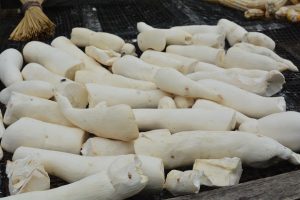
Living Earth Uganda and Total energies introduced the AgricSSP (Agricultural Support Services Project), targeting over 1,479 project-affected households (PAPs) and the 85 farmer groups. Each group of 30 members received a chipping machine and drying rack, to be managed by group leaders. Alongside the chipping machine and drying rack to improve post-harvest handling, Living Earth Uganda, also introduced the farmers to NAROCASS 1, to help spur productivity. With 60 per cent of the farming population adopting improved techniques and the distribution of high-quality cuttings over the past four years, Buliisa’s potential has surged.
The firsthand equipment
In addition to the NAROCASS 1 stems, silo, a chipping machine, and a drying rack, Living Earth Uganda also invested in a milling machine. This answered the post-harvest loss question.
“Once we harvest cassava here, we chip it, for easy drying on the racks. Some is stored in the silos and the surplus is taken to Ngwedo [the milling machine location]. No more wastage” says Onenchan’s wife.
The leap from farming to value addition required more than just manual skill. The introduction of a commercial milling machine at Ngwedo was the true engine of Onenchan’s success. Unlike the planting technique, this was a massive investment, both expensive to acquire and incredibly demanding to maintain, but it transformed the region’s output from raw tubers into a high-quality flour. “We make about UGX25000 a week; we currently have UGX 6Million in our savings group and our target is to acquire land for extension as a group,” says Ezekiel Ungyerwun the chairperson.
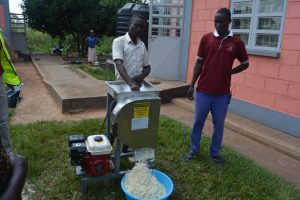
The cassava flour from the milling machine is packaged in well-branded bags with Ngwedo Millers Association labels, stored, and sold in bulk at a better price.
“Our target as an association is to supply cassava flour to the whole of Buliisa, because it’s our staple food here” says Ungyerwun.
In Avongera village, Ngwedo sub county, Nyakato Everlyne, a female farmer and beneficiary says the milling machine has helped with both value addition and marketing of their harvest. “Before, we used to worry about whom to sell to but now, we just have to bring all the cassava here and wait for the cash,” says Nyakato.
Despite the excite from the farmers and their association, however, the milling machine isn’t working, at the moment. This high-end equipment has introduced a new kind of vulnerability.
At the time of writing this story, the milling machine at Ngwedo was down, bringing production to a standstill.
With the right engineers, located 296 kilometers away in Kampala, farmers have been reluctant to invest the necessary money to transport these highly skilled individuals that are necessary for maintenance and major repairs.
However, the good news is that, the plans for repair are underway. An agreement has already been reached for the farmers’ association savings, TotalEnergies, and the district headquarter to jointly fund these repairs.
This story was sponsored by Environmental Defenders.