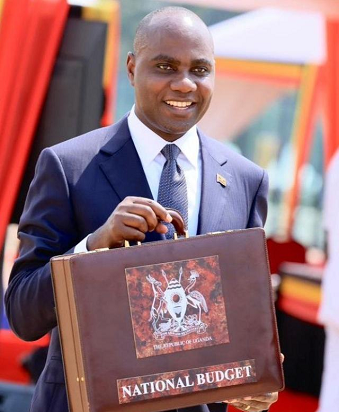

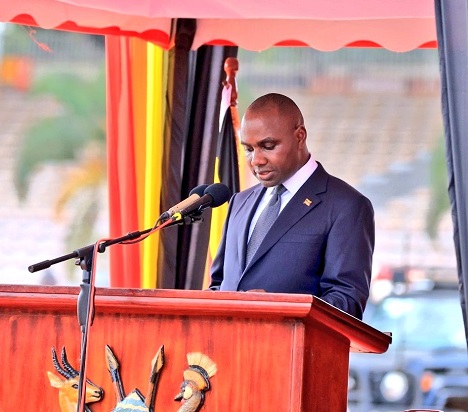
Finance Minister, Henry Musasizi read his first budget speech on the 12th Parliament on Thursday.
The government has increased the budget for education, skills development, and sports in the 2026/27 financial year, with a small upward adjustment from the previous allocation.
Currently, primary classroom teachers earn a minimum of 499,684 shillings per month regardless of their qualification, while secondary classroom teachers (arts) receive a minimum of 960,288 shillings for degree holders and 745,000 shillings for diploma holders. If the salaries are increased by 25 percent, the minimum monthly pay for primary classroom teachers would rise from 499,684 shillings to 624,605 shillings.
Secondary classroom teachers (arts) with a degree would see their salary increase from 960,288 shillings to 1,200,360 shillings, while those with a diploma would earn 931,250 shillings, up from 745,000 shillings.
According to figures in the budget speech, the sector will receive over 6.66 trillion shillings, up from 5.04 trillion shillings allocated in the previous year.
This represents 7.82 percent of the projected national budget of 84.4 trillion shillings, a modest rise from 6.97 percent of last year’s 72.376 trillion shillings envelope.
“Mr Speaker, next financial year, the Government has allocated Shs 6.66 trillion to further improve the education of Ugandans,” the speech reads in part.
Finance Minister Henry Musaasizi said the funds will target five priority areas. These include expanding access to quality Universal Primary Education and Universal Secondary Education.
Another focus is strengthening Science, Technology, Engineering, and Mathematics alongside vocational training.
The government also plans to improve teacher welfare and training, with special attention to pre-primary educators.
Other areas cover curriculum reform and support for public universities and research. A portion of the funding will go toward completing key sports infrastructure ahead of the Africa Cup of Nations (AFCON) 2027.
The major highlight, however, is the long-awaited salary enhancement for arts and primary school teachers, offering some reprieve to arts teachers who have agitated for years over pay disparities with their science counterparts.
“Beginning FY 2026/27, an additional 568.65 billion Shillings has been allocated to enhance salaries for primary school teachers and arts teachers in secondary schools and BTVET institutions,” Minister Musaasizi noted.
The adjustment covers more than 155,000 teachers, according to ministry records.
It forms the first phase of a broader plan worth about 2.5 trillion shillings, aimed at reducing the pay gap that emerged after science teachers received major salary increases in 2022/23.
The reforms also align with the National Teacher Policy (2019) and human capital targets under the Fourth National Development Plan (NDP IV).
Alongside the salary adjustment, the government plans include the recruitment of new teachers.
Michael Aliyo, Commissioner for Planning, told Parliament’s education committee in April that the ministry plans to recruit 3,000 teachers.
The intake includes 1,842 science teachers and 1,158 arts teachers, intended to ease staffing gaps, especially in newly established seed secondary schools.
Uganda National Teachers Union (UNATU) has welcomed the increment.
Zadock Tumuhimbise, National Chairperson of UNATU, said the government should honour its commitment and ensure a percentage is allocated each financial year as agreed.
Tumuhimbise also noted that the increment excludes non-teaching staff, who play a critical role, and should be considered in future salary adjustments.
Despite the increase, Uganda’s education budget remains below global and regional benchmarks.
The country allocates about 2.7 percent of GDP to education, compared to an East African average of 4.2 percent and UNESCO’s recommended range of 4 to 6 percent.
The 2019/20 Uganda National Household Survey shows that for every 1,000 shillings the government spends on primary education, households spend about 1,450 shillings.
The Uganda Human Capital Development and Growth Review Report 2025 presents a strained system.
It highlights overcrowded classrooms, low teacher pay, heavy workloads, weak learning outcomes, and widening inequality, despite gains since the introduction of universal primary education in 1997.
The report, jointly produced by the Government of Uganda and the World Bank, warns that scaling education to meet demand by 2040 will require major expansion. It projects a 440 percent increase in education spending, 360,000 additional teachers, more than double the current classroom stock, and nearly four times more textbooks.
-URN