
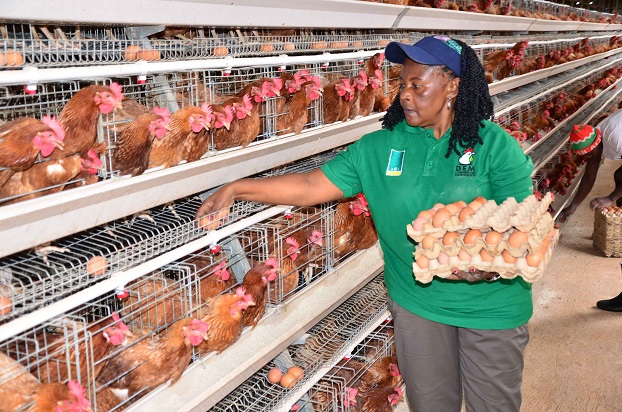
Natukunda picking eggs from the chicken house. Picture by Herbert Musoke
Grace Natukunda, a co-founder of Dem Poultry Farm, picking eggs from the chicken house.
Uganda’s agriculture sector is not short on activity, what it has historically lacked is structure, consistent financing, and the technical support needed to turn farming into a reliable business at scale, that gap, more than production itself, has been the constraint.
dfcu Bank has positioned itself directly at that pressure point, building an agribusiness model that focuses on making farming bankable, scalable, and commercially viable.
Through its agribusiness offering, the Bank provides financing across the value chain, input suppliers, farmers, processors, and exporters, ensuring that production is supported by market access and distribution capacity. Its credit solutions are structured around agricultural realities, seasonal working capital aligned to production cycles, repayment terms matched to cash flow, and financing that does not rely solely on traditional collateral.
Beyond working capital, dfcu supports investment in productive assets, enabling agribusinesses to acquire equipment, expand infrastructure, and strengthen logistics. The bank also finances value addition, supporting businesses to move into processing, packaging, and regional trade, where margins are higher and growth is more sustainable.
This financing is complemented by business advisory, financial literacy, and market linkage support, equipping farmers with the skills and networks required to operate more efficiently and compete at scale.
Dem Poultry Farm shows what becomes possible when this kind of support is applied consistently.
Founded in 2019 by Grace Natukunda and her brother Edwin Muhereza, the enterprise has grown from a small, family-led venture into a diversified agribusiness spanning poultry, crop production, and forestry.
That growth has been underpinned by access to financing. Through its relationship with dfcu, the farm has been able to secure credit to expand production, invest in infrastructure, and strengthen operations without disrupting cash flow.
The business is built around efficiency and value retention, poultry waste is processed into branded organic fertiliser, creating an additional revenue stream, while timber production, supported by a privately owned forest and in-house machinery, provides both construction input and commercial output.
This level of integration allows the farm to manage costs, diversify income, and retain more value within the business.
Today, the farm operates at scale, with over 10,000 birds in the brooding stage and a structured management system that separates key functions across production units. Brooding, layer production, and logistics are managed independently, supported by strict biosecurity protocols that protect flock health and consistency.
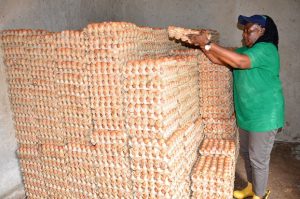
Picture by Herbert Musoke
The business has expanded beyond local markets and now supplies South Sudan and the Democratic Republic of Congo, with plans underway to invest in a large-scale hatchery, a move that will require further capital investment and continued financial partnership.
Recognition through the 2025 Best Farmers Awards has strengthened the farm’s visibility and credibility, reinforcing its position as a growing agribusiness enterprise.
The Best Farmers Awards, organised by Vision Group in partnership with dfcu Bank, the Embassy of the Kingdom of the Netherlands, KLM Royal Dutch Airlines, and Koudijs Animal Nutrition, have over the past decade recognised more than 130 farmers for excellence in productivity, sustainability, record-keeping, and agribusiness management. Beyond recognition, the initiative exposes winners to global best practices through study visits to the Netherlands, while promoting agriculture as a structured and commercially viable enterprise.
“This recognition is a boost for our future endeavours. It allows us to expand further and inspire more young people to see farming as a viable career,” says Grace Natukunda.
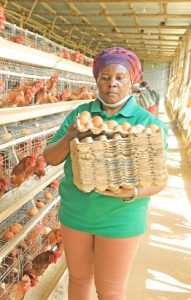
Beyond production, the farm plays an active role in its community, creating employment, training farmers, and sharing practical knowledge with schools and local groups.
Grace is preparing for an international study trip to the Netherlands, where she will engage with advanced farming systems and apply those insights to further scale the business.
For dfcu Bank, enterprises like Dem Poultry Farm reflect what becomes possible when financing is aligned with how agriculture operates, linking capital, knowledge, and markets to build businesses that are structured, competitive, and positioned for long term growth.