

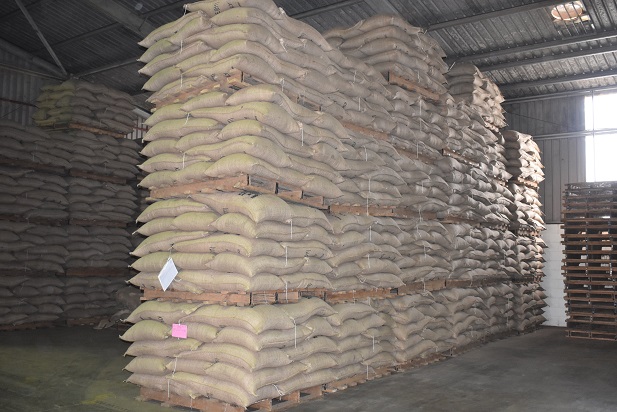
Coffee ready for export
Uganda continues to rely on coffee and gold as top foreign exchange earners
The Ministry of Finance has revealed that Uganda’s export earnings rose by 55.9% to US$1,496.45 million (UGX5.403Trn) in October 2025 from US$959.89 million (UGX3.467Trn) in September 2025.
The details are contained in the Performance of the Economy Monthly Report for November 2025 that was released last week by the Ministry of Finance.
However, the Ministry expressed concerns over Uganda’s reliance on gold and coffee as its main export commodities and called for diversification of Uganda’s exports.
The growth in exports was mainly driven by higher earnings from gold, cocoa beans, crude oil (from simsim, palm oil and sunflower), tobacco, among others. Gold and coffee constitute 76.8% of Uganda’s exports, under scoring the need for diversification of the export basket,” as noted in the report.
The Ministry also indicated that in October 2025, the Middle East remained Uganda’s leading export destination, accounting for 49.1 percent of Uganda’s exports and at a country specific level, the United Arab Emirates dominated, receiving 98.8 percent of our exports to the region, while other key export destinations included Asia (19.8 percent), the East African Community (17.5 percent) and the European Union (8.8 percent).
The analysis from the Ministry of Finance also revealed that in the same period, Uganda’s merchandise imports rose by 7.6 percent having risen from US$1,460.19 million (UGX5.274Trn) in September 2025 to US$1,570.91 million (UGX5.673Trn) in October 2025, due to higher non-oil, formal private sector imports and the most imported items excluding petroleum includes vegetable and animal products, beverages, fats & oils and miscellaneous manufactured articles among others.
According to the Ministry of Finance, in October 2025, Asia remained Uganda’s major source of imports, accounting for 30% of the total import bill. Within Asia, China, India and Japan were the dominant sources of our imports, accounting for 50.6 percent, 22.3 percent and 8.1 percent of our imports, respectively. Other notable sources of our imports were the East African Community, Rest of Africa and the Middle East, accounting for 29.2 percent, 23.8 percent and 9.7 percent respectively.