
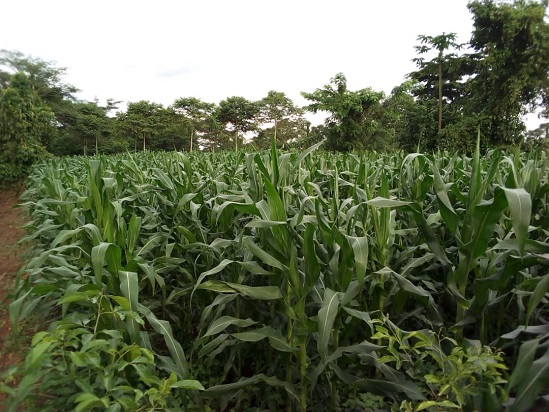
Kuta harvested 2,700 kilograms of maize grain from three quarters of an acre last season
Agriculture is one of the sectors attracting high interest rates
The weighted average shilling lending rate rose to 18.2 percent in the FY 2024/2025 from 17.9 percent in the previous financial year. This is in line with the relatively tight financial conditions and rise in risk-free rates.
This revelation is contained in the recently released Bank of Uganda Integrated Annual Report 30 June 2025.
Similarly, the report says, the average time deposit rate on shilling deposits increased to 11.5 percent from 10.8 percent, indicating a moderate rise in the cost of funds for banks.
“Consequently, the spread between shilling lending and time deposit rates narrowed to 6.6 percent from 7.1 percent. However, the weighted average foreign-currency lending rate fell to 8.6 percent from 8.9 percent in the previous financial year, supported by exchange rate appreciation,” the report says.
Lending by sector
According to the report, the shilling lending rate edged up across major economic sectors in FY 2024/2025.
While the average lending rate was recorded at 18.2 percent , BoU says the highest rates were charged on loans to the Mining sector (21.7 percent), Agriculture (21.2 percent), Electricity and water (20.5 percent) and Personal and Household Loans (18.7).
In contrast, BoU says, the lowest interest rates were observed in Transport and Communication (15.0 percent), Manufacturing (16.8 percent), and Trade sector (17.9 percent).
“These relatively lower average lending rates in these sectors reflect the dominance of prime borrowers, particularly in the telecommunication industry,” BoU says in its report.
Private sector credit continues to recover
BoU says Private Sector Credit (PSC) extended by commercial banks, credit institutions, and microfinance deposit-taking institutions continued to recover, with the average stock growing by 8.8 percent in FY 2024/25 compared to 8.4 percent in FY 2023/24.
“This improvement reflects stronger economic activity, a stable exchange rate, and low inflation. The average growth rate of shilling-denominated loans edged up slightly to 10.6 percent from 10.5 percent, while foreign-denominated loans grew by 3.7 percent relative to 3.1 percent over the same period,” the report reads.
During the period under review, the report says, lending conditions eased as default rates declined, reflected in lower non-performing loans.
“These favourable conditions boosted borrowing appetite, resulting in increased lending. Furthermore, PSC growth has been supported by various structured/community-based government credit schemes such as Emiyooga and the Parish Development Model (PDM). The schemes have helped develop creditworthy enterprises and promoted financial literacy, aiding the transition of previously unbanked individuals into the formal banking sector,” BoU says, adding: “Notably, PSC growth was uneven across major economic sectors. Credit growth slowed in manufacturing, trade, transport & communication, electricity & water, and personal loans, declining to 4.6 percent, 2.3 percent, 0.1 percent, -32.4 percent and 15.1 percent, respectively, in FY 2024/25, compared to 5.3 percent, 4.3 percent, 3.2 percent, -21.0 percent and 17.1 percent in FY 2023/24. In contrast, credit growth strengthened in agriculture, building, mortgage, construction and real estate, business services and mining and quarrying, expanding to 13.1 percent, 8.7 percent, 30.1 percent, and 52.9 percent, respectively, in FY 2024/25, up from 10.4 percent, 6.8 percent, 3.3 percent and 32.1 percent in FY 2023/24.”