
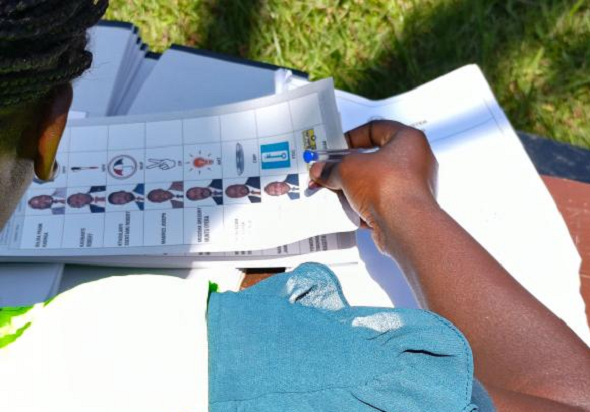
The ballot paper for the 2026 presidential candidates/ Photo by Judith Kukunda
Uganda has registered its lowest voter turnout in the Presidential and Parliamentary elections on record, according to results declared by the Electoral Commission on Saturday evening.
This unprecedented civic withdrawal highlights a growing crisis of public confidence in presidential elections.
Official figures indicate that just over eleven million voters participated in the election out of slightly more than twenty-one million registered voters, translating into a turnout of just above fifty percent.
This means that more than ten million eligible voters did not cast a presidential ballot on polling day, a striking indicator of civic withdrawal.
The Uganda Human Rights Commission (UHRC) has expressed concern over the trend. Pauline Nansamba, the Director for Complaints, Investigations, and Legal Services, described the low turnout as troubling, noting that voting is a fundamental civic right that many Ugandans appear to be abandoning.
“As the Commission, we are going to analyse the data and investigate what made citizens shun their civic duty to vote. We shall later brief the media on our observations,” she said.
Political analyst and human rights defender Dr Livingstone Ssewanyana attributed the poor turnout partly to systemic failures on polling day, particularly the malfunctioning of biometric voter verification kits (BVVKs). He argued that the delays discouraged many voters from participating.
“We need explanations from the Electoral Commission on why the verification machines failed. This wasted valuable time, and many voters became frustrated and went back home, while others did not turn up at all after learning that polling had been delayed,” Ssewanyana said.
Across much of the country, voting did not commence until late morning after the Electoral Commission suspended the use of BVVKs.
Although polling hours were later extended by one hour, voters effectively had about six hours to vote instead of the planned ten, significantly constraining participation.
Beyond logistical failures, intimidation and violence were also cited by observers, political leaders, and the Human Rights Commission as key deterrents.
In Kampala, turnout was particularly low, with fewer than one in three registered voters casting ballots. By the time results were being declared, tallies had been completed for the majority, though not all, polling stations in the city.
The wider Buganda region also recorded weak participation, with less than half of registered voters turning up. Similar patterns were observed in Acholi and Busoga, where turnout hovered around the mid-forties. In contrast, regions such as Teso and Tooro recorded participation levels of around two-thirds, while Sebei, Kigezi, and Karamoja posted relatively stronger turnout figures.
Ankole registered the highest turnout nationally, with nearly three-quarters of registered voters casting presidential ballots, followed closely by Karamoja, where participation was about seven in ten voters.
Commenting on the turnout, National Unity Platform (NUP) member Benjamin Katana accused the incumbent president, Yoweri Museveni, of using state machinery to intimidate voters in areas perceived as opposition strongholds, thereby suppressing participation.
Historical data show a steady decline in voter engagement over the past three decades. In the mid-1990s, turnout stood at over seventy percent, gradually dropping in subsequent elections.
While participation briefly recovered in the mid-2010s, the current figures represent the lowest level of voter turnout in Uganda’s presidential election history.
The data signal more than administrative failures on election day; they reveal a growing crisis of public confidence in the electoral process, as millions of Ugandans turn away from participation.
-URN