
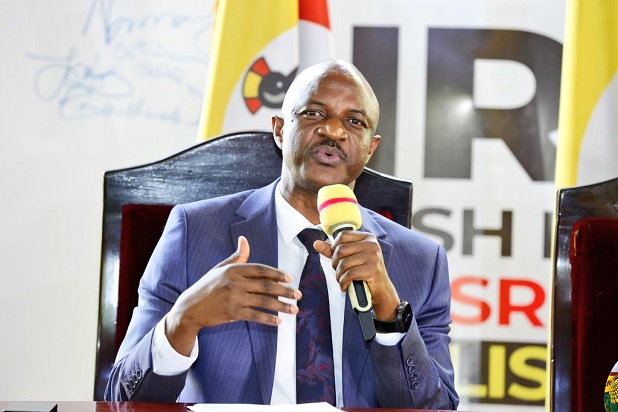
Dr. Ramathan Ggoobi, Uganda’s Permanent Secretary/Secretary to the Treasury
Ramathan Ggoobi, Secretary to Treasury
The Ministry of Finance has revealed the need for Uganda to moblise resources to a tune of UGX46.737Trn for climate adaption and resilience investments in order to spur Uganda’s agriculture sector and improve its credit worthiness.
The details are contained in the Interim report: Building adaptation & resilience into Uganda’s sovereign debt and credit profile published by the Ministry of Finance on 12th June 2026, with the report noting that Climate-related risks are impossible to ignore within Uganda’s communities given the fact that; Droughts, floods and land degradation are eroding growth potential, increasing fiscal stress, and threatening macroeconomic instability.
“Yet mobilising finance at the scale needed remains difficult, both externally and domestically. Uganda’s updated Nationally Determined Contribution (NDC) estimates USD 17.7 billion (UGX65.654Trn) is needed for adaptation from 2022 to 2030, of which 86% is tagged for external finance. Based on what has been mobilised to date, this means Uganda must mobilise USD 12.6billion from FY2025/26 – 2029/30 (UGX46.737Trn) from external sources – USD 2.5 billion each year,” the report reads in part.
The Ministry of Finance admitted that the moblisation of the desired funds appears challenging given the fact that only US$1.7 billion was mobilised in external climate finance between FY2021/22 to 2024/25.
Ramathan Ggoobi, Secretary to Treasury in his foreword of the report, argued that the challenge of climate change goes to the heart of Uganda’s development model, especially the Fourth National Development Plan makes the first step toward achieving ten-fold growth over the next 15 years.
He wrote, “Agriculture and agro-industrialisation are central to this ambition, yet the sector remains highly exposed to climate change and nature degradation, posing a significant risk to sustained growth. In 2017, a severe drought cut our economic growth by 1.5 percentage points from the initial projection and affected 1.3 million Ugandans. It triggered unplanned disaster response spending, a sharp decline in agricultural output, and consequent shortfalls in domestic revenue and service delivery.”
Ggoobi defended the need for Uganda to invest in climate adaptation & resilience, saying such a move is intended to safeguard its development and preserve its creditworthiness.
“These investments are essential for building long-term resilience against escalating climate, nature and terms-of-trade shocks. However, the international financial system does not yet adequately recognise adaptation & resilience investments as macro-critical. Sovereign risk assessments, which influence investment decisions, access to finance and the cost of capital, often capture only the upfront fiscal costs of these investments, without fully reflecting their long-term benefits,” wrote Ggoobi.
The Secretary to Treasury however noted that the focus on climate resilience and adaption investment is likely to result into borrowing costs rising and shrinking of fiscal space when countries are making investments that reduce future risks.
“This makes it harder for countries like Uganda to finance resilience on affordable terms. This work is about changing that paradigm. It sets out a practical approach to make the returns on resilience
visible in sovereign debt dynamics and credit profiles. When such gains are understood, they can unlock the capital flows that countries like Uganda urgently need. Our hope is that other countries will build on this work and join us in making the case for resilience investment. Together, we can help ensure the relevant institutions recognise investment in resilience as not just a fiscal cost, but an investment in sustainable growth, stability and development,” stated Ggoobi.
The report highlighted the systemic constraints that might affect investment in climate change resilience and adaption including the tight external financing conditions that limit Uganda’s access to affordable finance, because many development partners are facing rising fiscal pressures.
“The US continues to cut development budgets, while in Europe, priorities are shifting toward defence spending. As a result, concessional finance envelopes have shrunk, official development assistance has plateaued, and climate and adaptation funds remain modest relative to need. This creates a major challenge for Uganda. Concessional finance and grants remain an important part of Uganda’s financing mix, which together made up nearly one quarter of gross financing needs in FY2024/25,” read part the report.
Even when Uganda shifts sight from external financing to borrow internally, the report pointed out that borrowing on commercial terms remains expensive for Uganda, reflecting high global interest rates and heightened risk sensitivity toward EMDEs.
“This is compounded by growing investor sensitivity to countries’ climate vulnerability. As a result, Uganda is increasingly turning to domestic borrowing at relatively high rates to finance budget deficits, increasing debt service costs and reducing fiscal space for new investments in A&R,” the report notes.