
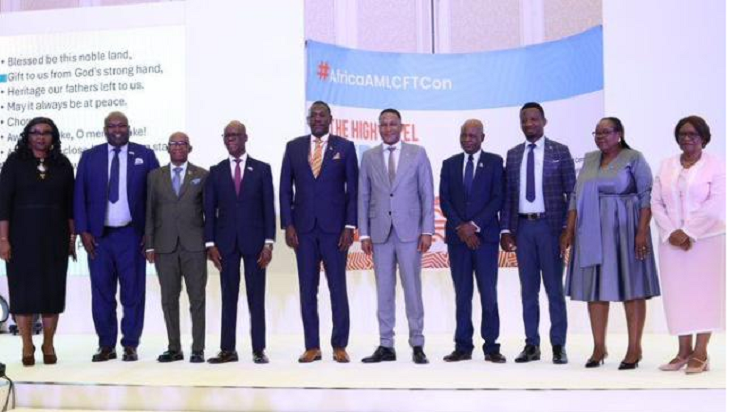
Wanjala and President Boko (centre) at the civil society conference in Gaborone, Botswana
Wanjala and President Boko (centre) at the civil society conference in Gaborone, Botswana
Financial experts and the civil society have cast a grey shadow on the national and global frameworks used by governments and the international agencies to fight money laundering and terrorism financing as suppressing civic space.
They were meeting in Botswana to chart ways of helping fight the crime, including keeping African countries off the grey and black lists of the Financial Action Task Force (FATF).
Uganda has just been removed from the Grey List, a categorization that is a step away from the country’s financial industry from being blacklisted and giving the rest of the countries the option of barring financial transactions with it.
The categorization arises from the monitoring by FATF, of the policies and their enforcements by countries, against money laundering and terrorism financing.
Those on the grey list exhibit strategic deficiencies in their anti-money laundering (AML) and counter-terrorist financing -CFT systems, and risk negative economic consequences due to increased scrutiny.
While on the grey list, FATF engages with the respective government to help raise their policy and policy enforcement levels and make their system safer.
While acknowledging the need to fight against money laundering and terrorism financing, the civil society says it is being used to suppress the civic space.
Yona Wanjala, Executive Director of Civic Advisory Hub, says that the vice robs Africa of USD 88.6 billion annually, affecting the already little resources available for development purposes.
However, he says, the Anti-Money Laundering and Counter Terrorism architecture has been “weaponized” to weaken the civil society, with some facing court cases, closures and freezing of their bank accounts.
He was speaking at the High-level Africa Civil Society conference 2025 in Gaborone Botswana, under the theme, “Placing Civic Space at the Heart of Combating Money Laundering, Countering Terrorism, and its Financing in Africa”.
Wanjala urged the President of Botswana to be the African civil society’s Civic Space Ambassador, with a hope that he can have an influence on other leaders of countries that are considered not at democratic and Botswana, a country that ranks high is democracy and human rights on the continent.
Uganda was on FATF’s grey list until February 2024 when the organisation upgraded her rating, but the European Union did not lift its sanctions until a June 2025 update.
This left Algeria, Angola, Bolivia, Bulgaria, Burkina Faso, Cameroon, Côte d’Ivoire and the Democratic Republic of Congo on the grey list.
The black list remains with Democratic People’s Republic of Korea, Iran, and Myanmar.
The blacklisted countries are identified due to “significant deficiencies in their anti-money laundering and counter-terrorist financing (AML/CTF)” regimes.
Victoria Ibezim-Ohaeri, the Executive Director, Spaces for Change, West Africa, appealed to the governments to recognise that the civil society and non-profit organisations as a whole, were allies of the government in fighting crime.
She voiced similar sentiments, and supported the idea that the civil societies were increasing getting suppressed, quoting from a report by the UN Rapporteur on human rights.
The President of Botswana, Duma Boko, hailed the civil society for the task of putting governments to account, but also noted the challenges they have especially in the fight against rich criminals.
He explained that the source of the vice and is all because of the existence in the systems, of people who want to get rich quickly with or without working for the wealth. In the end, the turn to the public resources, he said.
Unfortunately, he says, even those that are supposed to fight the crime can easily get compromised, including the civil society and government security agencies.
This, he says makes it hard to fight organised crime which is being perpetuated a rich middle class.
According to President Boko, organised crime is a growing reality in Africa, which both state and non-state actors, including non-profit organisations, must be willing to undergo painful yet necessary scrutiny to ensure they are not exploited as conduits for illicit activities.
-URN
About the Author