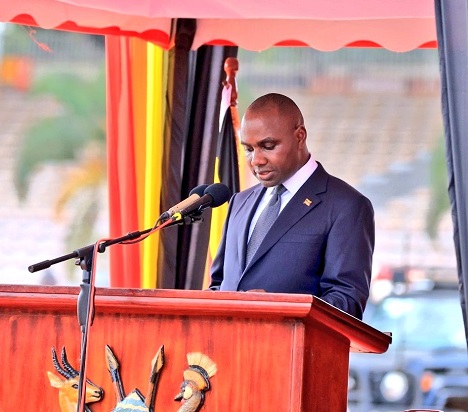

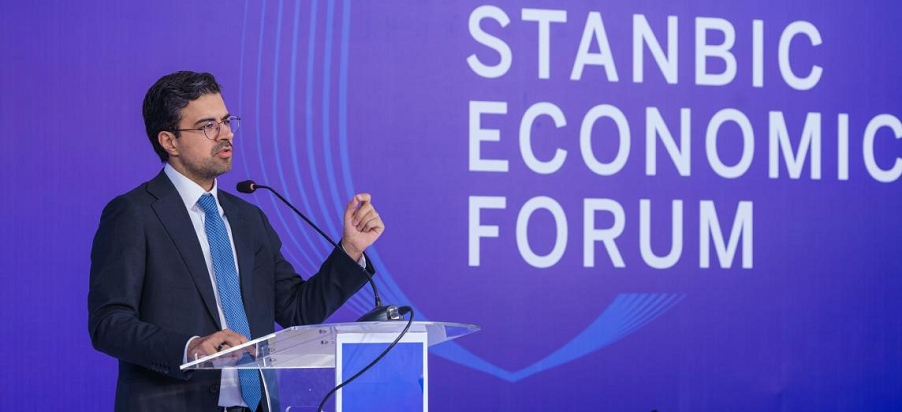
Jibran Fauz Qureish, the Head of Africa Economic Research for Standard Bank Group speaking at the 5th Economic Forum in Kampala. Courtesy Photo
Jibran Fauz Qureish, the Head of Africa Economic Research for Standard Bank Group speaking at the 5th Economic Forum in Kampala. Courtesy Photo
When Jibran Fauz Qureish, the Head of Africa Economic Research for Standard Bank Group, stepped up to the podium at the 5th Stanbic Economic Forum in Kampala, he did something unusual. Instead of opening with data tables or forecasts, he offered a question that cut straight to the heart of Uganda’s economic story.
“Why is the macro so good, yet the micro so bad?” he asked. It was a simple line, but it captured a paradox that many Ugandans have felt but few economists have articulated so plainly.
At the national level, growth is strong, and the economic fundamentals are improving. Yet in markets, towns, and homes across the country, the lived experience for ordinary people often feels disconnected from those headline numbers. For anyone unfamiliar with economic language, Qureish’s framing makes sense when you think about it this way.
Macro refers to the big picture: the overall size of the economy, national growth, foreign exchange reserves, and investment inflows. Micro refers to the day-to-day reality of households: jobs, incomes, savings, and price pressures.
What Qureish was pointing to — and what many Ugandans intuitively feel — is that high-level success has not yet translated into widespread improvements in living standards.
“Even though the GDP numbers look impressive, the dinner table story remains different,” Qureish said, and his voice echoed across the conference hall. In 2026, Uganda finds itself at a crossroads. On paper, the country’s economy is among the most resilient in Sub-Saharan Africa.
Behind the scenes, deep structural shifts are reshaping the way that prosperity flows, or doesn’t flow, to individuals and communities. Uganda’s economic performance in recent years has been undeniably strong.
According to Qureish, the country’s economy grew by around 6.3 percent in the 2024/25 fiscal year, and Standard Bank Research has projected growth of between 6.5 and 6.7 percent in 2025/26.
Even more striking, Qureish shared, is the expectation that, by the time the 2026/27 fiscal year is underway, Uganda’s annual growth rate could be approaching seven percent.
“We said five years ago that Uganda would join the seven percent growth club. That projection is manifesting,” he noted. What is driving this performance?
A complex mix of factors. Investment spending, particularly in the oil sector, has been a major stimulus. Public infrastructure projects, roads, a new stadium for the African Cup of Nations, and airport upgrades are creating demand in construction and industry.
Agriculture, long the backbone of Uganda’s economy, continues to contribute even as weather patterns shift.
“We’re seeing a pickup in output, electricity is up, and construction is buoyed by public investment,” Qureish explained.
But while that macro growth chart looks healthy, the story at ground level is less straightforward. A huge share of Uganda’s workforce, between eighty and ninety percent, is engaged in informal work, where job security, savings, and access to financial protections are limited.
Many households do not benefit directly from the projects and investments that show up in national statistics.
This is part of what Qureish was referring to when he talked about capital-intensive rather than labor-intensive growth.
“The issue of macro good, micro bad is not about rich versus poor, it’s about asset holders versus non-asset holders,” he said.
That distinction matters. In a world where infrastructure and extractive investments drive headline growth, it is often those who already hold assets, land, capital, and financial instruments who benefit most quickly.
Households that rely on daily wages or small-scale farming may see slower improvements. Uganda’s currency story is another piece of this puzzle.
Over the past year, the shilling has shown resilience, supported by a strengthening of foreign exchange reserves.
At the end of 2024, Uganda held about three billion dollars in reserves. By the end of 2025, that number had nearly doubled. Part of this improvement comes from foreign portfolio investors buying Ugandan government securities.
Two years ago, these offshore holdings were under a billion dollars. Today, they sit at roughly three billion.
“Even when foreign investors have taken profits, they’ve largely stayed in the swap markets, which means they haven’t exited Uganda physically,” Qureish said. “That signals confidence.”
That confidence has not come without moments of tension. In late 2025, the shilling weakened against the dollar.
Qureish explained that much of this pressure was generated not by Uganda’s economic fundamentals, but by investors hedging ahead of the election season.
“At the time, hedging was driven by concerns about regional political developments and the timing of elections rather than the fundamental Ugandan story,” he said.
Even as those pressures mounted, the Bank of Uganda chose a deliberate policy of limited intervention in the foreign exchange market. That restraint preserved reserves, but Qureish also noted that markets need occasional reassurance that the central bank is present and ready to act if volatility becomes disorderly. “The Bank of Uganda does not intervene when the currency is weakening, which is great because it does not drain your foreign exchange reserves,” he said.
“But to show the market you’re there is important.” That measured approach reflects a broader confidence in the institution. Qureish lauded the Bank of Uganda as one of the most proactive, investor-friendly central banks in the region.
“Across the markets I cover, nearly seventeen or eighteen, the most efficient, most preemptive central bank is the Bank of Uganda,” he said.
This credibility matters in markets where sentiment and expectations can drive capital flows. It also underpins the monetary stance that has kept inflation relatively benign.
In 2026, Standard Bank Research expects inflation to remain below five percent. That offers room for the Monetary Policy Committee to consider modest interest rate cuts later in the year, perhaps by at least twenty-five basis points, even as it navigates domestic and international risks.
At the same time, fiscal policy presents its own challenges. Qureish observed a pattern of frequent supplementary budgets that can undermine the credibility of initial fiscal plans, crowd out private sector lending, and make it harder for monetary policy to be fully effective.
“We need to be careful about announcing something in the budget and then having years where the eventual fiscal deficit is way higher than originally stated,” he said.
To ease pressure on domestic borrowing, Qureish suggested that the government explore substituting some domestic financing with external funding, from the IMF, World Bank, or other international sources, to help support development and maintain monetary flexibility.
Another structural shift that could bolster Uganda’s external position is a new domestic gold purchase program planned by the Bank of Uganda, similar to one that has been successful in Ghana.
Under this initiative, the central bank would buy gold from artisanal miners in Uganda shillings, adding monetary gold to reserves or refining it for sale.
“That will add further muscle to Uganda’s foreign exchange reserves,” Qureish said. “Whether they buy three tons or ten tons a year, it ultimately increases foreign exchange capacity.”
The role of gold and coffee exports, both benefitting from strong global prices, has already helped improve the country’s balance of payments. Combined with rising portfolio investment, these inflows have contributed to a more resilient external position.
Yet even as reserves improve and investment flows rise, Qureish emphasized that there is risk in concentration, that a significant share of reserves is tied up in a relatively small group of offshore investors.
This is precisely the sort of vulnerability that IMF engagement can help mitigate by anchoring confidence and attracting diverse forms of capital.
“When countries go to the IMF, it is normally for balance of payment support,” he said. “But it also proves to be a catalyst for other multilateral financing.”
Even if Uganda’s balance of payments position has strengthened, and even though the country is no longer in a crisis mode, there remains strategic value in continued IMF engagement, particularly as a signal to global investors that institutional frameworks are stable and credible.
Through all of this, there is one clear theme in Qureish’s analysis: macro strength opens opportunities, but it does not automatically deliver broad-based economic well-being. “We are constructive on Uganda, but inclusive growth remains the true test,” he said.
That inclusive growth, where jobs are created, incomes rise for all, and households feel the benefit of economic expansion, is the challenge that policymakers, businesses, and communities must confront in the years ahead.
Oil production will ramp up. Gold will bolster reserves. Infrastructure will continue to expand. But for total economic success in 2026 and beyond, the gains of macro stability must increasingly be felt at the micro level, in homes across Uganda.
Uganda’s story today is one of promise and complexity: a nation growing in strength and standing, navigating global change, and working to ensure that the good news in economic headlines becomes good news at every dinner table.
-URN