
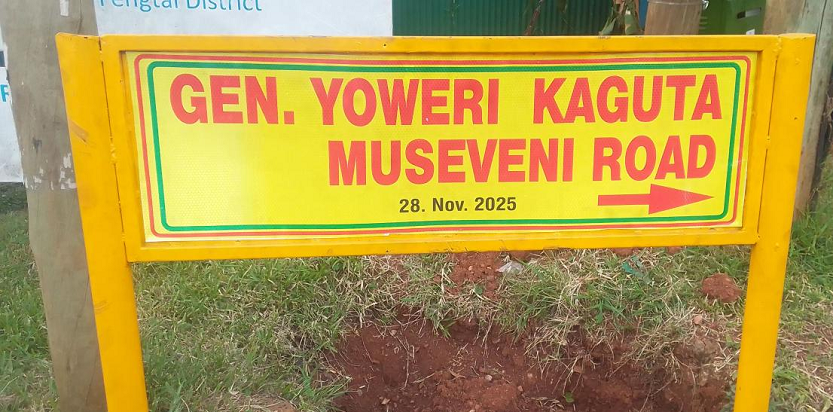
A sign post at Nakasero road in Kampala showing road named after President Yoweri Museveni
A sign post at Nakasero road in Kampala showing road named after President Yoweri Museveni
The Kampala Capital City Authority (KCCA) says road naming is a structured, community driven process designed to preserve local history, improve city addressing, and ensure fairness across neighborhoods.
The explanation comes as a result of unidentified individuals recently going ahead and purporting to rename Nakasero road to Gen. Yoweri Kaguta Museveni Road, which KCCA said it is not under the authority’s guidance.
Flavia Zabali Musisi, the supervisor physical planning and information management system at KCCA said the formal road-naming programe began in 2015 under the Kampala Institutional Infrastructure Development Project (KIIDP) as part of efforts to improve city addressing.
The exercise involves both naming roads and numbering buildings, a system that supports service delivery, emergency response, postal services, and urban planning.
Zabali further illuminates that at the time the program started, Kampala had more than 7,000 roads, but only about 500 had official names, mostly inherited from the colonial era and were largely concentrated in Central Division.
She also noted that in (other) Kampala suburbs, residents used informal road names that were well known locally but absent from the official city mapping system which created confusion and lack of uniformity.
“People knew road names on the ground, but those names did not exist in the system,” Zabali explains.
She acknowledges that some divisions had approved road names, but many of these approvals never went beyond council minutes and were never integrated into KCCA’s official records.
As a result, KCCA developed Road naming guidelines, approved in May 2017, to standardize the process across the city.
She noted that the KCCA Act gives the authority the powers to name roads, install road signage, number buildings, and requires property owners to display address plates.
However, the law provides limited procedural details hence the introduction of the guidelines to clarify who names roads, how they are named, what they can be named after, and the approval process.
According to the guidelines, Zabali says communities are encouraged to name roads after local and indigenous history individuals who made significant contributions to the community, and after natural features such as plants, trees, rocks, gardens, cultural or environmental landmarks.
While naming or renaming a road, Zabali explains that preference is generally given to naming roads after deceased persons, whose legacy is considered permanent.
Naming after living individuals is allowed only if the community agrees the person has made a substantial contribution, particularly where a road passes through or significantly affects their land.
Road naming begins at the community level residents meet to identify unnamed roads, agree on appropriate names, and record their decisions in formal minutes. Participation prioritizes property owners, although long-term tenants with knowledge of the area may also attend.
For roads affecting a specific stretch, only residents along that road are expected to decide. This is meant to prevent outsiders or temporary tenants from influencing decisions that affect permanent residents.
The community submits signed minutes, attendance lists, and plot details to LC1, then to LC2, followed by endorsement from the Division Council (LC3). The proposal is later reviewed by KCCA’s Physical Planning Committee and finally approved by the Authority Council.
A part from the President, Parliament, cabinet and the authority council Zabali emphasizes that no individual can name or rename a road, even if they are influential or well-known, saying road naming is not a personal proposal.
(Re)naming must reflect community consensus, follow legal procedures, and be approved through the established structures.
Zabali noted that renaming of some roads in Kampala is difficult as the names roads appear on plots and land tittles of the people living along the road. Renaming a road requires change of people’s land tittles which may cause some challenges.
Fredrick Nsibambi the Deputy Executive Director of the Cross-Cultural Foundation of Uganda cautioned against viewing renaming as a simple solution, arguing that history however painful cannot be erased. “History happened, and we need to move forward, keeping a name does not necessarily mean celebrating the individual,” he explains. Sometimes it serves as a reminder of what went wrong and why it should never be repeated.”
Roads whose have caused unease in Kampala include Mobutu and Siad Barre, Congolese and Somali defunct dictators respectively, Colville who was a colonial soldier accused of conducting genocide against the Banyoro. Bokassa Street that was named after a defunct defunct Central African dictator but was later renamed after Archbishop Janan Luwum who was killed in 1977 and has since been declared a saint of the Angilcan Church.
Nsibambi instead proposes that new roads and infrastructure should be created through city expansion and be named after contemporary leaders and contributors to national development, rather than altering existing streets. He concludes that sometimes naming a road after someone minimizes their legacy, yet there are other meaningful ways to recognize outstanding contributions to this country.”
-URN