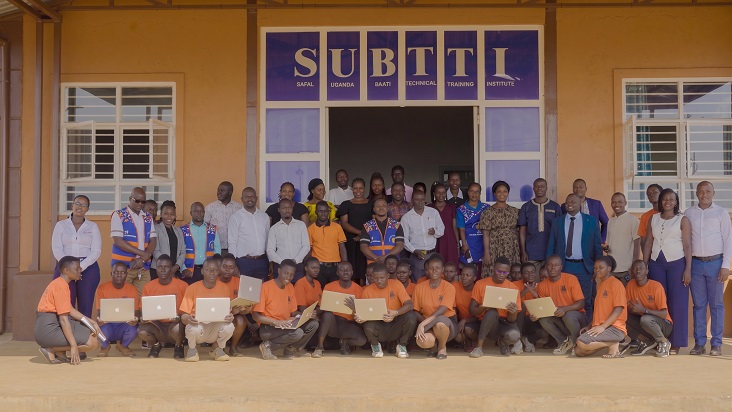


Persons with Disabilities in a group photo
As the world commemorates the International Day of Persons with Disabilities, a story of tangible progress unfolds in Uganda. Over the past year, meaningful advances in disability inclusion have been realized across the Mastercard Foundation’s initiatives, significantly strengthened by the strategic approach of the We Can Work program. In a context where disability data is still limited, organizations like Light for the World, the Mastercard Foundation, and their partners have demonstrated the transformative impact of addressing inclusion intentionally and strategically.
At the forefront of this change are young people with disabilities themselves, who are stepping forward as leaders, advocates, and innovators. Central to this shift are Disability Inclusion Facilitators (DIFs)—young leaders with lived experience embedded directly within partner organizations to ensure no young person with a disability is left behind.
Implemented by Light for the World, the We Can Work program empowers DIFs to bridge the historic gap between development programs and the young Ugandans with disabilities they have often excluded. Their work is driving systemic change: prompting revisions to recruitment practices, adjusting resource allocation, redesigning financial services, and embedding inclusion into institutional budgeting and planning. Crucially, they are making the inclusion agenda actionable.
Young Leaders Driving Inclusion from Within
For many DIFs, the work starts with dismantling misconceptions. In Western Uganda, Charlotte Kebirungi, a DIF with the Youth Inclusive Dairy Market Systems (YIDaMS) program, works in communities where persons with disabilities were rarely given equitable opportunities. She trains community groups on inclusive communication and engagement.
Her influence extends to program staff. “Staff had no idea about reasonable accommodation,” Charlotte notes. “Now they ask me to help them select accessible venues or guide communication during meetings.” Village agents who were once hesitant now actively consult her and recruit young people with disabilities.
Carol Alum, a YIDaMS Enterprise Development Officer, confirms this shift: “Through hands-on support, DIFs have helped us understand inclusion deeply. Since Charlotte joined, we have seen a significant increase in the participation of persons with disabilities.”
Transforming Mindsets and Allocating Resources for Access
The inclusion journey often requires changing institutional culture and priorities. At MAMIDECOT Microfinance, the arrival of DIF Pamela Nasolo, who has a visual impairment, was a learning moment for staff. “At first, if you wanted to give her a chair, someone would tell her neighbor to help her,” recalls supervisor Jacintha Nakayiwa. “Now, we have learned to communicate directly.”
Pamela’s impact went beyond etiquette. She successfully advocated for the inclusion of a laptop with JAWS screen-reading software in the institution’s 2026 budget. “We learned that without these tools, we are discriminating,” Jacintha states. This commitment to accessibility has contributed to MAMIDECOT’s client base with disabilities growing from 65 to over 90. “Staff used to see persons with disabilities as beggars,” Pamela observes. “Now they see us as potential customers.”
From Participation to Prosperity: Tangible Economic Gains
Programs are now translating inclusion into direct livelihood improvements. Within the Stimulating Agriculture for Youth Employment (SAYE) program in Eastern Uganda, DIF Latif Lugudo supported Kalali Paul, a young man with albinism who faced profound exclusion. Through mentorship and enrolment in a Youth Savings Group, Paul regained confidence. He invested savings into poultry, generating enough capital to open a retail shop. “Our role is to help participants rediscover what they can do,” Latif shares.
For young women like Nagujja Catherine, inclusion means belonging. After secondary school, she remained home, uncertain any training centre would accept a person with a visual impairment. A DIF mobilized her to enroll in hairdressing. Today, she runs a home-based salon, earning an income and mentoring others. “I used to stay inside… Now I meet clients, earn from my hands, and show others like me that we can stand and work too.”
These stories affirm the transformative power of embedding lived experience into program delivery. DIFs are strengthening institutional capacity, reshaping attitudes, and proving the immense value persons with disabilities bring when systems are designed to include them. Their work signals a pivotal shift across Young Africa Works programs toward inclusion that is intentional, practical, and sustainable laying the foundation for equitable work pathways for all young people.