
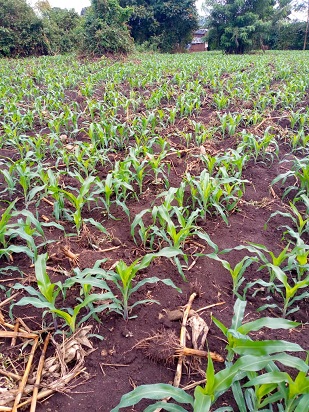
Kuta's maize for this season at three weeks
The World Bank has commended Uganda’s recent economic growth performance but warns that the country’s continued dependence on nature-driven agriculture poses a major risk to achieving its long-term development targets.
Agriculture contributes about a quarter of Uganda’s Gross Domestic Product (GDP) and accounts for 35 per cent of export earnings. However, the sector remains largely primary and rain-fed, with minimal value addition. Production depends heavily on favourable weather, adequate rainfall, moderate temperatures, and fertile soils, leaving both agriculture and the broader economy highly vulnerable to climate shocks.
“Uganda’s growth remains strong, but economic activity is currently concentrated in low-productivity and climate-vulnerable agriculture and informal jobs, which offer limited opportunities for income growth and upward mobility,” said Francisca Ayodeji Akala, the World Bank Country Manager for Uganda.
She was speaking after the launch of the 26th edition of the Uganda Economic Update, which focuses on agro-industrialisation as a pathway to sustainable growth.
According to the report, transforming the economy toward higher value-added activities is critical if Uganda is to deliver on its Ten-Fold Growth Strategy. Agro-industrialisation, the Bank argues, can serve as a cornerstone for this transformation by using agriculture as a platform for industrial growth, job creation, and export expansion.
Uganda’s long-term development frameworks, including Vision 2040, the National Development Plan IV (NDP IV), and the Ten-Fold Growth Strategy, seek to position the country as an upper-middle-income economy. Under the Ten-Fold Growth Strategy, agro-industrialisation is expected to contribute USD 20 billion annually to GDP by 2040, while NDP IV aims to increase growth in agriculture, forestry, and fisheries from 6.6 per cent to 10.13 per cent by 2030.
“Achieving this will require transforming raw agricultural products into high-value processed goods and attracting private investment across diverse value chains, including meat, dairy, coffee, cassava, tea, fruit, and oilseeds,” the report notes.
To drive this transformation, the government is prioritising improved productivity and commercialisation, promoting value addition and agro-processing, expanding access to inputs, finance, and markets, and strengthening public-private partnerships, particularly in storage, processing, and exports.
At the production level, emphasis is being placed on expanding irrigation, especially among smallholder farmers, through the World Bank-supported Micro-scale Irrigation Program, aligned with the National Irrigation Policy.
The policy targets the development of 1.5 million hectares of irrigated land by 2040, focusing on climate resilience and commercial agriculture using micro, medium, and large-scale systems. In parallel, Uganda’s Agro-Industrialisation Policy seeks to shift agriculture from subsistence to a commercial, value-adding sector, boosting exports and food security through improved production, storage, processing, infrastructure, technology, and access to finance.
“The building blocks for Uganda’s agro-industrial agenda align with the World Bank’s AgriConnect initiative, which aims to integrate smallholders into agribusiness and transform agriculture into an engine of sustainable growth, job creation, and food security,” said Armine Juergenliemk, a Senior Agricultural Economist and co-author of the report.
She added that the initiative opens space for productive public-private partnerships to promote technology adoption, reduce risks across value chains, expand service delivery, and create more jobs in rural economies.
Despite Uganda’s favourable natural endowments, the report notes that reliance on fertile soils has discouraged modernisation. Fertiliser use remains extremely low, even as soil erosion and degradation increase. Only about 10 per cent of households use fertilisers, applying between 3 and 8 kilograms per hectare, far below the Sub-Saharan African average of 60 kilograms per hectare.
Adoption of improved seeds, mechanisation, and modern farming tools is also limited, meaning growth in agricultural output has largely come from expanding acreage rather than improving productivity. The report further highlights major weaknesses in agricultural extension services.
One extension worker currently serves between 1,500 and 2,500 farmers, compared to a regional benchmark of 1,000 to 1,500. Many extension officers also lack practical skills. “Extension officers struggle with hands-on knowledge because universities lack adequate field-based training facilities,” the report states, citing findings from the Consultative Group on International Agricultural Research (CGIAR) and data from the Uganda Bureau of Statistics.
Some officers reportedly cannot identify drought-tolerant maize varieties, a challenge compounded by policy reversals and institutional inconsistencies. The transition from the National Agricultural Advisory Services (NAADS) to Operation Wealth Creation (OWC) prioritised input distribution over advisory services, weakening information flow.
Current efforts to consolidate extension services under the “Single Spine” model remain underfunded and understaffed. Beyond productivity, food security remains a concern. Agnes Kirabo, Executive Director of the Food Rights Alliance, cautions that excessive focus on cash crops risks undermining household nutrition.
“It is a constitutional duty for the state to maintain national food reserves for times of crisis. It is troubling that we expect rural households to cope when many are already food-insecure,” she said.
The World Bank report concludes that agro-industrialisation offers enormous potential for inclusive growth, employment, and value addition, but only if foundational gaps are addressed.
It recommends investing in climate-smart technologies, irrigation, rural infrastructure such as roads, energy and water, skills development, and digital delivery of agricultural services. It also calls for policy and institutional reforms to strengthen farmer cooperatives, improve seed systems, attract private sector participation, expand access to finance, and harmonise regional trade policies.
-URN
About the Author