


NaCORI says drought-tolerant varieties are performing well in field trials. They are high yielding and have bigger beans
NaCORI says drought-tolerant varieties are performing well in field trials. They are high yielding and have bigger beans/ Ali Milton photo
Climate change-characterized with prolonged dry spells is threatening the future of coffee production in Uganda.
Coffee, a major foreign exchange earner for Uganda, is largely produced by small scale farmers who face the brunt of the changing weather patterns.
Climate change-characterized with prolonged dry spells and abnormal hot temperatures, puts the livelihoods of an estimated 1.8 million households engaged in coffee farming in Uganda, at risk.
In 2024/2025 Financial Year, Uganda exported 7.7 million 60kg bags, generating US$2.2 billion in revenue. Uganda targets to produce 20 million bags by 2030.
To curb the adverse effects of climate change and ensure sustainable coffee production in the country, scientists at National Coffee Research Institute (NaCORI), with support from the European Union (EU) through the French Agricultural Research Centre for International Development (CIRAD), are developing drought resistant Robusta coffee varieties.
The European Union through CIRAD committed 713,000 Euros to support the green coffee project for a period of three years, beginning December 2022.
Business Focus had an exclusive interview with the researchers at NaCORI in Kituza, Mukono, to understand better the ongoing efforts to develop the drought-resilient coffee varieties and the progress made so far.
The journey to drought-tolerant varieties
Dr. Pascal Musoli, a senior coffee breeder at NaCORI, says developing new coffee varieties is a process which takes years before coming to fruition.
“Farmers have been complaining about drought and the role of breeders is to develop varieties that solve farmers’ problems. That’s why we are developing varieties that are drought-tolerant,” Dr. Musoli says, adding that researchers started with the identification of varieties that are drought-tolerant and understanding the broader genetic materials at the institute; beyond the drought, they also looked at the pests and diseases that are affecting coffee as a result of climate change.
Dr. Musoli together with Dr. Godfrey Sseremba. Dr. Mathieu Gonin from CIRAD are supervising two Makerere University PhD students, Ali Milton and Mildred Julian Nakanwagi, who are working on the development of drought-resilient coffee varieties.
Milton is PhD student in Plant Breeding and Biotechnology at Makerere University, conducting his doctoral research at NaCORI. His research focuses on improving drought tolerance in Robusta coffee, with the goal of developing resilient varieties that can withstand climate stress and contribute to sustainable coffee production in Uganda, while Nakanwagi is a PhD Student at Makerere University, with her research focusing on understanding the native Robusta Coffee diversity in Uganda so that it can be used to breed climate-resilient varieties. Her work also provides insights in conserving the coffee the country has by planting them in other places other than the forests where they are threatened by deforestation
Dr. Musoli says the process of developing new drought-tolerant varieties starts with screening the germplasm for drought tolerance.
Germplasm refers to genetic resources such as seeds, tissues, and DNA sequences that are maintained for the purpose of animal and plant breeding, conservation efforts, agriculture, and other research uses.
“We believe that in nature, everything that disturbs you, God has provided a solution for it, but you don’t know where it is. In this case, within our Robusta coffee population across this country, there must be some useful genes that are resistant or tolerant to drought. So, the first step is to create an environment for the identification of those genotypes or individuals that have genes for drought tolerance,” Dr. Musoli says.
He adds that the conducive environment involved the construction of a Screen House, raising of plants from various sources and having the manpower (researchers).
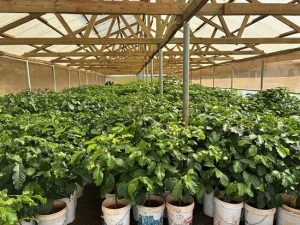
According to Dr. Musoli, Milton did the screening of the germplasm for drought tolerance, while Nakanwagi scanned the coffee gene bank to collect the diverse materials that will be kept at NaCORI for future use.
Useful materials at NaCORI coffee gene bank
Milton says the drought-tolerant varieties were found within NaCORI coffee gene bank.
“The previous researchers had collected a huge germplasm that is conserved here and they didn’t know whether it had genes for drought. What I did was to look for plants or varieties that had good attributes in terms of bean size, yields and pests and diseases. I multiplied them and put them in big buckets to grow into bigger plants. From there, I removed water from some them while I continued watering the others at regular intervals. I wanted to find out the impact of removing water on these coffee plants. I left them without water for three weeks,” Milton explains.
He adds: “These plants responded differently; there are those that within five days they had already shown signs of wilting, others had shown signs of water stress within seven days. There are individuals (plants) that even after 21 days, there were no signs of them completely being impacted by drought or water withdrawal. Those are the materials that I picked and measured their indices to see whether they are drought tolerant or not. From the first screening, I was able to identify 17 drought tolerant materials that were not impacted by drought both physiologically and physically when you look at them.”
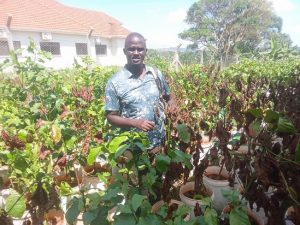
After this step, the researchers took these drought-tolerant plants to farmers’ fields in drought-prone areas such as Nakaseke, Sembabule and Ntungamo districts.
Promising results
The researchers are observing the response of these varieties in the field.
“When you look at the materials that were tolerant in the Screen House, some of them are still very drought-tolerant in the actual field/ environment where heat is intense and we are continuing to observe this. We are also looking at other attributes like yield, resistance or tolerance to pests and diseases. We want to ensure that the materials we want to release are high yielding, disease resistant, good cup quality and an additional attribute of drought resistance,” Milton says.
He adds: “On drought, we have some good varieties that are drought-tolerant. In terms of yield, we have some good varieties that are very promising. They even look much better than the varieties that we currently have in terms of yield. In terms of pests and diseases, they are also doing very okay.”
When asked how many varieties that are performing well in the filed out of the 17, Milton said four varieties are highly promising.
Dr. Musoli added that in the trials, they have included the best of the current varieties i.e KR8-10 as controls/checks. In simple terms, the drought- tolerant varieties are being benchmarked against KR8-10 in terms of performance.
“The varieties are very good; they are promising. From the first observation, I can see they have big cherries, a lot of cherries on the primaries and they are withstanding the hot temperatures in those environments which has been lacking in the current varieties. I am confident that when time comes for presentation, they will be passed. They are good,” Musoli, who’s credited for spearheading the development of KR varieties, said.

He says that KR8 can produce an average of 3100kg green beans (kasse) per hectare per year, while KR9 and KR10 can yield an average of 3900kg and 4800kg respectively.
“Although the drought-tolerant varieties are in their initial stages of production/yielding (two years old), their yield falls within the range of KR8-10,” Dr. Musoli said.
On when farmers should expect to have the varieties ready for planting, Dr. Musoli said the process of releasing new coffee varieties is long, noting that it will take about five to six years to have these drought-tolerant varieties available to the end users.
(In part 11 of this story, we’ll explain in detail, the process of releasing new coffee varieties)
Conserving indigenous varieties
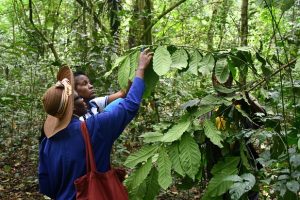
Under this European Union-funded project, researchers are also collecting indigenous coffee materials from forests spread across Uganda for future use/ research. This is to ensure sustainable coffee production in Uganda in light of climate change.
Nakanwagi, who’s collecting these materials told Business Focus that while Uganda is so rich in forests with various species, the country risks losing useful plant species due to high levels of deforestation.
“This means that the materials we have been using are falling culprit or getting wiped away. That’s why we have to go back to our source (forests) to get that material and see how we can use it to able to curb the negative effects of climate change,” she says.
Uganda has different ecological zones or different climatic environments and therefore, researchers have to get the materials from forests spread across Uganda.
“In the North, we have been to Zoka forest (located in Adjumani District). Originally, people didn’t think coffee would grow well in the North, but when you go to the forest, there’s coffee. That’s a very good place to tap on diversity especially in terms of drought resilience. The climate in the North is harsh in terms of temperatures and the dry period is longer. If we get materials that are thriving in the wild, we are assuming that they have adapted to the environment. If we can use them as a source to feed into the varieties that we want to release for drought tolerance, that can actually work better,” she says.
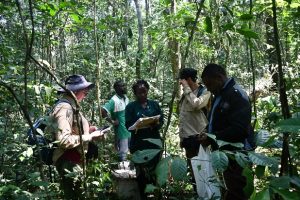
She adds that the other good place with high moisture and high temperatures is Semuliki National Park in Bundibugyo.
“Beyond the hot springs, there’s diversity of coffee. It’s not only one type. Our focus is on Robusta, but as you move across various forests, you realize there are different species or types of coffee that we can tap in. The other forests we have been to are; Mabira, Maramagambo, Malabigambo, Budongo, Kibale and Itwara,” Nakanwagi says, adding: “From the European Union funding since 2022, we have gone to 10 forests, but we have not fully explored them given the financing limitations and other activities. You go there and tackle one part of the forest. We believe quite a lot hasn’t been explored in those forests which makes this work relevant. Regularly, someone can go and tackle different parts of the forests that haven’t been explored and bring germplasm to NaCORI for future use.”
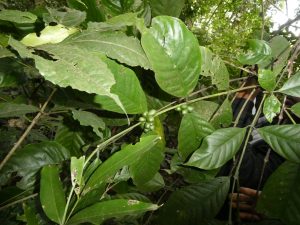
She however says forests are under threat.
“Currently, deforestation is at its peak. People are doing charcoal burning within the forests and as a result, we are not only losing coffee species, but biodiversity. They are targeting coffee trees because they believe it makes good charcoal. Even those building temporary shelters also target coffee trees because they believe they have hard wood. We risk losing our wealth of coffee species which we have in forests which calls for concerted efforts to combat this,” Nakanwagi says.
She says the materials that have been collected since 2022 have been brought to NaCORI for conservation, while some of them have been regenerated and planted. “Currently, they are at a tender stage,” she says.
EU support commended
Dr. Musoli commends the European Union for its coffee sustainability efforts in Uganda through supporting coffee research.
“We thank the European Union for supporting coffee research in Uganda. They’ve been our great and reliable partners,” Dr. Musoli says.
The European Union has been supporting Uganda’s coffee sector for many years. The Ministry of Agriculture, Animal Industry and Fisheries (MAAIF) is currently implementing the Coffee and Cocoa Value Chain Development Project (CoCoDev). The project, previously under the Uganda Coffee Development Authority (UCDA), is co-funded with the support from the European Union and has a total implementation budget of UShs25.5bn.
However, Dr. Musoli says the research project for drought-tolerant coffee varieties ends this year, yet they need three years of continuous collection of data sets.
“As a scientist, I would have loved to sleep around my plant to understand it better, but due to limited financial resources, you can miss collecting some data sets. There are times when scientists can’t go to the field because they don’t have the money,” Dr. Musoli says, adding: “So, you might find some gaps in the data sets because you’ve not collected data as regular as you would have wished and as a scientist, you’re not happy with that. You might have to collect data for a bit longer time. Instead of having the variety released in about three years, it may take another three years, meaning it may take six years for you to have enough data sets to produce convincing reports to various stakeholders.”
In the 2nd part of this story, we’ll explain in detail, the process of having new coffee varieties released.
It’s good lecture about coffee and am ready to learn more
Good work I need some seedlings for the new variety so that I plant
Can I get some coffee seedlings for planting this season from Nacori. And also do you have other stations for seedlings say in wakiso or kampala or I have to come to Mukono
This is so important as we look to tap into the future of the export
Greetngs
Iam local farner with several local farmers. What can we do such that we become your member groups.
Hope to here from you
This is very promising and great work for sustainability and profitability of the coffee sector! More funding for research is greatly needed for more convincing and reliable findings!
Good work I need some seedlings for the new variety so that I plant
Thanks so much for introducing the drought resistant coffee. That means I can now grow coffee in Teso. I have planted about 70 KR plants to study if it can do well.
thank you for the work you do
Hi, great article – but there is a lot more one would like to find out – such as the arabica varieties that have been done research on.
More info on the actual research and how it’s been done. What went well, what went wrong. What leads to drought or disease resistance?
Thanks!
Promising research.
I would be proud to if I can be part the research . I’m very keen at observation. The major requirement in research.
I live in Nntungamo -Uganda.