

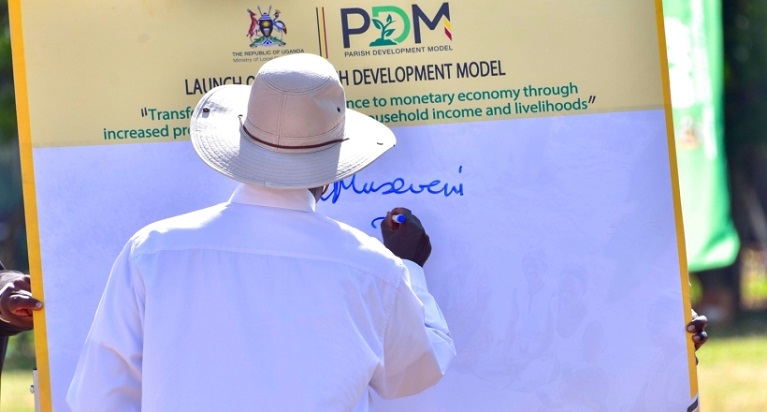
Museveni launches PDM
Museveni launching the Parish Development Model Programme
The Ministry of ICT and National Guidance wants Parliament to approve UGX45Bn in a move to rollout the automation of the Parish Development Model (PDM) and Smart City project that will rid cities and towns in Uganda of the fibre cable wires and polls installed by telecom companies.
The request was made by Iddi Isabirye, Vice Chairperson, Parliament’s Committee on ICT, while appearing before the Budget Committee on 28th January 2026, to present his committee’s report of the 2026/27 National Budget Framework Paper for the digital transformation programme.
Isabirye explained, “The Committee was informed that the Ministry has a plan to further automate and roll out electronic government services, including PDM and smart city solutions, and the requirement for this financial year 2026-2027 is UGX45Bn. However, only UGX34Bn has been allocated, leaving a funding gap of UGX11Bn.”
However, Paul Omara (Otuke County) wondered the need to spend more money on automation of the PDM yet there is an app in place “WENDI” where these funds are transacted.
“We have had this thing called WENDI. You know, WENDI, I think that is the PDM payment platform, isn’t it? Yes. And it has already been rolled out and I think it is functioning well. So, when you say that the committee recommends that UGX11Bn be provided to enable government to automate PDM and facilitate smart city solutions and other e-government services, maybe you would expound more,” he said.
Achia Remigio (Pian County) questioned why the Ministry of ICT was asking for additional funds for automation of Government services yet in the 2025/2026 national budget, the Ministry of ICT budgeted for UGX16.1Bn to undertake the same continuous automation and rollout of government services, under the guise of improving efficiency in business cross-sourcing and public service delivery with evolving technologies that require efficiency, security, continuity, and adaptability of IT services.
“And the available funding which was given to them was UGX6.51Bn, resulting to a funding gap of UGX.5Bn. And the recommendation which was adopted then was that the committee recommend that government allocates UGX9.59Bn for the continuous automation of government services for the financial year 2025-2026, which was given. Now, the financial year 2026/2027 is UGX45Bn, however, only UGX34Bn has been allocated, leaving a funding gap of UGX11Bn,” remarked Achia.
He faulted Parliament’s ICT Committee for failing to thoroughly interrogate this matter during the consideration of the BFP saying this could explain why the Ministry developed a higher appetite for more funds.
“So, what has the other UGX16.1Bn done? Because they said they needed just this UGX16.1Bn to do this, and we gave them. So now they are upscaling, the appetite has risen through the roof, now they want UGX45Bn, and even though they have given UGX34Bn, they are still crying. UGX34Bn is twice what they requested in the current financial year, now they have been given UGX34Bn. They are not even happy with it. Please interrogate these ministries further, ask them, what did you do with what was given to you?” said Achia.
Although Moses Magogo (Budiope East) backed the proposal for funding smart city, he however faulted the ICT Committee for bundling up the automation of PDM with Smart City project noting, “When you talk about these cables which are scattered all over, we’re saying, can we have a centralised way of moving? But the private sector, you will find MTN doing optic fibre, Minister of ICT doing optic fibre, everybody putting up lines in the air, and then you’re talking about the smart city, you know?”
Musa Noah (Koboko North) explained to the Committee that during an earlier meeting held with the Ministry of ICT, the same question were raised by MPs of the ICT Committee about the smart cities and the Committee was informed that one of the components will involve cleaning the cities and get rid of the optic fibres, which are all over the place.
“So, they want to see that all these fibres go into service ducts. The city should have service ducts where every provider, IP should come and run their fibres from there. That is one component. And then the other component is about managing traffic. And then managing waste and so on. But in automation of government services, it is all the range of services, e-procurement, e-equipment, which we are talking about. The PDMS, which is for PDM. Education management system. And all those E-Systems, we know about government,” Noah explained.