
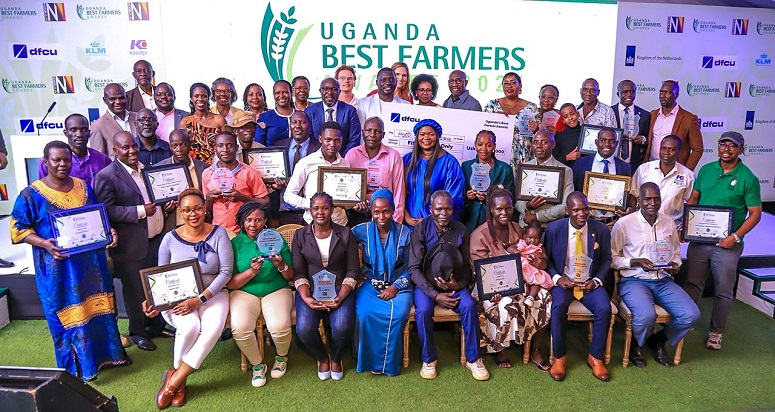
Winners of various categories in the Best Farmers Competition 2025 in a group photo
For over six decades, dfcu Bank has supported Ugandans to build businesses, with agriculture remaining at the heart of that journey. Through financing, partnerships, and platforms that recognise and uplift farmers, the Bank continues to play a role in helping agriculture move from subsistence into a more structured and sustainable business.
One such platform is the dfcu Bank–Vision Group Best Farmers Awards, run in partnership with Vision Group and other stakeholders. Now in its 12th edition, the initiative recognises farmers who are doing more than just farming, those keeping records, adding value, and building businesses that can grow. Since 2014, the competition has recognised over 130 farmers across the country, while giving winners financial support and exposure through study visits to countries like the Netherlands.
It is through this kind of support that Patrick Olobo’s journey has taken shape.
Patrick Olobo, once a devoted secondary school teacher, traded chalk for soil, transforming a modest banana garden called Mwalimo Smart Farm, located in Amach Town Council, Lira District, into a thriving agribusiness that now feeds families, inspires youth, and redefines rural resilience in the Lango sub-region of Northern Uganda.
For over two decades, Patrick stood before classrooms shaping young minds, yet behind the scenes, another story was quietly unfolding. Farming, first a side activity, was sustaining his livelihood more reliably than his teaching salary. The realization was gradual but undeniable: agriculture was not just survival, but an opportunity.
In 2015, he made a bold decision many would hesitate to take, leaving the certainty of formal employment and stepping fully into farming, guided by instinct, experience, and a deeply rooted connection to the land.
What began as a single acre of bananas has since expanded into six acres, complemented by coffee farming and value-added production. When COVID-19 disrupted global economies, halting businesses and livelihoods, his farm stood firm. Agriculture, one of the few sectors that remained essential and active, became confirmation that he had chosen wisely.
The path has not been without struggle. Northern Uganda’s harsh dry seasons threaten crops with relentless drought, while pests like the destructive banana weevil challenge productivity. These obstacles, however, have not broken his resolve. Instead, they have refined his approach, driving him toward better farming practices, resilience, and innovation. His farm is not just productive, but a model of discipline, with well-maintained gardens that have become a point of pride and a learning ground for others.
Patrick’s impact extends far beyond production. Recognising the limitations of selling raw produce, he ventured into value addition, drying bananas into chips, processing banana flour, and experimenting with products that address malnutrition among children. These innovations are rooted in community needs. The banana porridge he developed has already shown promise as a nutritious option for infants. Now, he is pushing further into banana wine and juice production, with a vision of reaching export markets.
This vision has not gone unnoticed. Through an unexpected nomination, Patrick emerged as a winner in the dfcu Bank–Vision Group Best Farmers Awards, now in its 12th edition, organised in partnership with Vision Group, KLM Royal Dutch Airlines, De Heus Koudijs Nutrition BV, and New Vision Foundation. The competition recognises farmers who are building real agribusinesses, with a focus on productivity, value addition, and market access.
His win earned him national recognition, a cash prize of UGX 7 million, and a fully sponsored study trip to the Netherlands. For Patrick, it is more than a reward, it is an opportunity to learn, connect, and take his farm to the next level.
Back home, the ripple effect is already visible. Farmers who once doubted banana farming are now planting. Youth who dismissed agriculture as a last resort are beginning to reconsider. Patrick mentors them with a simple but powerful message: start with what you have.
His farm has become both a classroom and a catalyst, proving that agriculture is not backward, but foundational to economic independence.
Not everyone embraces change. While many are inspired, others remain sceptical. Patrick accepts this duality, focusing on those willing to learn and grow. For him, progress is not measured by universal approval, but by tangible transformation, new farmers, new crops, and new income streams.