
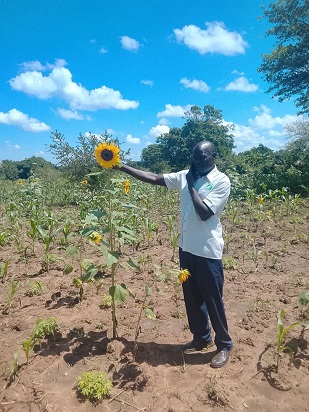
Denis Odyang inspects a sunflower plantation during a field visit in Acanpii Village, Agali Sub-county in Lira District
Deep in Acanpii Village in Agali Sub-county, Lira District, a quiet agricultural transformation is taking shape, powered by the European Union support that farmers say is changing livelihoods and restoring hope among rural households.
Agali Farmers’ Cooperative Society Limited (AFCSL), a farmer-led organization with 2,892 members, has emerged as one of the growing examples of how targeted financing, infrastructure support and cooperative-based farming can strengthen household incomes and improve agricultural productivity in Northern Uganda.
The support is being implemented under the EU’s “The Support to Agricultural Revitalization & Transformation (START) Facility,” through which the cooperative received Ugx361 million to boost its operations and support farmers.
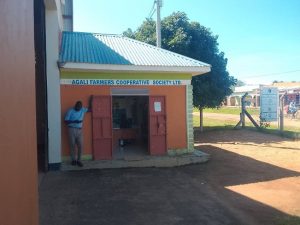
Out of the funding, Ugx50 million was directed towards crop financing while the balance facilitated acquisition of a tractor, completion of the cooperative store and fencing of the cooperative’s headquarters.
During a field tour conducted between May 5-7, 2026, Denis Odyang, the Chairperson of Agali Farmers’ Cooperative Society Limited, told Business Focus that the European Union intervention has significantly strengthened the cooperative’s ability to support farmers and stabilize production.
“On behalf of our members, I would like to thank the European Union for giving us the financial support which has seen many of our members improve their lives and look after their children in school, attend to their health needs, and other daily necessities,” Odyang said.
He added: “We would like to call upon the European Union to give us more support especially on crop financing. Let the project continue because we have many groups that need support.”
Growing markets
Founded in 2013 as a youth Village Savings and Loans Association (VSLA) shortly after the Lord’s Resistance Army insurgency displaced many families into camps, the cooperative has evolved into a major agricultural enterprise operating across Lira, Dokolo and Alebtong districts.
Today, the cooperative aggregates and markets maize, soybeans, rice and sunflower for members while also providing training, seedlings, produce bulking and soft loans to farmers ranging between Ugx300,000 and Ugx1 million.
According to Odyang, one of the biggest gains from the European Union -backed intervention has been the cooperative’s strengthened bargaining power in crop markets.
He said farmers are now benefiting from improved commodity prices partly because the produce is sold collectively in bulk to buyers in Lira, Kitgum and surrounding urban centres.
“For instance, a kilogram of unprocessed sunflower is currently averaging Ugx1,900 compared to Ugx1,000 five years ago; maize is Ugx1,200 compared to Ugx700; rice has had its price at Ugx2,000 compared to Ugx1,000; soyabean price is Ugx2,500 compared to Ugx1,500,” Odyang told Business Focus.
The cooperative still faces challenges including price fluctuations, limited capital and financing gaps for agricultural assets, but Odyang says the future outlook remains positive.
“The future of Agali in 10-15 years, we expect to see us grow, in terms of improved production, household income and more,” he said.
“The good thing is that right now we have electricity here and so we can access some of the services cheaply without moving too far to Lira.”
Cooperative power
Agricultural experts say support directed through cooperatives remains one of the most effective ways of transforming rural economies because it enables smallholder farmers to access markets, financing, mechanization and extension services collectively.
They argue that many farmers in Uganda continue to struggle individually due to limited bargaining power, fragmented production and poor access to credit facilities.
Experts note that interventions such as the European Union START Facility help cooperatives build infrastructure, strengthen value chains and improve post-harvest handling — factors that directly translate into better incomes for farmers.
The cooperative model is critical in helping farmers transition from subsistence farming into commercial agriculture, especially in regions recovering from conflict and economic vulnerability such as Northern Uganda.
Government of Uganda officials have also repeatedly urged farmers to form and join cooperatives as a way of benefiting from government programmes, affordable financing, input distribution systems and partnerships with development entities like the European Union.
The government views cooperatives as important vehicles for wealth creation, household income growth and modernization of agriculture under Uganda’s broader economic transformation agenda.
Future expansion
Agali Cooperative is now positioning itself for value addition and expansion into regional export markets.
The cooperative already supplies produce to companies in Kenya and South Sudan and is working toward improving rice processing capacity with support from other development partners.
Its long-term vision includes working with more than 20,000 farmers while increasing access to quality seeds, storage facilities and mechanized farming services.
Agali has also extended its impact beyond agriculture through community initiatives including construction of a staff house for a school in Acanpii village.
“We want to start adding value to our products because now we do cleaning only — that will help us earn more when we take them to the market,” Odyang said.
For many farmers in Agali, the European Union -backed intervention is not only improving production, but also rebuilding confidence in agriculture as a pathway out of poverty.