
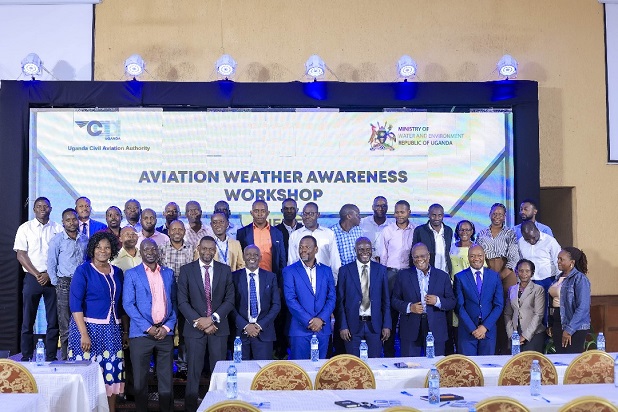
Aviation experts in a group photo at the Aviation Weather Information Workshop held at Imperial Golf View Hotel – Entebbe, on 14th-15th August 2025.
The Ministry of Water and Environment’s Department of Meteorological Services, has urged aviation stakeholders to leverage technology, enhance early warning systems and strengthen collaborations in order to reduce accidents linked to extreme weather conditions.
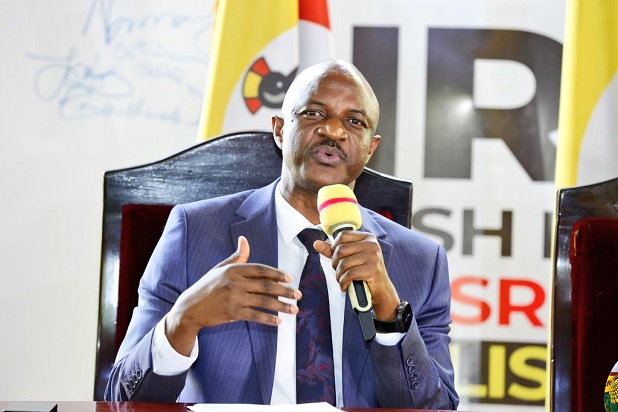
Dr. Bob Alex Ogwang, the Commissioner, Department of Meteorological Services at Ministry of Water and Environment, made the call during the Aviation Weather Information Workshop held at Imperial Golf View Hotel – Entebbe, on 14th-15th August 2025.
The workshop was organized by the Directorate of Airports and Aviation Security, in liaison with the Department of Meteorological Services, Ministry of Water and Environment. It attracted a diverse gathering of experts, stakeholders, and partners committed to enhancing aviation safety through accurate and timely weather information.
Weather is one of the most critical factors influencing aviation safety, regularity and efficiency. Challenges, ranging from turbulence and thunderstorms, to low visibility and wind shear, adversely pose significant risks to aircraft operations.
Dr. Ogwang the role of meteorologists “is not just to predict these phenomena, but to ensure that the information we provide is precise, actionable, and seamlessly integrated into aviation decision-making processes.”
“Aeronautical Meteorological Services have been greatly upgraded (eg. LLWAS (wind-shear system); Weather Radars (upgrade in progress); Upper Air (upgrade -SOFF project); PUMA forecasting system (installed), AWS, Personnel deployed at NMC (5 Principal Meteorologists and Meteorologists- Awaiting Access). These are some of the areas on improvement in recent months,” Dr. Ogwang said.

He noted that the increasing frequency and intensity of severe weather events due to climate change requires that stakeholders remain vigilant and innovative.
He urged aviation stakeholders to enhance early warning systems, urging them to strengthen their capacity to detect and communicate severe weather threats to aviation stakeholders in real-time.
He also called on them to leverage technology, urging stakeholders to explore advancements in weather monitoring systems, including the application of artificial intelligence, to improve forecast accuracy.
He further asked stakeholders to strengthen collaboration.
“Fostering closer ties between meteorologists, air traffic controllers, airport operators, and regulators to ensure a unified approach to minimise weather-related challenges is critical,” he said.
He added: “Let us use this workshop as an opportunity to share knowledge, address gaps, and develop practical solutions that will safeguard our skies, remembering that the lives of passengers, the crew, and the integrity of our aviation infrastructure depend on the work we do.”
Speaking at the same event, Fred Bamwesigye, the Director General of Uganda Civil Aviation Authority, said aviation is, by its very nature, highly dependent on accurate, timely, and reliable meteorological information.
“From take-off to landing, weather conditions influence every decision in the cockpit, at air traffic control, and in airport operations. This will impact: Flight planning; Air Traffic Control (ATC); Airport Operations; and Aircraft Performance,” Bamwesigye said.
He added that accidents and delays linked to weather remain a global concern in aviation safety, which is an indicator of the importance of accurate weather information.
In the case of aviation weather, he said, UCAA wants to ensure that stakeholders have access to accurate meteorological data; ability to interpret and use it effectively.
“This workshop exemplifies the cooperation between UCAA, the Department of Meteorological Services (DMS) of the Ministry of Water and environment (MWE), airlines, and airport operators. Such partnerships are essential because weather information is only as valuable as the action it inspires. Together, we can ensure that forecasts lead to proactive safety measures and operational resilience. This is even more important as air traffic movements increase,” Bamwesigye said.

He revealed that in 2024, Entebbe International Airport recorded 32,552 aircraft movements, which marked a significant increase compared to the 30,901 aircraft movements recorded in the previous year of 2023, 28,985 aircraft movements recorded in 2022 and the 21,584 aircraft movements recorded in 2021.
“Such growth needs to be matched with enhanced safety measures,” he said, adding that advancements in satellite imagery, radar systems, and data modelling are revolutionizing the ability to forecast and respond to weather events.
“However, technology alone is not enough. We need skilled professionals, continuous training, and a culture of safety where weather awareness is part of every operational decision,” he said.