

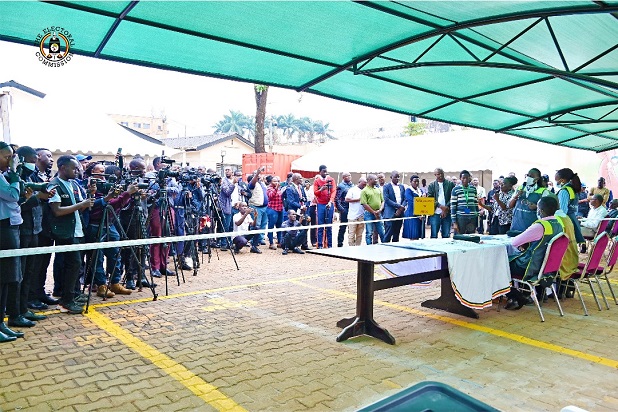
Journalists participating in the mock polls aimed at demonstrating how BVVK machines will be used
Journalists participating in the mock polls aimed at demonstrating how BVVK machines will be used
The Electoral Commission has conducted a live demonstration for journalists, observers, and political party representatives on the use of the Biometric Voter Verification Kit (BVVK) ahead of the upcoming general elections.
Held on December 17, 2025 at EC offices in Kampala, the mock polling station was set up to enable the media to experience the voter verification process firsthand, as part of efforts to enhance transparency, voter education, and public confidence in the electoral process.
In a statement signed off by Justice Byabakama Mugenyi Simon, the Electoral Commission Chairperson, the EC said it has acquired 109,142 Biometric Voter Verification Kits (BVVK) which will be deployed for the 2025/2026 General Elections, as a measure aimed at improving the management and conduct of elections through authentication of voter identity.
“The BVVK basically uses fingerprints and facial recognition to match voter details which will help the Presiding Officer to confirm the identity of the voter as being the one on the Voters Register of that particular polling station,” Byabakama said in a statement, adding: “The system will enable the Commission to ensure that only registered persons vote during the elections and that such persons (voters) do not vote more than once for the same election, hence it will help the Commission achieve the One-Man/Woman-One Vote principle.”
He added that the EC is progressing with the training of the officials who will operate the kits during the elections, from the national level to the polling station level.
He said the purpose of this demonstration is to: Sensitize stakeholders on polling day procedures and the use of the BVVS; Demonstrate how voters are identified and verified using biometric and facial recognition technology; Build confidence, transparency, and trust in the voter verification process; Allow stakeholders to observe, participate, and ask questions on the system’s functionality; Clarify safeguards in place to prevent multiple voting, impersonation, and other electoral malpractices, and Promote understanding of how technology enhances the credibility, integrity, and efficiency of elections.