
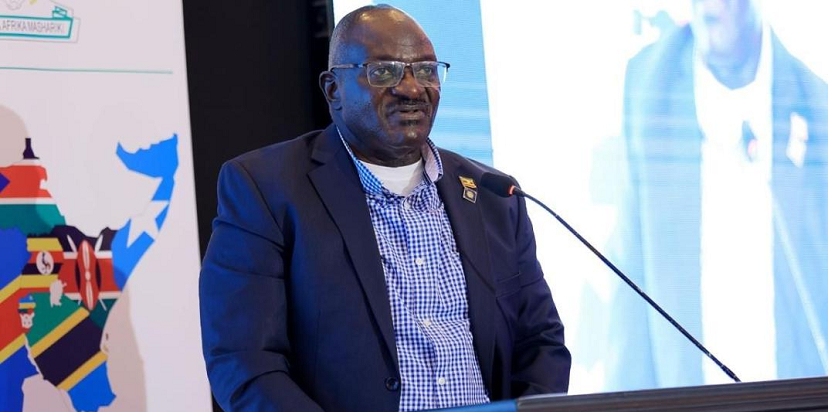
Gen. Katumba Wamala stressing the importance of the Multinational Expressway
Uganda and Kenya have approved the feasibility study for the implementation of the proposed expressway.
The Multinational Expressway is expected to ease the movement between Kenya and Uganda via the Northern Corridor.
The announcement was made during a Market Sounding Conference held in Kampala, Uganda, where government officials, financiers, and private sector leaders endorsed the close to 200-kilometre expressway as a key infrastructure priority for the region.
The project is supported by the African Development Bank (AfDB) and implemented under the EAC framework, with grant financing provided through the NEPAD Infrastructure Project Preparation Facility (NEPAD-IPPF).
Once developed, the corridor should redefine mobility and trade between the two countries, cutting travel time, easing congestion, and enhancing the flow of goods and people across one of East Africa’s busiest transport routes within the Trans-African Highway and the EAC Regional Trunk Road Network.
The feasibility studies recommend major upgrades on both sides of the border.
In Uganda, a new 60-kilometre greenfield expressway will be developed between Jinja and Busesa through a Public–Private Partnership, alongside dualling of the Busesa–Malaba and Busitema–Busia sections, while Lwakhakha–Bumbobi will remain a single carriageway.
On the Kenyan side, works will involve dualling the Kisumu bypass and upgrading the Kimaeti–Lwakhakha road to bitumen standards.
The Busia and Malaba One Stop Border Posts will also be rehabilitated to enhance clearance and efficiency. Together, these developments will strengthen regional connectivity, open new economic opportunities, and symbolise East Africa’s commitment to seamless integration.
The conference served as a platform to examine investment opportunities, raise critical questions, offer insights, and explore potential partnerships. It also provided an opportunity to gather market feedback that will help structure the project into a bankable, sustainable, and impactful regional investment.
Speaking at the event, Uganda’s Minister for Works and Transport, Gen Katumba Wamala, emphasised the strategic importance of the Northern Corridor as the main transport artery for Uganda and the Great Lakes Region, connecting Kenya, Uganda, Rwanda, Burundi, the DRC, and South Sudan to the port of Mombasa.
“The project aligns with Uganda’s Vision 2040, which seeks to modernise the country’s road network to world-class standards, targeting an average paved road density of 100 km per 1,000 sq. km,” he noted, adding that “the active participation of the private sector through Public–Private Partnerships and other blended financing models will be critical.”
On his part, the EAC Deputy Secretary General in charge of Infrastructure, Productive, Social, and Political Sectors, Hon. Andrea Aguer Ariik Malueth, highlighted the importance of designing a smart corridor that integrates digital technology, safety, and social inclusion.
“Eighty percent of projects fail at the preparation stage. The support provided by EAC Development Partners has enabled the Community to prepare high-quality, bankable regional infrastructure projects that have successfully attracted both public and private financing,” he noted.
Participants reviewed the outcomes of the feasibility studies, including traffic projections, preliminary designs, environmental and social impact assessments, and cost estimates—all of which confirmed the project’s strong technical and economic viability.
Eng. Charles Obuon, Director in charge of Public–Private Partnerships at the Kenya National Highways Authority, emphasised the project’s catalytic role in addressing cross-border infrastructure gaps.
“Regional transport infrastructure remains poorly connected due to missing links on cross-border corridors. This expressway project will catalyse economic growth and enhance the competitiveness of the EAC region.”
In the same way, Eng. Charles Wani, Commissioner for National Roads in Uganda’s Ministry of Works and Transport, remarked, “Large-scale infrastructure investment cannot be achieved in isolation. We must embrace Public–Private Partnerships and other blended financing models to deliver transformative projects.”
The expressway is part of a wider network of multinational road corridors being developed across East Africa to enhance connectivity, facilitate trade, and promote regional integration.
These include the Arusha–Namanga–Athi River (235 km), Voi–Taveta/Holili–Moshi–Arusha (240 km), Malindi–Lungalunga–Tanga–Bagamoyo (400 km), and the Masaka–Mutukula–Kumunazi–Bugene–Kyaka corridor linking Uganda and Tanzania.
Others are the Lusahunga–Rusumo–Kayonza–Kigali (162 km), Uvinza–Kanyani–Gisuru–Rusengo–Bugarama (375 km), Kisumu–Busia/Malaba–Jinja Expressway (256 km), and Ngozi–Kirundo–Kanyaru Bas–Nyamiyaga (176 km) roads.
Collectively, these corridors form the backbone of the EAC’s infrastructure programme, designed to reduce transport costs, attract investment, and accelerate the free movement of goods and people across the region. A conference on the proposed Expressway between Uganda and Kenya has approved the feasibility study of the project, paving the way for its implementation.
The road will run from Kakira in Jinja to the border at Malaya, through Busia, to Kisumu in Kanya.
It is expected to transform movement between the two countries and boost economic activity.
The announcement was made during a Market Sounding Conference held in Kampala, Uganda, where government officials, financiers, and private sector leaders endorsed the close to 200-kilometre expressway as a key infrastructure priority for the region.
The project is supported by the African Development Bank (AfDB) and implemented under the EAC framework, with grant financing provided through the NEPAD Infrastructure Project Preparation Facility (NEPAD-IPPF).
Once developed, the corridor should redefine mobility and trade between the two countries, cutting travel time, easing congestion, and enhancing the flow of goods and people across one of East Africa’s busiest transport routes within the Trans-African Highway and the EAC Regional Trunk Road Network.
The feasibility studies recommend major upgrades on both sides of the border.
In Uganda, a new 60-kilometre greenfield expressway will be developed between Jinja and Busesa through a Public–Private Partnership, alongside dualling of the Busesa–Malaba and Busitema–Busia sections, while Lwakhakha–Bumbobi will remain a single carriageway.
On the Kenyan side, works will involve dualling the Kisumu bypass and upgrading the Kimaeti–Lwakhakha road to bitumen standards.
The Busia and Malaba One Stop Border Posts will also be rehabilitated to enhance clearance and efficiency.
Together, these developments will strengthen regional connectivity, open new economic opportunities, and symbolise East Africa’s commitment to seamless integration.
The conference served as a platform to examine investment opportunities, raise critical questions, offer insights, and explore potential partnerships. It also provided an opportunity to gather market feedback that will help structure the project into a bankable, sustainable, and impactful regional investment.
Speaking at the event, Uganda’s Minister for Works and Transport, Gen Katumba Wamala, emphasised the strategic importance of the Northern Corridor as the main transport artery for Uganda and the Great Lakes Region, connecting Kenya, Uganda, Rwanda, Burundi, the DRC, and South Sudan to the port of Mombasa.
“The project aligns with Uganda’s Vision 2040, which seeks to modernise the country’s road network to world-class standards, targeting an average paved road density of 100 km per 1,000 sq. km,” he noted, adding that “the active participation of the private sector through Public–Private Partnerships and other blended financing models will be critical.”
On his part, the EAC Deputy Secretary General in charge of Infrastructure, Productive, Social, and Political Sectors, Hon. Andrea Aguer Ariik Malueth, highlighted the importance of designing a smart corridor that integrates digital technology, safety, and social inclusion.
“Eighty percent of projects fail at the preparation stage. The support provided by EAC Development Partners has enabled the Community to prepare high-quality, bankable regional infrastructure projects that have successfully attracted both public and private financing,” he noted.
Participants reviewed the outcomes of the feasibility studies, including traffic projections, preliminary designs, environmental and social impact assessments, and cost estimates—all of which confirmed the project’s strong technical and economic viability.
Eng. Charles Obuon, Director in charge of Public–Private Partnerships at the Kenya National Highways Authority, emphasised the project’s catalytic role in addressing cross-border infrastructure gaps.
“Regional transport infrastructure remains poorly connected due to missing links on cross-border corridors. This expressway project will catalyse economic growth and enhance the competitiveness of the EAC region.”
Eng. Charles Wani, Commissioner for National Roads in Uganda’s Ministry of Works and Transport, remarked, “Large-scale infrastructure investment cannot be achieved in isolation. We must embrace Public–Private Partnerships and other blended financing models to deliver transformative projects.”
The expressway is part of a wider network of multinational road corridors being developed across East Africa to enhance connectivity, facilitate trade, and promote regional integration.
These include the Arusha–Namanga–Athi River (235 km), Voi–Taveta/Holili–Moshi–Arusha (240 km), Malindi–Lungalunga–Tanga–Bagamoyo (400 km), and the Masaka–Mutukula–Kumunazi–Bugene–Kyaka corridor linking Uganda and Tanzania.
Others are the Lusahunga–Rusumo–Kayonza–Kigali (162 km), Uvinza–Kanyani–Gisuru–Rusengo–Bugarama (375 km), Kisumu–Busia/Malaba–Jinja Expressway (256 km), and Ngozi–Kirundo–Kanyaru Bas–Nyamiyaga (176 km) roads.
Collectively, these corridors form the backbone of the EAC’s infrastructure programme, designed to reduce transport costs, attract investment, and accelerate the free movement of goods and people across the region.
-URN