
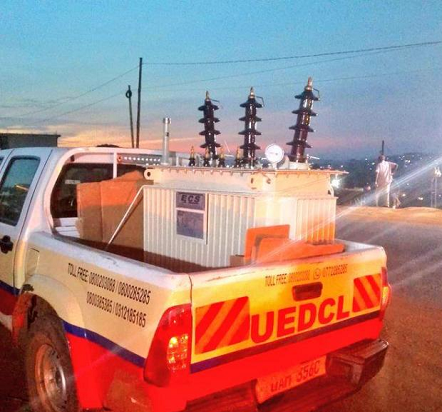
UEDCL vehicle
UEDCL vehicle
The Ministry of Energy has ordered an internal administrative review into the performance of the Uganda Electricity Distribution Company Limited (UEDCL).
The order follows reports that the Prime Minister, Robina Nabbanja, had blocked the Minister of Energy, Ruth Nankbirwa’s plans to sack some of the senior managers at the national power distributor.
A statement issued on Friday, Dr. Patricia Litho, Assistant Commissioner for Communications and Information Management at the Ministry, said the UEDCL Board had been directed to conduct a thorough investigation into the issues highlighted by ERA and to report back in “a clear, actionable, and time-bound manner.”
It stressed that, despite public speculation, no staff member has been fired in connectionwith the inquiry.
“To date, no staff member has been dismissed from UEDCL as a result of the internal inquiry,” the Ministry noted, urging the public to “allow this procedure to conclude without speculation.”
The controversy stems from concerns raised by the Electricity Regulatory Authority (ERA) about operational and management lapses at the state-owned distributor.
According to the Ministry, the action stems from ERA’s latest performance review of UEDCL, a mandatory oversight function under the Electricity Act, 1999, which empowers ERA to monitor licensees, enforce compliance, and safeguard consumer interests.
UEDCL, a fully state-owned enterprise, operates the national electricity distribution network outside concession areas and supervises private distributors such as Umeme during concession periods.
The Ministry said it is working with ERA and the Office of the Prime Minister to stabilise the situation and will issue updates as the internal review progresses. “The consumer must receive a reliable and continuous power supply,” the statement emphasised.
“Accountability, due process, and professionalism remain central to managing Uganda’s distribution network.” It added that the government remains committed to ensuring that the electricity distribution system is managed effectively, safely, and in the public interest.
As part of its annual regulatory cycle, ERA examines distribution entities’ performance across service reliability, network safety, technical and commercial losses, financial management, and customer service.
Although the Ministry did not disclose the specific lapses flagged in ERA’s report, the decision to order an internal audit suggests that the concerns were substantial enough to trigger formal scrutiny.
The Ministry also acknowledged knowledge of a letter circulating on social media and in newspapers purportedly from the Office of the Prime Minister (OPM), reportedly directing a halt to any intended termination of senior UEDCL managers. While stopping short of authenticating the letter, the Ministry emphasized that all actions concerning UEDCL staff must strictly follow the law and established procedures.
A senior government official familiar with the matter, who spoke on condition of anonymity, said there was a need for caution in addressing governance concerns within the company.
“UEDCL manages strategic national infrastructure,” the official said. “Any abrupt leadership changes can disrupt service delivery and create gaps in oversight, especially at a time when the sector is undergoing transitions.”
UEDCL was created under the Electricity Act, 1999, as part of power-sector reforms that sought to unbundle generation, transmission, and distribution. The company was established as the custodian of Uganda’s electricity distribution assets and is mandated to own, operate, and manage the national distribution network outside concession areas.
It also supervises private concessionaires, oversees rural networks where private operators decline to invest, and ensures quality, safe, and reliable electricity supply to consumers.
UEDCL operates networks in West Nile, parts of Northern Uganda, several mini-grids, and is overseeing the transition of assets previously operated under the Umeme concession, which expires in 2025. Given the strategic importance of these assets, governance instability within UEDCL has wide national implications.
Despite the government’s reassurances, several questions remain unanswered.
The public is yet to know what exactly ERA uncovered, whether governance shortcomings were severe enough to warrant leadership changes, and why the Office of the Prime Minister felt compelled to intervene.
There is also uncertainty on whether the findings of the internal review will be made public.
With UEDCL set to take back all distribution assets from Umeme next year, attention has now turned to its leadership stability, operational preparedness, and capacity to manage Uganda’s electricity distribution landscape without disruption.
-URN