
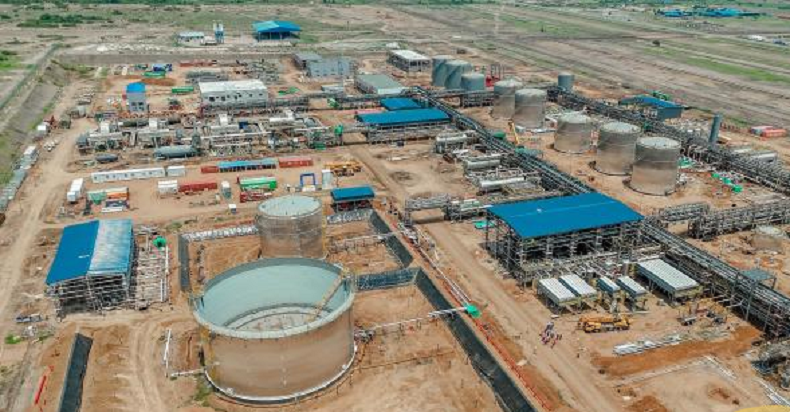
Central Processing Facility at Kingfisher project. Courtesy Photo
Central Processing Facility at Kingfisher project. Courtesy Photo
The oil and gas project developers under the Kingfisher and Tilenga projects in the Albertine Graben are working around the clock to deliver first oil by July 2026. However, a key component -the oil refinery- won’t be ready when crude oil begins to flow.
This means that Ugandans will have to wait a bit longer to have petrol and diesel products from Uganda’s crude powering their cars and other machines.
They will further have to be patient and wait for the refinery before they can realise other products for petrol chemicals out of the refinery.
Frank Mugisha, the acting Commissioner Petroleum Upstream Department old Uganda Radio Network in an interview that the refinery may not come immediately after first oil because more time needed to construct a refinery.
Before the Project Framework Agreement between Albertine Graben Energy Consortium (AGEC) and the Government expired, the construction of 60,000-barrel-per-day refinery was expected to be concluded in 2027.
That timeline was based on the anticipation that the American-led consortium would have commenced the construction in 2023. It now appears unlikely that the new developer may be able to have the project by 2028 even if its engineers set the boots on ground in the next three years.
However, Mugisha in an interview seemed to be confident that UAE-based new developer will deliver within the anticipated period. “Rest assured that the refinery is a coming,” he said. “And this time, we are not talking of moving targets. When it comes to first oil, it is a fixed target. When it comes to the refinery, it is a fixed target.”
Some industrial experts have previously told Uganda Radio Network the construction of the refinery similar to the one Uganda is planning to put in place can take at most four years to complete.
Uganda National Oil Company is yet to award contracts for Front-End Engineering Designs (FEED) for the refinery.
UNOC, which carries the government’s commercial interest in the sector also plans to establish Kabale Refinery Company Limited, which should oversee the implementation of the refinery.
In 2019, the final refinery configuration study was completed and approved by the government. The study was to determine the final refinery as a Residue Fluid Catalytic Cracker (RFCC) type of refinery.
In 2021, the Front-End Engineering Design (FEED) for the refinery was concluded and later approved by Cabinet. The FEED was also approved by the Petroleum Authority of Uganda (PAU), the sector regulator. Now, it appears like those developments were set aside.
The construction of 211 km long multi-products pipeline that will evacuate refined products from the refinery to a storage terminal at Namwabula in Mpigi District has not started. All these gaps point to the anticipation that the refinery project might come in much later than anticipated.
If the refinery comes much later after oil production has taken off, all the crude oil that will be produced will be exported through the East African Crude Oil Pipeline (EACOP). It has been planned that part of the crude from CNOOC’s Kingfisher and TotalEnergies Tilenga project would be shared with some reserved as a feedstock for the refinery.
At the end of March this year, a Refinery Implementation Agreement was entered between the government of Uganda and UAE-based Alpha MBM Investments LLC to construct a 60,000-barrel refinery in Hoima. The project will be developed under a public-private partnership arrangement.
In August, President Museveni wrote on his official X page saying that an Oil refinery implementation agreement with Alpha MBM Investments LLC. Alpha MBM Investments LLC which is to fund 60% of the project was yet to make a Final Investment Decision (FID).
UNOC indicates that at least three commercial agreements are expected to be signed under the refinery project before the Final Investment Decision (FID).
“These are the Host Government Agreement, Crude Supplier’s Agreement, and the Shareholders’ Agreement. However, there will also be an Off-takers Agreement which can be concluded later,” reads the UNOC statement.
The Host Government Agreement, like that of the crude oil pipeline, will be signed between the government and the refinery company, set to be created.
The agreement lays out commitments and obligations of each part such as security and land ownership for the Government of Uganda side, and the issues related to National Content and Health Safety and Environment (HSE) by the refinery company.
According to a study by Natural Resource Governance Institute (NRGI), Uganda’s planned oil refinery will have several benefits for the country, including for its security of fuel supply and balance of payments.
-URN