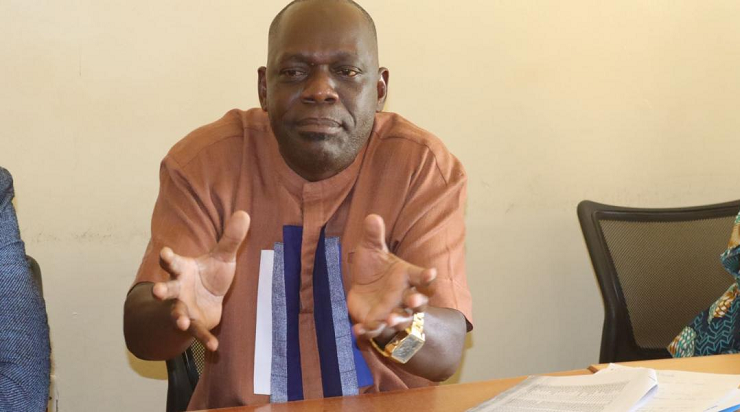
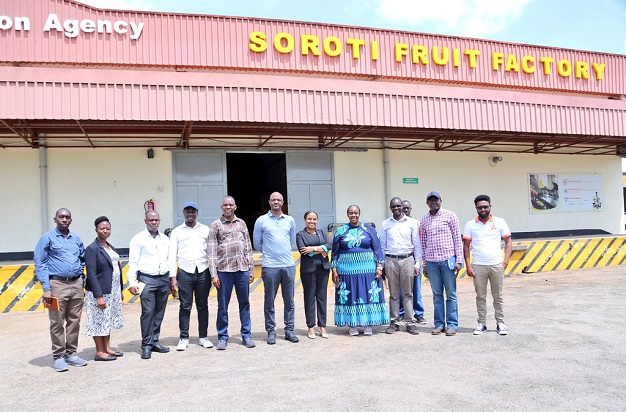
Ramathan Ggoobi and team during the visit to Soroti Fruit Factory
The Secretary to Treasury, Ramathan Ggoobi has revealed plans to expand and modernise Soroti Fruit Factory in partnership with a management firm from Ethiopia.
The deal to revamp the factory is likely to cost US$30Million (UGX 107.211Bn) despite the initial UGX100Bn investment failing save the factory from collapse.
Ggoobi made the revelation over the weekend during an oversight visit at Soroti Fruit Factory to assess the performance of the factory following the directive by President Museveni, where he indicated that the revamp will take two years before the factory becomes operational again.

“The Soroti Factory has been trying to change the destiny of this region in terms of processing and adding value, but there are a number of challenges which has been facing it in the past, which government has been addressing one by one and improving. And now recently we got a very good management firm, a partner from Ethiopia to help us and manage more effectively this factory so that we can transform it and become a more successful entity,” said Ggoobi.
Launched in April 2019 and started commercial operations in October 2019 after Uganda National Bureau of Standards (UNBS) issued the factory certification, Soroti Fruit Factory was established following a Memorandum of Understanding in August 2012 with the Korea International Cooperation Agency (KOICA) in which the South Korean Government invested US$8m (UGX29.977Bn) and these funds were mainly used for plant construction, equipment purchase, and associated costs including importation, transportation and staff training, while between FY 2010 to February 2022 when the probe was undertaken by Parliament, Government had spent UGX70.73Bn, thus bringing total investment to UGX100.713Bn by February 2022.
Information from Ministry of Finance indicates that the planned expansion would cost over US$30Million and the planned new factory will have advanced technology with an automatic bottling and packaging line, multi-fruit processing units and organic fertilizer and animal feeds production.
Ggoobi noted, “The new management team has been able to get on the ground and understand the farmers’ issues and how these issues can be addressed and we are addressing that farmers are being supported to ensure that instead of coming here to bring their oranges, their mangoes and then they reach here and they are rejected, now the new model is the factory management to go to the farmers and pick these fruits from them but also train the farmers on the post-harvest management. As a result of that we have learnt that the rejection rate has reduced from 80% to just less than 1% and that is a tremendous achievement.”
While addressing journalists after the oversight visit, the Secretary to Treasury said that upon completion, the factory which is able to crush 10 tonnes of oranges, mangoes and all other fruits per hour when it is transformed and he expressed hope that the new extended facility will be able to perform much better and is going to be able to make the people of this region proud and its products will be sold both locally but also in foreign nations.
“The factory will be able not only to target the market here but to export so that all the fruits in this region now which farmers have been saying are not taken up by the factory can be fully demanded, can be fully brought here for processing and exported. So, we are here to assess that requirement and we are going to invest in that as government will demand that, expand this factory but also make it more efficient. So, we are happy for the baby steps we have taken but now we are working on how do we transform, we are going to expand it on the land which is here by building an extension which is almost equivalent to even bigger and better technologies than the ones we are seeing,” said Ggoobi.
The development comes at the time in October 2023, when MPs from Soroti sub-region protested the plans by Government to relinquish its interest in Soroti Fruit Factory on the that the factory was making losses describing the reasons as baseless, and instead accused Government of failing to provide requisite funds for the smooth flow of operations at the factory.