
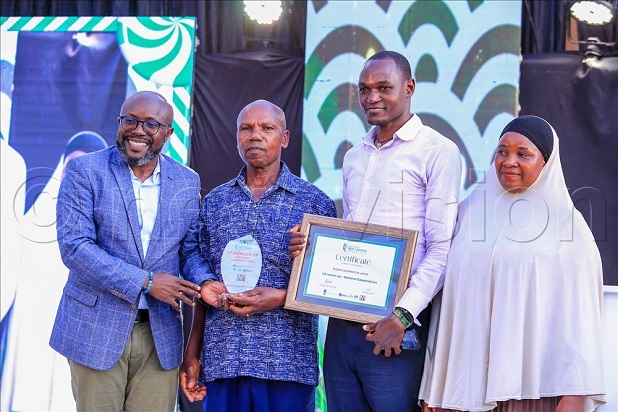
Godfrey Bwaya (2nd left) being receiving his award at the Best Farmers Awards 2024.
Godfrey Bwaya (2nd left) receiving his award at the Best Farmers Awards 2024.
Elgon Cooperative Union (ECU), based in Bududa District, recently received the Special Category Award at the 2024 dfcu Bank & Vision Group Best Farmers Awards. The recognition highlighted the Union’s outstanding contributions to coffee production and community development in the region.
With 15 primary societies spread across 12 sub-counties in Bududa, ECU supports more than 1,600 smallholder coffee farmers, strengthening household incomes and driving sustainable agricultural growth.
Among the awardees was Godfrey Bwaya, founder of Elgon Cooperative Union, who joined a select group of winners on a dfcu Bank–sponsored study tour to the Netherlands. The trip exposed participants to advanced farming techniques and modern agribusiness models. In an interview with Business Focus, Bwaya described how this experience has catalyzed major changes within the Union—improving operations, boosting productivity, and inspiring the broader farming community in Bududa.
Below are highlights from the conversation:
Q: Who is Godfrey Bwaya?
A: I am a farmer from Bududa, a district with a rich history of coffee growing. I inherited part of my farm from my father and have expanded it to 13 acres of coffee. As founder of Elgon Cooperative Union, I now oversee operations that support 1,650 member farmers. My focus is on collective progress—helping smallholder farmers access improved practices, reliable markets, and appropriate financing.
Q: What inspired the establishment of Elgon Cooperative Union?
A: We saw an opportunity created by growing demand for coffee, but also a challenge. The mother cooperative—Bugisu Cooperative Union—was delaying payments to farmers after collecting their produce. Farmers have immediate needs, and such delays discouraged production. This gap created space for Elgon Cooperative Union, which prioritizes fairness, timely payments, and farmer empowerment.
Q: Managing over 1,600 farmers is no small task. How does your model ensure efficiency?
A: We procure coffee from individual farmers and from our 15 primary societies. This structure allows us to coordinate training, production, and marketing effectively. It enables personalized support while allowing us to scale. Through collective marketing and organized input distribution, the entire membership benefits. Our team of eight includes a manager, accountant, extension worker, storekeeper, internal controller, and security personnel.
Q: You’ve ventured into value addition. What products do you produce and where do you sell them?
A: We produce processed coffee—including green beans, roasted beans, and ground coffee—under the Bugisu Highland Coffee brand. Our products, known for their high quality, are sold in local restaurants, shops, and companies in Mbale. We supply established players like Kyagalanyi and work with Endiro Coffee, which exports Ugandan coffee to the U.S. We also supply one café in South Africa. Although we do not yet have our own export license, we are fully equipped for international markets and preparing for future direct exports.
Q: How does Elgon Cooperative Union support farmers with financing and inputs?
A: We operate with clear governance structures. Every year, five delegates from each primary society attend our Annual General Assembly (AGA) to discuss challenges, production plans, and training needs. We also provide agro-inputs on credit, with repayments deducted upon delivery of coffee harvests. This system has strengthened trust, increased productivity, and encouraged membership growth.
Q: Your cooperative won the ‘Special Category’ award in 2024. How did you learn about this competition, and what drove your success?
A: I first heard about the Best Farmers Competition in 2014 when I was growing passion fruit. I narrowly missed the cut that year—ranking 16th out of 15 selected farmers. I tried again in 2019 but didn’t succeed. I kept improving. In 2024, on my third attempt, we were ranked third overall. The judges recognized our strong governance, training programs, and commitment to helping farmers adopt good agronomic practices.
Q: What key lessons did you take from the study tour in the Netherlands—and how have you applied them?
A: I thank dfcu Bank for sponsoring the trip. It was transformational. We visited farms and agribusiness companies that demonstrated high-level organization and modern practices. When we returned, we immediately fenced our cooperative land—something we saw commonly in the Netherlands for asset protection and orderliness. We also installed a solar dryer to improve post-harvest handling. These improvements have boosted efficiency, productivity, and community confidence. People now see that progress is driven by knowledge, not just capital.
Q: What message would you like to share with policymakers and financial institutions?
A: In Europe, governments provide affordable loans to farmers, enabling them to produce efficiently. The growth of the farms and companies we visited is largely due to this support. Uganda can achieve similar progress. Banks like dfcu play a critical role, but their impact would be even greater with complementary government policies. If our farmers accessed affordable credit, our productivity would multiply. Policymakers must prioritize practical support for agriculture—clear programs, affordable financing, and systems that ensure farmers receive timely services.