
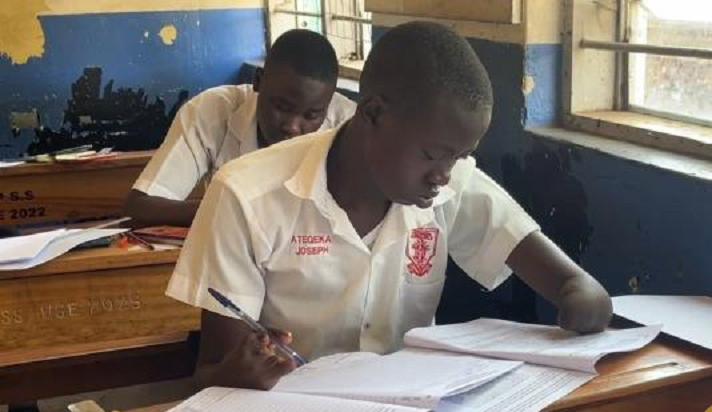
Joseph Ategeka writing his UCE exams.
Joseph Ategeka writing his UCE exams.
Inside the examination room at Mpanga Secondary School in Fort Portal City, the atmosphere is tense as Senior Four students scribble their answers in the ongoing Uganda Certificate of Education (UCE) examinations.
Among the 570 candidates is 18-year-old Joseph Ategeka, whose quiet determination tells a story of courage, hope, and resilience.
Ategeka lives with a congenital hand condition scientifically known as Symbrachydactyly. People with symbrachydactyly are born with fingers, a full hand, or an arm that didn’t develop normally.
His left hand is shorter than normal, and his right arm with only one finger—his presence in the exam room is more than passing exams; it is a testament to endurance, faith, and an unbreakable spirit.
Born on June 29, 2007, in a humble family in Mugusu Town Council, Kabarole District, Ategeka is the firstborn of five and the only one with a disability.
His parents, instead of treating him as fragile or helpless, chose to raise him like any other child, which became the foundation of the strong, confident young man he is today.
“When I was young, I used to ask my mother why I was different from other children,” Ategeka recalls. “She always told me that’s how I was born and that I was special in my own way,” he says.
At home, Ategeka was encouraged to live fully. Being a firstborn, his mother encouraged him to participate in all activities in the household. He said that he learnt how to dig, wash clothes and utensils, sweep, take care of his siblings, and other basic house chores.
He says that this helped him grow in confidence and motivation, that he could do anything like other children of his age.
After completing his primary education at Mugusu Primary School, Ategeka joined Mpanga Secondary School, a decision that opened new doors and friendships. Unlike what many might expect, his disability never made him an outcast.
“When I joined secondary school, I was never shy or scared that students would stare at me,” he says. “I received a very warm welcome. My classmates were supportive, and the teachers encouraged me,” Ategeka noted.
He quickly settled in, balancing academics with an active social life. His confidence inspired many students, some of whom admit that they draw motivation from his determination.
In primary school, Ategeka was on the school football team, but when he joined secondary school, he found passion in another sport- table tennis.
He says that he was attracted to the sport by the way it is played because it needs focus and concentration.
He says that it wasn’t easy at first in the sport.
However, he was determined to practice more.
His dedication paid off when he earned a place on the school team. Earlier this year, he and other team members represented Mpanga Secondary School at the National Secondary Schools Sports Competitions, where he delivered the school’s only win in the tournament.
Kennedy Ronnie Ayesiga, his friend and classmate, describes him as a hardworking, friendly, and proud fellow who doesn’t let his condition stop him from doing anything.
Yunus Kakembo, his teammate, describes him as “a great teammate who plays with heart and always lifts the team’s spirit.”
Aman Mugenyi, his other friend and teammate, praises Ategeka’s discipline, humility and calls him the pillar of the school’s table tennis team.
In class, Ategeka is equally focused. His favorite subjects are Mathematics and Geography, and he dreams of becoming a businessman in the future.
During the exams, the Uganda National Examinations Board (UNEB) allows him an extra 45 minutes to complete each paper, considering his condition. But Ategeka rarely uses them. He says that he writes fast and often finishes before others.
“I was also given an assistant to help me in the exams, but I will need his help only in the practical papers. For the other exams, I can write by myself without any assistance because I trained myself to cope like other students,” he adds.
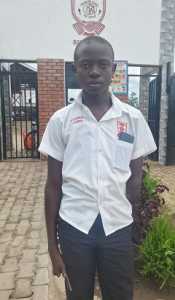
Joel Ambrose Ewalu, who doubles as Ategeka’s Class teacher and Sports patron, says that he is humble, disciplined, and interacts well with everyone.
He adds that Ategeka is one of the most admirable students the school has.
“Joseph’s love for sports doesn’t stop at table tennis. He also enjoys watching rugby and has recently taken an interest in draft and chess. He’s a true sportsman,” says Ewalu.
Charles Drake Rubongoya, the Headteacher of Mpanga Secondary School, praises Ategeka as a friendly, disciplined, and focused student who mixes freely with other students.
He adds that his uniqueness doesn’t limit him in any way but rather encourages him to explore the best in him.
The headteacher uses Ategeka’s determination in encouraging parents who have children with physical challenges not to hide them but rather expose them to the world, support them, and take them to school.
Ategeka urges parents of children with disabilities to embrace them, educate them, and believe in their potential.
To other children with disabilities, he advises them not to give up or underestimate themselves, and that they can achieve anything if they have the courage.
Although Ategeka grew up as a resilient person who has taught himself to overlook his uniqueness, he says that there are some challenges he has encountered.
Some of these challenges include social stigma, especially when he is in a new environment, people over stare at him, limited resources for people with disabilities at school and in the community, among others.
According to the World Health Organization, between 93 million and 150 million children live with a disability worldwide.
The United Nations Sustainable Development Goals include those with disabilities with targets to be reached by 2030, such as equal access to education and vocational training, building or upgrading education facilities to make them inclusive learning environments, and Safe, accessible transport systems for all.
-URN