
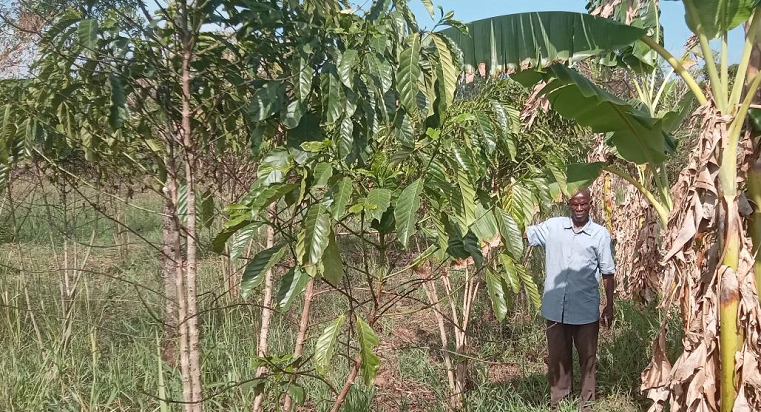
A coffee grower in Parak inspecting his coffee garden. Photo by Daniel Ojara
A coffee grower in Parak inspecting his coffee garden. Photo by Daniel Ojara
As the Ministry of Agriculture, Animal Industry, and Fisheries continues to promote coffee growing in Northern Uganda, many farmers in the region say they are struggling to maintain their plantations due to limited technical knowledge and harsh weather conditions.
Coffee farming has been introduced in several districts in the Acholi sub-region as part of efforts to diversify agriculture and improve household incomes. While some farmers are beginning to see progress, many others say they are facing serious challenges that are affecting productivity.
A visit by our reporter to coffee farmers in Omoro District found that several growers who planted coffee between five and nine years ago are still struggling to get meaningful harvests.
Caesar Oyaro, a coffee farmer from Tegot Parish in Akidi Sub-county, planted Robusta coffee on three acres of land in 2018 but says he has never achieved the harvest he expected.
“I planted Robusta coffee in 2018 on three acres of land, but since then, my coffee has not yielded the qualityand quantity I expected,” Oyaro said. He says his plantation is being attacked by flies, ants, and scale insects that spread diseases and dry the branches. “My coffee normally flowers between December and January during the dry season. That period attracts many insects that destroy the flowers and prevent good yields,” he explained.
Oyaro says he has avoided using pesticides because he lacks guidance on the recommended products. “As local farmers in rural areas, we don’t know the right pesticides to use. I fear using the wrong chemicals that might destroy the entire plantation,” he added.
Peter Komakech, another coffee farmer from Parak Parish in Omoro District, says prolonged dry spells are also affecting coffee production. Komakech planted about 1,500 coffee trees in 2019, but says maintaining the plantation during dry seasons has been difficult. “Most of the coffee plantations in this area get damaged during the dry season because of too much sunshine and the absence of irrigation systems,” he said.
According to Komakech, the shade trees planted alongside coffee lose their leaves during dry periods, leaving the coffee plants exposed to intense heat.
“When the trees lose their leaves, and the coffee is flowering, the flowers drop, and the yield becomes very low,” he said.
Komakech says his first harvest in 2023 produced only half a bag of coffee worth about Shs356,000. In the second harvest last year, he got one bag, which earned him about Shs572,000—far below his expectations.
Ivan Otika, a farmer from Bobi Sub-county in Omoro District, planted one acre of coffee in 2023 but says he is already facing similar difficulties. “At first, I was excited and expected to earn good money in the future, but maintaining coffee is difficult because of pests, stray animals, and intense sunshine,” he said.
Otika says he noticed insects attacking the roots and leaves of his coffee plants during the dry season, causing some plants to dry up despite his efforts to water them regularly.
Ivan Oweka, the Agricultural Officer for Omoro District, says the biggest challenge affecting coffee production is that farmers rarely consult agricultural extension workers.
“We have staff at the sub-county level who can provide technical advice on coffee farming, but many farmers do not contact them,” Oweka said. According to him, coffee growing was officially introduced in Omoro District about ten years ago, but farmers have not fully embraced technical support services.
“Coffee requires proper pest and disease control and the use of fertilizers to improve yields.
Farmers should consult extension workers for guidance,” he added.
Brenda Acan, a coffee extension worker overseeing the Acholi and Lango sub-regions, says farmers should avoid buying pesticides from unverified agro-input shops.
“There are recommended pesticides for controlling coffee pests and diseases, but farmers should obtain this information from extension workers or district production departments,” she said.
She explained that farmers can also adopt biological pest control methods such as using natural predators, applying organic manure, and botanical extracts like neem oil. For disease control, she says fungicides such as copper-based products and Mancozeb can help manage diseases like coffee leaf rust. Acan adds that many farmers are shifting to Integrated Pest Management approaches that combine biological control, improved agronomic practices, and resistant coffee varieties.
Coffee farming is gradually expanding in Northern Uganda with support from government initiatives such as Operation Wealth Creation and the Agriculture Cluster Development Project. Districts including Gulu District, Omoro District, and Amuru District are emerging coffee-producing areas, while Nwoya District has shown significant growth. In Omoro District alone, statistics indicate that about 1,471 coffee farmers produced 452 metric tonnes of coffee in 2023. Government programmes have also distributed thousands of coffee seedlings across the region.
For instance, Bobi Sub-county received about 40,000 seedlings planted on 40 acres, while Lalogi Sub-county received 20,000 Robusta seedlings through Operation Wealth Creation and the Ministry of Agriculture. Coffee remains Uganda’s leading export crop and a major source of foreign exchange. The country has over 1.7 million coffee farmers and millions more people engaged in coffee processing and trade.
According to government statistics, Uganda exported about 8.7 million bags of coffee during the 2024/2025 financial year, earning approximately $2.4 billion. For the 2025/2026 season, production is projected to increase to about 558,000 tonnes (9.3 million 60-kilogram bags). Ugandan coffee is exported to more than 30 countries, including Italy, Belgium, Germany, India, Sudan, Algeria, Morocco, China, and the United States, with Europe accounting for the largest share of exports.
-URN