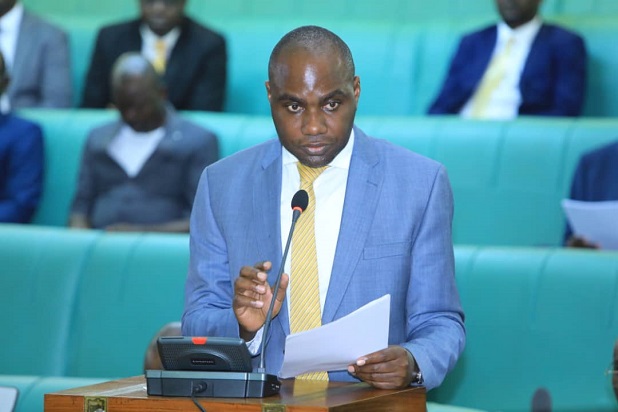
Henry Musasizi, the Minister of State for Finance in charge of General Duties
Parliament has summoned lawmakers for a special sitting next Tuesday, 16 December 2025, to consider a borrowing request by the Ministry of Finance to borrow over 2.17 trillion shillings (USD 610 million).
In a letter, the Clerk to Parliament, Adolf Mwesige Kasija, notified Members of Parliament that plenary will resume at 2:00 PM to receive the National Budget Framework Paper for FY 2026/2027 – FY 2030/2031. “This is therefore to inform you that plenary will resume on Tuesday, 16 December 2025 at 2:00 PM to receive the National Budget Framework Paper… pursuant to Section 9(5) of the Public Finance Management Act,” the letter reads.
According to the Order Paper, the session will begin with the presentation of the Tax Expenditure Report for July–September 2025, followed by a request for a waiver of tax arrears for NewPlan Limited. Thereafter, the Minister of Finance is expected to table three major motions seeking parliamentary approval.

The first motion seeks authorization to pre-finance the design and construction of the Kayunga–Bbaale–Galiraya Road, an 87-kilometre stretch earmarked for upgrading from gravel to paved standard.
The second motion requests approval to borrow USD 162 million (approximately UGX 579.2 billion) from the Korea Export-Import Bank to finance the Makerere University Improvement Project, which aims to enhance infrastructure and academic facilities.
The third motion seeks Parliament’s consent for the government to borrow EUR 385 million (about USD 448 million or UGX 1.595 trillion) from Rand Merchant Bank (RMB) and other financial institutions to support Uganda’s broader infrastructure and development budget for the FY 2025/26. Collectively, the proposed borrowing amounts to USD 610 million (UGX 2.172 trillion).
The sitting will also consider the Energy Efficiency and Conservation Bill, 2024, which the Minister of Energy and Mineral Development will present for second and third readings.
This latest borrowing request follows Parliament’s recent approval of UGX 8.1 trillion in supplementary expenditure for FY 2025/26, following a heated debate earlier this month.
Opposition MPs cautioned against what they described as runaway fiscal indiscipline and an increasing reliance on borrowing to finance government operations.
“These Supplementaries 1, 2 and 3 have revised the 2025/26 annual budget to UGX 78 trillion. Financing these supplementary requests through borrowing will automatically raise public debt. We were already borrowing UGX 32 trillion to finance the approved budget. Now the government is returning to commercial banks for more borrowing for all sorts of things,” said Kira Municipality MP and Shadow Finance Minister Ibrahim Ssemujju Nganda.
Meanwhile, Asuman Basalirwa, the Bugiri Municipality MP and president of the Justice Forum (JEEMA), expressed concern that while Parliament and its committees continue to approve loans critical for national development, the government has been slow to conclude binding loan agreements.
He warned that such delays could result in the country missing out on funding or even facing cancellations of approved financing. Basalirwa cited a USD 20 million loan from the Arab Bank for Economic Development in Africa, approved on 10 September 2025, noting that the government had committed an additional USD 3 million to cover supplementary works. He emphasized that the timely execution of loan agreements is essential to fully utilize approved funds.
Henry Musasizi, the Minister of State for Finance in charge of General Duties, referenced Section 24 of the Public Finance Management Act, which limits supplementary expenditure to 3% of the approved national budget, unless Parliament authorizes otherwise.
Rule 153(2) of Parliament’s Rules of Procedure, supplementary funding requests must clearly indicate their financing sources.
Patrick Isiagi, Chairperson of the Budget Committee, confirmed that this requirement was met during the presentation. However, the Auditor General’s 2023 report raised concerns that supplementary budgets have “become wasteful and undermine planning,” noting that they are often submitted without adequate consultation with programme secretariats.
As of June 2025, Uganda’s total public debt stood at UGX 116.2 trillion (USD 32.3 billion), representing a 26.2% increase from the previous year. Domestic debt accounted for UGX 60.3 trillion, while external debt totaled UGX 55.9 trillion, resulting in a debt-to-GDP ratio of 51.3%.
Analysts warn that rising borrowing, coupled with underutilized supplementary allocations, is shrinking fiscal space for development, increasing debt servicing costs, and heightening long-term sustainability risks.
“Frequent supplementary budgets and escalating debt could undermine fiscal discipline, governance, and public trust. Mismanaged borrowing risks diverting resources away from development priorities,” an economist familiar with Uganda’s budget process told this website.
-URN