

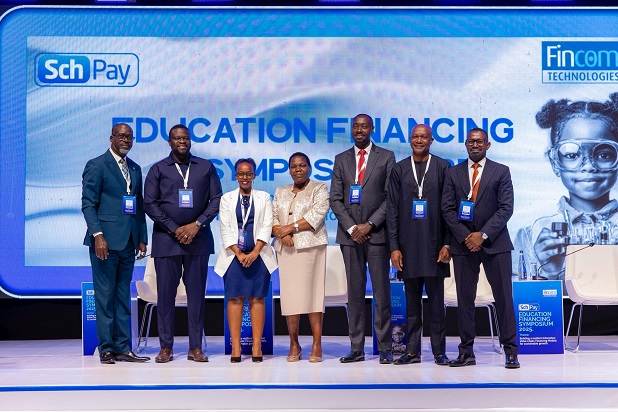
Participants at the SchoolPay Education Financing Symposium in a group photo with Muzora Atuhairwe (Centre), Commissioner at the Ministry of Education and Charity Mutagamba (3rd Left), the CEO at Fincom
Bankers and innovators are calling for collaboration in solving Africa’s education challenges and putting in place sustainable education systems that leave no child behind.
This discussion arose during this year’s SchoolPay Education Financing Symposium themed “Building a Resilient Education Value Chain: Financing Models for Sustainable Growth,” held at Serena Hotel in Kampala on Wednesday.
The symposium attracted government officials, financial institutions, telecom operators, and education innovators. Discussions focused on digital transformation and financing models that keep schools sustainable
Education experts warn that Africa risks falling further behind in education unless urgent steps are taken to close persistent funding gaps despite governments allocating significant budgetary resources to education.
Speaking at the symposium, Tineyi Mawocha, Chief Program Officer and Africa Regional Director at Opportunity International, highlighted the magnitude of the crisis.
“Africa has 61 million children excluded from classrooms, out of the 263 million globally. Even among those enrolled, millions are not acquiring basic literacy and numeracy,” he said.
Citing World Bank data, he added: “About 70% of children in low- and middle-income countries completing primary school cannot read well enough to understand a simple story.”
Although African governments allocate up to 20% of their budgets to education, Mawocha noted that limited fiscal space and weak revenues widen the gap.
While the global education finance market is valued at $36.4 billion, Africa accounts for only $5.4 billion.
Opportunity International alone has invested over $1 billion into education through 208 financial institutions across 32 countries, reaching 19 million children.
In Uganda, products like school improvement and fee loans have enabled parents to keep children in class. “Eighty-five percent of parents who accessed loans returned their children to school,” Mawocha emphasized.
He also pointed to the growing role of digital platforms. Tools like Furaha, developed with Standard Chartered Ventures and telecom partners, link to 25 million mobile wallets and support fee payments for six million children in 14,000 schools across Uganda.
“Africa stands at a crossroads with the youngest and fastest-growing population. Our choices today will shape the continent’s future. Let us invest in resilient, inclusive, and sustainable education systems that leave no child behind,” Mawocha urged.
Financing Innovation for Resilient Schools
Milly Kyolaba, Head of Banking and Strategic Partnerships at Stanbic Bank, said the bank has designed solutions to stabilize school operations during cash flow disruptions.
“We have developed products specifically for schools to support cyclic cash flow. This ensures continuity even during financial crises,” she explained.
Muganga Osbert, Head of New Markets at ServiceCops, emphasized technology’s transformative role. “We’ve expanded across Africa to create digital innovations that connect schools, empower parents, and transform education,” he said.
From Centenary Bank, Rashid Musisi Ssemmanda, Chief Manager of Corporate & Institutional Banking, cautioned against reliance on cash. “Carrying cash is risky for schools. Digital solutions create a transparent footprint that allows financial institutions to design tailored products. We must popularize these innovations and not revert to analog,” he noted.
Peninah Namubiru, Head of Enterprise and SMEs at Airtel Uganda, praised the adoption of mobile money. “Together with Fincom, we’ve seen schools embrace digital innovation. Parents no longer queue endlessly. SchoolPay via Airtel Money has made fees payment convenient and widely accepted,” she said.
Government and Private Sector Perspectives
Muzora Atuhairwe, Commissioner at the Ministry of Education, lauded digital platforms for easing stress on families.
“Previously, children carrying cash faced theft risks. Digital payments not only improve safety but also enhance access to quality education while reducing stress for both parents and learners,” she said.
She explained that flexible saving through these platforms allows families to manage fees gradually. “Parents can avoid lump-sum payments at term start by saving steadily, which reduces financial strain,” she added.
Atuhairwe also linked digital payments to accountability and mental health. “This solution eases the burden on families and schools while strengthening savings, loans, and transparency in managing education funds,” she emphasized.
Charity Mutagamba, CEO of Fincom Technologies, said her company’s mission goes beyond digital fee collection.
“We are not limited to facilitating school fees payments. Our focus is on building sustainable financing models that strengthen a resilient education value chain,” she explained.
She highlighted the importance of timely payments.
“When parents pay on time, schools operate at optimum levels and focus on delivering quality education,” she said.
Mutagamba added that Fincom is collaborating with financial institutions to extend solutions to even the most remote schools.
“We are developing models that allow banks to finance schools, ensuring that even those at the last mile can access funding to improve infrastructure while prioritizing education quality,” she concluded.