

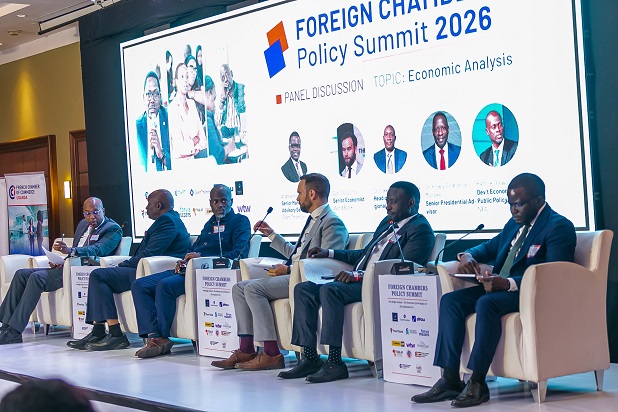
Panelists during the Foreign Chambers Policy Summit held at Sheraton Kampala Hotel on Thursday
dfcu Bank has called on government, private sector players, development partners and foreign investors to strengthen collaboration and move beyond policy discussions into concrete implementation to accelerate Uganda’s economic transformation.
The appeal was made during the Foreign Chambers Policy Summit held at Sheraton Kampala Hotel on Thursday (June 18), a high-level policy dialogue that brought together government leaders, diplomats, foreign chambers of commerce, development partners and business executives to deliberate on Uganda’s investment climate, trade competitiveness and growth prospects.
The one-day summit, supported by dfcu Bank and other partners, focused on aligning policy reforms with practical action to unlock investment, deepen regional trade integration, support private sector development and drive sustainable economic growth.
Speakers repeatedly emphasized that Uganda’s ambitions will depend not only on strong policy frameworks but also on execution, coordination and accountability across all sectors.
Speaking at the summit, Kate K. Kiiza, Executive Director & Chief Corporate and Institutional Banking Officer at dfcu Bank, said Uganda’s economic transformation will only be realized if stakeholders work together in a coordinated and deliberate manner. She stressed that discussions must translate into action if the country is to achieve its long-term development targets.
She warned that Uganda’s economic vision risks remaining unrealized without stronger implementation, noting that progress requires consistent effort from government, financial institutions, development partners and the private sector working in partnership.
Kiiza also reflected on dfcu Bank’s long-standing contribution to Uganda’s economy, tracing its origins to 1964 when it was established as the Development Finance Company of Uganda to support business growth through long-term financing. Over the decades, the institution evolved into a commercial bank offering services across agriculture, trade, manufacturing, infrastructure and energy.
She noted that dfcu Bank has supported numerous enterprises through financing equipment, investments and expansion projects, and continues to play a key role in enabling business growth across the country. She further highlighted the bank’s 2004 listing on the Uganda Securities Exchange, which opened ownership to Ugandans and strengthened its national footprint.
Agriculture and inclusion focus
Kiiza emphasized agriculture as a central driver of Uganda’s economy, noting that dfcu Bank, through its foundation, supports smallholder farmers by helping them transition from informal structures into organized financial groups such as Village Savings and Loan Associations.
She said improving access to finance for rural communities remains essential in shifting agriculture from subsistence to commercial production, which is key to national development.
She also underscored the importance of women’s economic empowerment, stating that supporting women-led enterprises has a multiplier effect on families and communities. According to her, dfcu Bank continues to promote inclusive growth through tailored financial solutions for SMEs, investment clubs and sector-specific financing.
Budget risks highlighted
The summit also featured insights from Andrew Kintu, Manager Transaction Advisory Services at Grant Thornton, who provided an analysis of Uganda’s Ugx84.4tn budget for FY2026/2027 environment.
He said the budget is being implemented within a complex context shaped by preparations for AFCON 2027, expectations of first oil production, rising public debt, health risks such as Ebola and global geopolitical tensions.
Kintu noted that while Uganda’s economy is growing, it remains exposed to significant risks, making timely execution of government programs critical. He urged stakeholders to prioritize implementation, warning that delays could undermine expected outcomes.
He advised businesses to prepare for stricter tax enforcement, reassess costs and strengthen their investment readiness, stating that firms must position themselves as financially credible and competitive in order to thrive.
Oil sector priorities
Further input came from Isaac Shinyekwa, Head of Trade and Regional Integration at the Economic Policy Research Centre, who focused on Uganda’s oil and gas sector. He emphasized the need for stronger local content participation and investment in human capital to ensure Ugandans benefit from emerging opportunities.
He also called for improved tax compliance from the private sector and stronger government accountability, including efforts to reduce corruption and ensure that public investments are effectively implemented.
Discussions at the summit also touched on broader economic priorities including expanding the tax base, formalizing informal businesses, strengthening agricultural organization, promoting tourism, enhancing value addition and deepening public-private partnerships.
Participants also highlighted governance and investment concerns, including debates around the Protection of Sovereignty Bill, 2026, and its implications for Uganda’s investment climate and civic space.
Speakers agreed that Uganda’s economic future will depend on stronger coordination between policy, investment and execution. While opportunities exist across agriculture, oil and gas, infrastructure and regional trade, they noted that success will require sustained collaboration and accountability from all stakeholders.
Kiiza reiterated that Uganda’s transformation journey depends on collective effort, stressing that meaningful progress will only be achieved when stakeholders work together with a shared commitment to delivery and results.