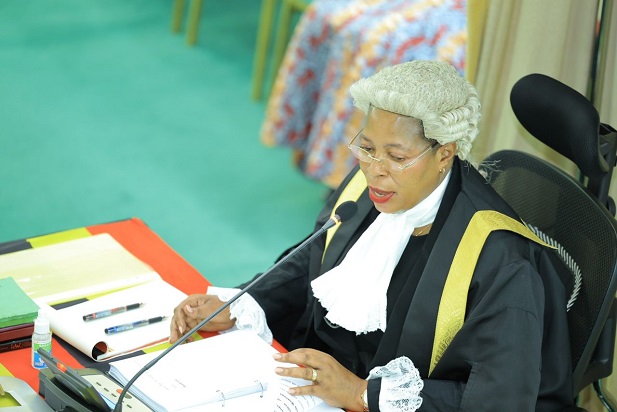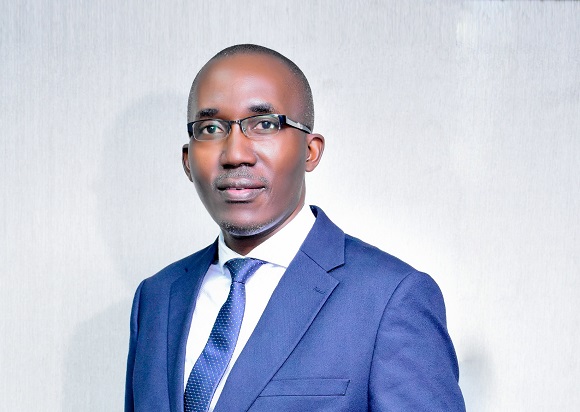

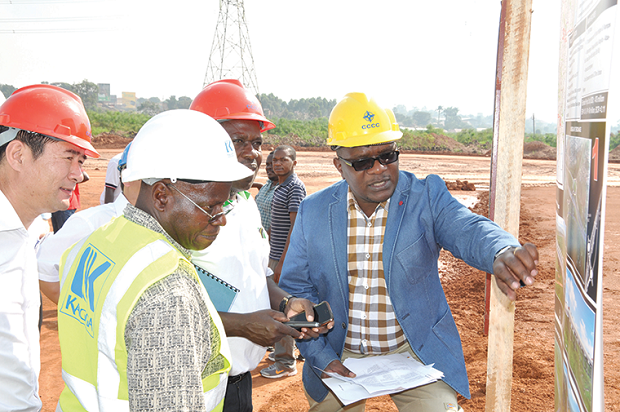
Eng. David Ssali Luyimbazi (right) has contributed significantly to Uganda’s key infrastructural projects
Eng. David Ssali Luyimbazi (right) has contributed significantly to Uganda’s key infrastructural projects
He has never sought a headline. For thirty years, Eng. David Ssali Luyimbazi has worked where the real business of national development happens: in the planning directorates, the procurement committees, the donor negotiating rooms, and the parliamentary accountability chambers. He built the systems that built Uganda’s roads. He helped in the digitalisation of the capital city’s finances. He answered to Parliament for every shilling entrusted to the nation’s largest road and urban authority. And now, quietly but unmistakably, his name is circulating in the corridors where senior public service appointments are decided.
Sources across government, the development partner community, and the private infrastructure sector describe Luyimbazi as being tipped for one or two of the most consequential — and most challenged — postings in Uganda’s public service: Permanent Secretary of the Ministry of Works and Transport, or Permanent Secretary of the Ministry of Water and Environment. Either appointment, insiders suggest, would signal a serious presidential intent to break the bureaucratic inertia that has slowed both sectors despite sustained Government and donor financing with the public demanding for results that are not forthcoming.
The case for Luyimbazi does not rest on rumour or political connection. It rests on a verifiable, three-decade record of institutional achievement that is, by any measure, extraordinary.
| 30+
Years’ Experience |
US$2B+
Infrastructure Funds Directed |
20,000km
Road Network Managed |
US$1B+
Donor Finance Negotiated |
4M+
Daily Beneficiaries |
A CV That Reads Like a National Infrastructure Manifesto
The headline facts are striking. Luyimbazi holds three postgraduate degrees: a Bachelor of Science in Civil Engineering from Makerere University (1995); a Master of Science in Highway Management and Engineering with Distinction from the University of Birmingham (2000); and — most unusually for a Ugandan public servant — a Master of Science in Major Programme Management from the University of Oxford (2017). He is a Registered Engineer with the Engineers Registration Board of Uganda and a Member of the Uganda Institution of Professional Engineers.
He has been formally trained in public-private partnership structuring at the Institute of Public-Private Partnerships in Washington D.C. (three separate courses), at Crown Agents in the United Kingdom (two courses), and at the École Nationale des Ponts et Chaussées in Paris. He has studied transport investment appraisal at the University of Leeds, road asset management at the University of Birmingham, and project management at the Engineering Construction Industry Training Board. In total, 18 international specialist training programmes across the UK, USA, France, and Israel — a depth of continuing professional development rarely matched in the Ugandan public service.
But credentials, however impressive, are context. What makes Luyimbazi’s profile genuinely distinctive is what he did with them — and more specifically, what he built for the first time in Uganda’s infrastructure history.
“He didn’t just sit in an office. David built the systems. The national roads databank covering 20,000 km? That was him. The first national M&E framework? Him. The Road Fund design? Also him. When UNRA was working, it was because he had set up the architecture.”
— Former UNRA colleague, speaking on condition of anonymity
UNRA 2008–2015: Architecting Uganda’s Road Revolution
When Luyimbazi joined Uganda National Roads Authority as Director of Planning in April 2008, the national roads network stood at approximately 10,800 kilometres. Roads in fair-to-good condition accounted for roughly 65 percent of the paved network and 50 percent of the unpaved network. The project gestation period from concept to tendering averaged four years. The procurement cycle ran to nearly two years. Unit costs for road upgrading had reached an alarming US$1 million per kilometre and were rising.
By June 2015, when his tenure ended, the network had grown to 21,000 kilometres. Paved roads in fair-to-good condition had risen to 77 percent, even as the network doubled. Roads ready for tendering had grown from 344 kilometres to 2,674 kilometres. Project gestation had been compressed from four years to under twelve months. The procurement cycle had been halved. And unit costs had been driven down from US$1 million per kilometre to US$0.7 million per kilometre — a 30 percent reduction achieved through a systematic programme of procurement reform that Luyimbazi personally designed and spearheaded.
These numbers represent the measurable output of seven years of sustained institutional reform. Behind each of them is a specific policy innovation, a system built, or a practice introduced — the majority of which were firsts in Uganda’s infrastructure history. It is to those firsts that we now turn.
Eight National Firsts: A Legacy Carved in Institutional Stone
What separates a capable official from a transformational one is not the volume of work done, but whether the work permanently changes the institutional landscape. By that measure, Luyimbazi’s service to Uganda stands in a category of its own. Across his career at the Ministry of Works and Transport and at UNRA, he was either the originating force or part of the team behind numerous institutional and policy firsts eight of which are listed below — each of which has left a structural imprint on Uganda’s infrastructure sector that outlasts his direct tenure, and each of which continues to shape how Uganda plans, finances, and builds infrastructure today.
| POLICY / INSTITUTIONAL FIRST | WHAT IT INVOLVED | LASTING BENEFIT TO UGANDA |
| Integrated National Transport Master Plan | Led preparation of Uganda’s first rolling, multi-modal transport master plan covering road, rail, inland water, pipeline and air sub-sectors — a coordinated strategic framework spanning all transport modes for the first time. | Ended siloed, mode-by-mode planning. Uganda’s transport investment has since been guided by a unified framework that aligns donor financing across sectors, prevents duplication, and enables trade corridor development to be planned holistically. |
| 10-Year Rolling Road Sector Development Programmes | Established rolling, HDM-4-driven 10-year investment programmes (RSDP I, II and III) that prioritised road investments across the entire national network within Medium Term Expenditure Framework budget ceilings. | Gave Government and development partners a credible, evidence-based investment pipeline. Improved budget absorption, sharply reduced project delays, and provided the investment predictability that bilateral and multilateral donors require before committing financing. |
| Road Unit Cost Study & National Monitoring Database | Commissioned and led Uganda’s first independent study of road construction and maintenance unit costs — conclusively disproving the entrenched narrative that Uganda’s unit costs were simply higher than regional peers — and established the permanent road costs monitoring database (ROCKS). | Protected Uganda from systematic over-compensation to contractors justified by false regional benchmarks. The ROCKS database has since served as the primary evidence base for every unit cost challenge, procurement audit, and value-for-money assessment in the road sector. |
| Contractor-Facilitated Financing — Kampala-Entebbe Expressway | Structured Uganda’s first contractor-facilitated infrastructure financing project using China EXIM Bank (US$350M for the Kampala-Entebbe Expressway). Also designed the first blended finance structure — a loan-and-grant combination — for the Mbarara Bypass. | Opened entirely new financing channels for Ugandan infrastructure, reducing dependence on traditional ODA grants and demonstrating sovereign creditworthiness to commercial and quasi-commercial lenders. The blended finance model has since been replicated across multiple development programmes. |
| First PPP Road Transaction — Kampala-Jinja Expressway | Initiated Uganda’s first road public-private partnership: the US$1.2 billion Kampala-Jinja Expressway. Prepared the business case, justified direct engagement of the IFC as Transaction Advisor, and established the PPP procurement framework — the first time a Ugandan roads authority had formally structured a private capital road transaction. | Established the legal, institutional, and commercial precedent for private sector participation in Uganda’s road sector. Every subsequent PPP conversation in Uganda’s infrastructure space — from toll roads to industrial parks — builds on the framework, documentation, and lessons generated by this transaction. |
| Procurement Reform & Red Flag System | Implemented systematic procurement reforms: international bid advertising in major global media, independent parallel evaluation panels, subscription to the Construction Sector Transparency Initiative (COST), creation of a dedicated procurement directorate, and introduction of a procurement red flag system to detect and deter manipulation of tender processes. | Drove unit costs down 30% (from US$1M/km to US$0.7M/km). Grew bidder numbers from a handful to 10+ per project. Halved the procurement cycle. These are not estimates — they are documented outcomes from UNRA’s own institutional records, representing hundreds of millions of shillings saved on every subsequent contract. |
| Government-Financed Project Preparation Pipeline | Established a Government-funded project preparation programme to build a standing pipeline of fully appraised, designed, and tendering-ready projects — eliminating the historically long gestation period and removing nugatory expenditure caused by delays to externally financed projects awaiting preparation. | Project gestation fell from four years to under twelve months. At UNRA’s 2015 handover, 2,674 km of fully designed roads were ready for immediate tendering — compared to 344 km in 2008. This pipeline became the foundation of Uganda’s sustained road construction momentum over the following decade. |
| Information-Based Infrastructure Decision Systems | Introduced, calibrated, and quality-assured Uganda’s full suite of evidence-based infrastructure management systems: the 20,000 km National Roads Databank, the dTIMS total asset management system, HDM-4 calibrated specifically to Ugandan road and traffic conditions, and a four-level national M&E framework covering sector, institution, programme, and individual project. | Replaced subjective, politically driven project selection with objective, data-driven investment decisions. These systems remain the primary evidence base for road investment decisions in Uganda today and have been used — without replacement — by every UNRA management team that followed. |
Taken individually, each of these achievements is significant. Taken together, they represent the systematic construction of a modern infrastructure governance framework — one that has guided billions of dollars of investment decisions and continues to shape Uganda’s road sector to this day. The question worth asking is not merely what Luyimbazi achieved, but what would have remained undone had someone of lesser capability and conviction occupied these roles.
“The systems he built — the HDM-4 calibration, the databank, the investment programmes — are still the tools the sector uses. He didn’t just deliver projects. He changed how the entire sector thinks about evidence, investment, and accountability.”
— Senior transport sector official, speaking on background
KCCA 2020–2024: Running a City of Four Million
From 2020 to September 2024, Luyimbazi served as Deputy Executive Director of Kampala Capital City Authority — the second-highest executive position in Uganda’s capital city government, with statutory accountability to Parliament for all public funds of the Authority. He presented the annual budget to the Authority, advised the Lord Mayor on government policy, and oversaw day-to-day operations across every directorate of a city serving over four million daily users.
He simultaneously coordinated nine major flagship programmes with a combined investment value of approximately US$640 million: the Kampala City Roads Rehabilitation Programme (US$270 million, 200+ kilometres of urban roads reconstructed); the Kampala Institutional and Infrastructure Development Programme (US$175 million, World Bank); the Citywide Drainage and Climate Resilience Programme (US$85 million); the Smart City Kampala Programme (US$40 million); urban public health and sanitation services (US$30 million annually); urban markets modernisation (US$25 million); the Kampala Capital City Physical Development Plan; municipal revenue transformation; and the Emyooga community wealth creation programme.
The revenue transformation result is particularly telling. When Luyimbazi joined KCCA, the Authority’s own-source revenue stood at approximately UGX 80 billion annually. By the time of his departure, it had risen to over UGX 120 billion — a 50 percent increase driven by the digitalisation of revenue administration systems, expansion of the taxpayer registry, and reform of compliance and enforcement mechanisms. This was not merely an administrative achievement. It was the difference between a city that depends entirely on central government transfers and one that can begin to finance its own infrastructure investments.
On the digital governance front, Luyimbazi oversaw the conceptualization of the Kampala Digital Twin — a data-driven planning platform that places Kampala among the pioneering African cities for technology-enabled urban governance. He directed the rollout of the Kampala Traffic Control Centre and smart traffic management systems across the city’s strategic intersections with conversion of numerous roundabouts to signalised junctions with finding from the Government of Japan. The pattern is consistent with everything that preceded it: where Luyimbazi leads, institutions are left with better systems, stronger data, and greater capacity than he found them.
The Ministries in Question: A Sector Analysis
The Ministry of Works and Transport carries a particular resonance in this discussion: it is the institution where Luyimbazi himself began his career, and where many of the foundational systems he later built — the Road Sector Development Programme, the National Transport Master Plan, the Output and Performance-Based Road Contracts pilot — were first conceived. Those systems, where they have survived intact, continue to serve the sector well. Where they have been allowed to atrophy, the consequences are visible on Uganda’s roads.
Career officials in the ministry speak of a culture where process has replaced progress — where technically competent professionals find their initiatives stalled by hierarchical inertia and risk aversion. The contrast with what Luyimbazi achieved at UNRA — compressing the project gestation period from four years to under twelve months, building a 2,674-kilometre pipeline of investment-ready projects from a starting point of 344 kilometres — is not lost on them.
The Ministry of Water and Environment presents a different but equally urgent challenge. Despite substantial donor inflows, water coverage continues to stagnate in parts of the country. Environmental compliance has struggled to keep pace with a rapidly developing economy. Development partners who have worked with the ministry describe a need for strategic programme management discipline — precisely the competence that Luyimbazi has demonstrated across three decades and two major institutions.
For either portfolio, what Luyimbazi brings is not simply technical knowledge — though that knowledge is deep and verified. It is the combination of technical authority, institutional design experience, donor relationship management, and the proven ability to reform procurement and governance systems from within. The eight institutional firsts documented above were not theoretical exercises. They were practical reforms, delivered under budget pressure, political constraint, and donor scrutiny, each of which produced documented, measurable results.
“Water and Environment needs a systems thinker. Someone who understands not just engineering, but fiscal strategy, donor negotiation, and — crucially — how to hold teams accountable. That is exactly what Luyimbazi demonstrated at UNRA and KCCA.”
— Development partner official, speaking on condition of anonymity
The Integrity Question
In any discussion of senior public service appointments in Uganda, the integrity question is not incidental — it is central. Luyimbazi’s record on this front is, according to sources across three ministries and two major institutions, unambiguous. Thirty years of managing billion-dollar infrastructure programmes, donor financing negotiations, and municipal budgets have not produced a single credible allegation of impropriety.
This is worth dwelling on. Luyimbazi operated at the intersection of government procurement, donor financing, and private contractor management — precisely the terrain where corruption most easily takes root in infrastructure governance. He personally reviewed and approved cost estimates on projects worth hundreds of millions of dollars. He participated in loan negotiations totalling over US$1 billion. He oversaw the award of contracts across more than 50 road upgrading and rehabilitation projects. And his procurement reforms at UNRA — the red flag system, the independent parallel evaluation panels, the Construction Sector Transparency Initiative — were specifically designed to increase transparency and reduce the scope for manipulation. A man who builds anti-corruption systems from scratch is rarely the man subverting them.
“He is not a politician,” said a former KCCA colleague. “He is a technocrat’s technocrat. He doesn’t want a cut. He wants the work to work. That is why he sometimes clashed with those who put personal gain ahead of public delivery. And that is precisely why he is what the permanent secretary office needs.”
The National Dividend of Government Investment
There is a dimension to this story that deserves to be stated directly: the Government of Uganda has invested substantially in David Luyimbazi’s formation. His Birmingham MSc was supported during his time at the Ministry of Works. His continuous professional development through 18 international training programmes was funded through government and donor resources over two decades. His Oxford MSc represents the highest level of programme management education available anywhere in the world.
That investment produced — by the evidence of the public record — an exceptional return. The systems Luyimbazi built have outlasted his direct stewardship. The Road Fund he designed remains the basis of Uganda’s road maintenance financing. The national roads databank he established remains the primary evidence base for road investment decisions. The HDM-4 calibration he conducted over 20 years of continuous application remains the foundation of Uganda’s project appraisal methodology. The procurement reforms he introduced measurably changed the cost and pace of road construction. The KCCA revenue digitalisation he was part of created a structural improvement in the capital city’s fiscal self-sufficiency.
He has also published: on hydrology and drainage design standards for Kampala; on multi-criteria analysis methodology in HDM-4 models; and — from his Oxford research — on the impact of geographical distance on major programme success in emerging economies. These contributions reflect a professional who does not merely implement — he thinks, he analyses, and he advances the knowledge base of his field.
The national dividend question is therefore straightforward: at what point does a government redeploy one of its most capable technocrat to where he can produce the greatest further return on that investment? The answer, by every measure available, appears to be now.
The Political Calculus
President Museveni has, in recent months, spoken publicly and repeatedly about the need to place qualified, patriotic Ugandans in positions of real authority — professionals who understand national development imperatives and can deliver results rather than manage processes. Luyimbazi’s career — eight institutional firsts, the Road Fund, the national roads databank, a billion dollars in donor financing negotiated, a capital city of four million people modernised — fits squarely within that framing.
But political rhetoric and institutional reality do not always align. Career bureaucrats who have spent years consolidating their positions do not yield them easily. And there are those, in every government, who prefer a compliant permanent secretary over a competent one — because competence, in the right hands, is a direct threat to those who profit from dysfunction.
“The question is whether the President is serious about reform,” said one transport sector analyst. “If he is, an appointment of this kind would send a signal — not just to the civil service, but to development partners, to contractors, and to the Ugandan public. This is an individual who has already demonstrated that he can deliver billion-dollar programmes cleanly, on time, and in a manner that leaves institutions stronger than he found them. That is an exceptionally rare thing.”
A Quiet Man With a Loud Record
Eng. David Ssali Luyimbazi is not a man who courts attention unless challenged. He did not build Uganda’s national roads databank to be famous. He did not structure Uganda’s first PPP road transaction for the recognition. He did take part in the digitalisation of Kampala’s revenue administration for a headline. He did these things because they needed to be done, and because he possessed the rare combination of technical mastery, institutional authority, and personal integrity required to do them properly.
As his name gains traction in conversations about Uganda’s most demanding ministry postings, a broader question emerges — one that goes beyond any individual appointment. Uganda has invested, over thirty years, in producing a cadre of technically excellent, internationally trained infrastructure professionals. The question is whether the country’s institutions are capable of deploying that investment wisely: placing the right person in the right role at the right time, and giving them the mandate to make a difference.
The public record on Eng. Luyimbazi’s capabilities is clear. The infrastructure sector’s institutional systems — from the 20,000-kilometre roads databank to the Kampala Digital Twin to the Road Fund itself — bear the imprint of his work. Eight institutional firsts. Two billion dollars of infrastructure directed. Four million daily beneficiaries. A billion dollars of donor financing negotiated. Thirty years of unglamorous, consequential, scandal-free service to the Ugandan state.
What Uganda’s most troubled infrastructure ministries now need is precisely what thirty years of that service has produced: not a manager, but an architect. Not a process-keeper, but a system-builder. Not an administrator, but a professional who knows — from verifiable, documented, first-time-in-Uganda experience — what it takes to make billion-dollar public programmes work.