

Chimpanzees
Chimpanzees
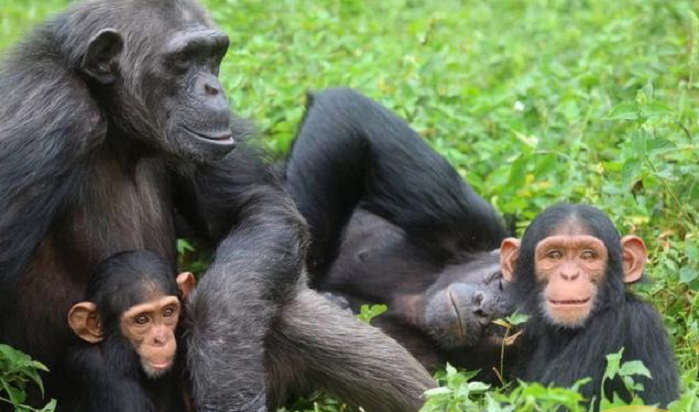
A census has confirmed the presence of 426 chimpanzees in Bwindi Impenetrable National Park following the first-ever dedicated chimpanzee census in the forest, a milestone conservation exercise that officials say will reshape management of the globally renowned park.
The census, conducted by the Jane Goodall Institute Uganda in partnership with the Uganda Wildlife Authority (UWA) and other stakeholders, provides clear scientific evidence on the presence, distribution, and conservation importance of chimpanzees in Bwindi.
Launching the findings, the Minister of State for Tourism, Wildlife and Antiquities, Martin Mugarra Bahinduka, described the findings as timely and critical for Uganda’s conservation and scientific community. “For many years, the status of chimpanzees in this unique ecosystem remained inadequately understood,” Mugarra said.
“The census findings being released today have changed that narrative by providing clear scientific evidence on the presence, distribution, and conservation importance of chimpanzees in Bwindi.” Bwindi is globally celebrated for its mountain gorillas and exceptional biodiversity.
However, chimpanzee numbers in the park had previously been derived largely from gorilla census exercises.
James Byamukama, Executive Director of Jane Goodall Institute Uganda, said the new census was “demand-driven” and followed recommendations from previous gorilla surveys.
“Chimpanzees have been counted elsewhere, but in Bwindi it was always an estimate based on the gorilla census. The last gorilla census had actually recommended that there be a chimpanzee census,” he said.
Byamukama noted that the institute works with UWA, the Greater Virunga Transboundary Cooperation, and other partners to conserve chimpanzees and their habitats, emphasizing that more than 80 percent of Ugandans depend on ecosystem services for their livelihoods.
He warned of growing environmental pressures, including habitat loss and the replacement of diverse forest landscapes with monocultures and large-scale agriculture.
“We are on a declining trend of green hope,” Byamukama said. “We therefore want to inspire and motivate Ugandans and other people around the world to live in harmony with nature and take action on behalf of the planet we share.”
He thanked Jane Goodall Institute chapters in the United States, Switzerland, Austria, France, and Germany for funding the census.
Chimps and Gorillas Share Space
Presenting the technical findings, Michael Jurua, Conservation Science and Monitoring and Evaluation Manager at Jane Goodall Institute Uganda and leader of the census team, said the study confirmed a key hypothesis: chimpanzees and gorillas overlap in parts of Bwindi.
“We noticed that there is an overlap in chimps and gorillas. They seem to live together. That was the hypothesis when we were heading for the census. Then the analysis confirmed this observation,” Jurua said. According to the findings, chimpanzees are more likely to occur in the northern section of the park and parts of Buhoma, while gorillas are more suited to the southern areas and sections toward Sarambwe.
UWA Executive Director Dr. James Musinguzi said the confirmation of 426 chimpanzees, mainly in the northern sector, marks a strategic turning point.
“For the first time, clear and scientifically robust evidence is provided about the presence, distribution, and status of chimpanzees in Bwindi Impenetrable National Park,” he said.
He added that chimpanzees are “not incidental occupants of the forest but an integral and widely distributed component of Bwindi’s great ape assemblage.”
“With the chimpanzees, the gorillas, and the people, you now have the three apes in one environment,” Dr. Musinguzi remarked. Evidence-Based Conservation and Tourism Opportunities.
Officials said the census results will guide protected area management decisions, conservation investments, and long-term monitoring frameworks.
“These findings strengthen our ability to plan and manage the park using evidence-based approaches,” Dr. Musinguzi said.
The survey recorded limited human activity along most transects, indicating that large sections of the park remain intact and capable of supporting viable chimpanzee populations.
However, traces of illegal activities were observed in some areas bordering relatively poor communities.
Dr. Musinguzi said UWA will institutionalize long-term chimpanzee monitoring, strengthen health risk mitigation, in collaboration with Conservation Through Public Health, and explore tourism diversification, particularly in the northern sector.
“This is an opportunity for us to emancipate communities through diversifying sustainable tourism,” he said. Minister Mugarra echoed the importance of science-led management, especially amid emerging threats such as climate change, habitat pressure, and growing demand for land.
“Evidence-based conservation is essential if we are to safeguard wildlife while responding to emerging challenges,” he said.
He added that the findings will inform policy, guide protected area management, and strengthen Uganda’s contribution to regional and global biodiversity conservation. The minister emphasized that wildlife conservation goes beyond environmental protection.
“Wildlife conservation is not only an environmental responsibility; it is also an investment in our economy, our identity, and the well-being of future generations,” Mugarra said.
He commended UWA for embracing science as the foundation for decision-making and praised the Jane Goodall Institute for its long-standing commitment to great ape conservation.
He also thanked development partners and foreign missions for supporting conservation efforts and promoting Uganda as a tourism destination, pledging continued government backing for conservation expansion and sustainable tourism growth.
Mugarra urged all stakeholders, government institutions, conservation organizations, local leaders, the private sector, and the public to translate the findings into practical action.
“Let us translate this knowledge into action that protects chimpanzees, sustains ecosystems, and promotes inclusive development,” he said. With the first comprehensive chimpanzee census now complete, conservation leaders say Bwindi’s identity as a multi-ape stronghold is firmly established, setting the stage for a new phase of science-driven management and community-centered conservation.
During a technical clarification session at the census release, there were questions about chimpanzees and their nesting behavior. This was based on the finding that they were laying their nests on the ground. Chimpanzee expert Peter Apel of the Jane Goodall Institute explained that a nest is essentially a chimpanzee’s nightly bed.
“A nest is where a chimpanzee sleeps every single night. It’s where they sleep, mate and do other activities,” Apel said. “Just like bird nests, it’s basically a home a bed for chimpanzees.”
A New Nest Every Night
Chimpanzees, which live in social groups ranging from 60 to 120 individuals, typically build a fresh nest each night and do not reuse old ones for sleeping. Each chimpanzee occupies roughly one square kilometre of territory.
However, Apel clarified that chimps also build “day nests”, temporary resting structures made when they become tired while moving through the forest.
“Chimps move about 10 kilometres a day,” he said. “If one feels tired, ill, or cannot keep pace with others, it makes a nest by folding branches together to create a solid cushion to rest in.”
How Nests Help Count Chimpanzees
Because chimpanzees are difficult to observe directly in dense forests, scientists rely on nests as a proxy to estimate population size. Not all chimpanzees build nests.
Adult males, adult females, and juveniles above seven years typically construct their own nests, while infants sleep with their mothers. This difference must be factored into population calculations.
Researchers use a formula that incorporates: The nest-building rate (about 1.09 nests per chimp per day in Uganda), the proportion of chimpanzees that build nests (0.88 occupants per nest), nest density per square kilometre, and the nest decay rate (about 55 days before a nest fully decomposes).
Population density is calculated as the number of chimpanzees per square kilometre, based on nests recorded along survey transects.
“The science behind it is to try and come as close as possible with an estimate that makes sense,” Apel explained, noting that the census carries a confidence interval with an estimated margin of error of about five percent.
-URN