
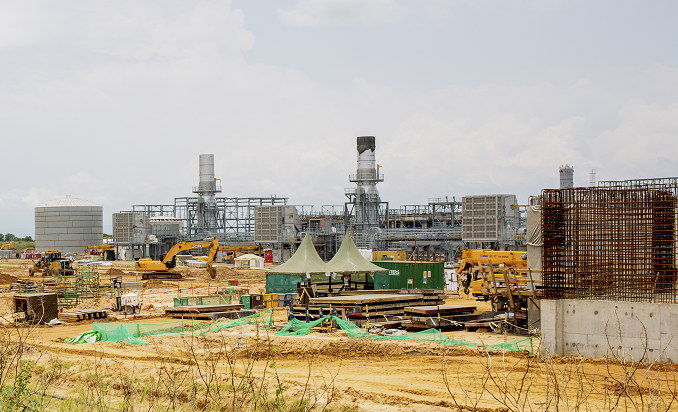
The CPF at Tilenga
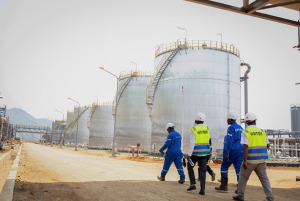
The Central Processing Facility for the Tilenga Project operated by Total is taking shape
TotalEnergies EP Uganda (TEPU), operator of the Tilenga Oil Production Project, and CNOOC Uganda Limited, operator of the Kingfisher Development Project, are intensifying efforts to deliver Uganda’s first oil before the end of 2026. As of September 2025, the two companies had successfully drilled 169 oil wells out of a total of more than 450 planned across 35 well pads.
A well pad is a cleared and leveled area of land used to access oil and gas reserves. It provides a stable surface for a drilling rig and can be designed to accommodate a single well or multiple wells drilled in different directions.
TotalEnergies is responsible for drilling 420 wells on 31 pads located in Buliisa and Nwoya districts. Oil pads in Nwoya district are located within Murchison Falls National Park. Each pad within Tilenga accommodates between 15 and 20 wells.
“For Tilenga, the target is to drill 170 wells to hit first oil. To date, 149 wells have been drilled out of 420,” said Anita Kayongo, Corporate Affairs and Communications Manager at TEPU. “We don’t need to drill all the wells to achieve first oil,” she added.
TEPU currently operates three rigs—two north and one south of the River Nile, while CNOOC operates one rig due to its smaller development area.
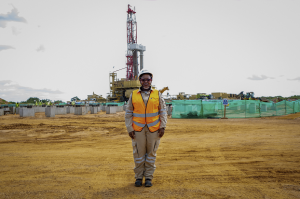
In the Kingfisher Development Area, 20 of the planned 31 wells have been drilled across four well pads. According to Maria V. Naiga, a Well Control Engineer at CNOOC, drilling a single well takes between 20 and 30 days, depending on design. “During exploration, four wells were drilled to confirm the presence of oil and to guide the placement of well pads. As CNOOC, we have so far drilled 16 wells; We now have 11 wells left to complete the drilling phase,” she said.
Naiga noted that CNOOC’s land rig is customized for offshore operations beneath Lake Albert. “The deepest well at Kingfisher is around 7.5 kilometers, so we procured a rig capable of drilling up to 8 kilometers. It is semi-automated, energy-efficient, and fitted with noise reduction systems to minimize disruption to nearby communities and the environment,” she explained.
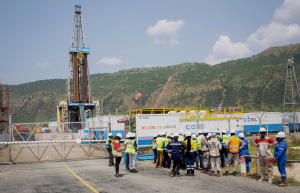
CNOOC’s Land Rig in operationAt Tilenga, drilling efficiency has significantly improved.
Julius Balamaga, Senior Drilling Engineer at Petroleum Authority of Uganda (PAU), who is overseeing Total’s ongoing drilling on behalf of PAU, ), said the team now drills a well in about nine days, down from eleven when operations began
“We first drill a well on paper… we do simulations and see how to improve efficiency. Automated drilling and casing while drilling have cut down time. We are having smoother drilling than before,” he says, describing rigs operating in Tilenga as “the most silent rigs you’ll ever find on the planet.”
Balamaga projected that all 420 Tilenga wells would be completed by 2028. “We normally drill 70 to 80 wells a year, but with improved efficiency, we could reach 100 annually,” he added. Once production reaches full capacity, TotalEnergies will produce 190,000 barrels of crude oil per day, while CNOOC will contribute 40,000, bringing total output to 230,000 barrels daily.
Key infrastructure taking shape
Government and oil companies are confident that first oil will flow before the end of 2026. The oil companies are setting up key facilities to facilitate the transportation of crude oil from the oilfields to the refinery and export hub in Kabaale, Hoima district.
The Central Processing Facilities (CPF) at both Tilenga and Kingfisher are taking shape. The CPF is central because it’s where oil is separated from the gas, water, sand, solvents, or additives it may contain before it is transported by the feeder pipelines to the main refinery and export hub in Kabaale, Hoima.
While production will begin before the refinery is completed, the Kabalega International Airport—which will facilitate transportation of refinery equipment—is nearing completion at 98% and expected to be operational by March 2026. This means that Ugandans will have to wait longer for locally refined petroleum products such as petrol, diesel, and petrochemicals.
Gloria Sebikari – Manager Corporate Affairs, Petroleum Authority of Uganda (PAU) told Business Focus that oil production will proceed before the refinery is finished, guided by a commercialization agreement that Government signed with oil companies.
“Government’s major interest is the refinery, but the companies justified the need for a pipeline to ensure continuous crude evacuation when the refinery undergoes maintenance,” she explained.
She added: “What was agreed was that no one project will stop the other from moving along; if the refinery comes first, then the oil goes there, if the pipeline comes first, then the oil goes there. When both are ready, the refinery will be given priority. Today, the pipeline is ahead of the refinery and when we are ready to produce, the oil will go to the pipeline and when both are ready, they’ll share but the refinery will have first-call on production. The refinery capacity is 60,000 barrels per day. This means that if you’re producing at 230,000 barrels per day, the refinery will take its 60,000 and the pipeline takes the 170,000, but that’s when they’re both fully operational.”
According to PAU, the Tilenga Project represents an investment of about US$5 billion and is over 57% complete, while the Kingfisher Project, valued at between US$2 billion and US$3 billion, is more than 70% complete. The progress underscores Uganda’s steady march toward achieving first oil in 2026—an important milestone in the country’s journey to becoming an oil-producing nation.