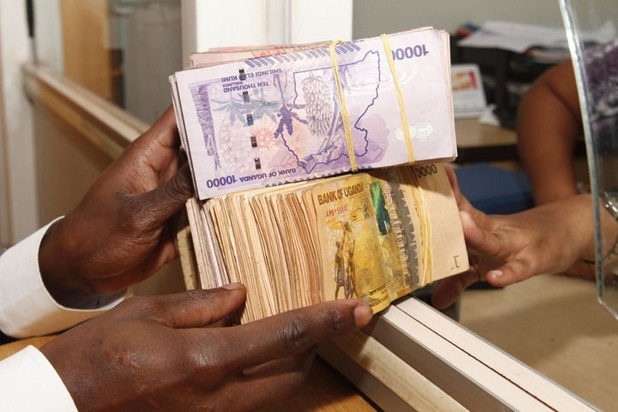
Bank teller: Money exchanges hands
Commercial banks in Uganda have increased their average base lending rates to around 21 per cent per annum as of October 2025, sparking concerns over the future of private sector credit growth.
According to data from the Bank of Uganda (BoU), the average interest rate on shilling-denominated loans rose from 19.1 per cent in July and 17.7 per cent in the three months to April 2025.
At Stanbic Bank Uganda, the country’s largest lender by assets, the prime lending rate currently stands at 19.75 per cent, though certain products are available at rates as low as 16 per cent. The rise in lending rates reflects the increase in the so-called “risk-free rate,” as the Central Bank Rate (CBR) has remained steady at 9.75 per cent since August 2024.
Foreign currency-denominated loan rates also edged up to 8.5 per cent, from 8.3 per cent over the same period.
A sectoral breakdown shows that lending rates climbed across manufacturing, trade, transport, and personal loans, signalling heightened risk perceptions in those sectors, while housing and agriculture saw modest declines.
BoU’s Bank Lending Survey for the fourth quarter of Financial Year 2024/25 had projected easing lending rates in the early months of Financial Year 2025/26, citing stable macroeconomic conditions.
“They could even ease further with continued ample liquidity, more robust economic growth, and a stronger exchange rate,” the survey noted. However, concerns persist over sector-specific rate hikes, increased government borrowing, and global financial volatility that could counteract this optimism.
Despite the tighter borrowing environment, Private Sector Credit (PSC) continues to expand, a trend the central bank attributes to prudent monetary policy and improved financial conditions.
In the three months to July 2025, annualised PSC growth rose to 9.7 per cent, up from 9.0 per cent in the previous quarter. Shilling-denominated loans grew by 11.2 per cent, slightly higher than the 11.0 per cent recorded earlier, while foreign currency loans rose by 5.5 per cent, up from 3.6 per cent.
“The improvement reflects stronger demand from borrowers as well as favourable supply conditions from lenders,” BoU said.
Credit demand increased to 8 trillion Shillings in the three months to July, up from 7.5 trillion Shillings in the quarter ending April 2025.
On the supply side, net credit supply rose to 5.6 trillion Shillings, from 4.5 trillion Shillings, driven by reduced perceptions of risk and a decline in non-performing loans (NPLs) to 3.7 per cent in June from 4.2 per cent in March 2025. The improved credit quality lifted the loan approval rate to 70.1 per cent, up from 59.2 per cent.
However, net credit extensions, including capitalised interest and revaluation changes, contracted by 300 billion Shillings to 1.1 trillion Shillings in the first quarter of the Financial Year 2025/26, largely due to a sharp decline in foreign currency loan disbursements.
In July alone, PSC growth slowed to 8.6 per cent, from 10.3 per cent between May and June. Year-on-year PSC growth was strongest in manufacturing, transport, business services, and personal loans, while agriculture and housing recorded contractions.
The central bank remains optimistic that robust credit demand, better inflation forecasts, and exchange rate stability will support further strengthening in private sector lending.
Still, potential risks remain. Rising domestic borrowing, if unchecked, could crowd out private sector access to credit, while global uncertainty and credit risk concerns may dampen banks’ lending appetite.
Overall, BoU expects credit growth to continue rising, supported by macroeconomic stability, prudent monetary policy, and ongoing reforms aimed at deepening Uganda’s financial markets. Sustained credit expansion is central to the government’s Vision 2040, which targets a tenfold increase in the size of Uganda’s economy to USD 500 billion.
To achieve this, private sector credit is projected to grow from 26.8 trillion Shillings in July 2025 to 260 trillion Shillings by 2040, a level deemed necessary to fuel long-term economic transformation. The central bank says it will maintain a prudent monetary policy to safeguard macroeconomic stability while expanding financial access through digital and agency banking.
It is also enhancing payment systems and credit infrastructure, including the Credit Reference Bureau and the Security Interest in Movable Property Registry System (SIMPRS), to boost borrower credibility and reduce risk aversion, particularly among micro, small, and medium enterprises (MSMEs).
In addition, government credit schemes and efforts to broaden long-term financing options such as green bonds, Islamic (Sukuk) bonds, and diaspora bonds are expected to support deeper credit markets.
The Bank of Uganda, in collaboration with the Uganda Bankers Association (UBA), is also rolling out an Environmental, Social and Governance (ESG) framework to foster sustainable lending practices and improve access to long-term financing.
Meanwhile, the Mortgage Refinancing Bill, once enacted, is expected to extend repayment periods and gradually lower interest rates over time. BoU projects that lending rates will ease gradually over the medium term, as inflation stabilises, fiscal risks are contained, and financial inclusion initiatives take hold, setting the stage for more affordable credit and stronger private sector-led growth.
-URN
About the Author