

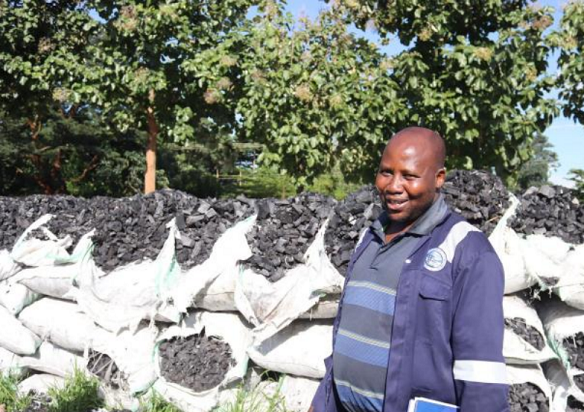
John Giribo, the National Forestry Authority (NFA) Range Manager of Aswa River Range shows some of the charcoal that are rotting away at NFA offices in Gulu city.
John Giribo, the National Forestry Authority (NFA) Range Manager of Aswa River Range shows some of the charcoal that are rotting away at NFA offices in Gulu city. The Charcoal was impounded by NFA officials/File photo
The Ministry of Finance, Planning and Economic Development has warned that if the rate at which Ugandans are cutting trees for firewood and charcoal isn’t controlled, Uganda will run out of its Woodstock in 28years.
The warning was issued by Wilson Asiimwe, Senior Economic Modeler, Ministry of Finance, during the High-Level 9th Economic Growth Forum, held at Kampala Serena Hotel last week, while addressing key stakeholders on strategic policies and investment initiatives that will enhance Uganda’s economic resilience, accelerate productivity and boost competitiveness in pursuit of the Tenfold Growth.
“As you have seen that in a few years, like about 28 years, if we don’t change the trend, we will have no wood in any forest in Uganda. And also, the harvest rate, about 1.3 million tonnes of wood which we harvest every year, is far much higher than the rate of regeneration of this wood in the forest. And it’s very hard to have, almost impossible, not only hard, to have economic growth without natural capital assets, the stock of these assets isn’t sustainable. So, we have to save these forests. And we found out that 92% of the harvest of wood stock in Uganda is used for firewood and charcoal,” Asiimwe explained.
According to the Ministry of Finance, by 1990, Uganda had about 102 million tonnes of wood stock in the economy, but currently, there are about 32 million, which Asiimwe described as a very high rate of depleting of the country’s resources.
While discussing the wood within forests and wood outside forests, by 1990, Uganda had about 223 million tonnes of wood stock in Uganda but by 2015, there are only about 91 million tonnes of wood stock, and that’s more than halving the stock of wood in Uganda.
The Ministry of Finance also indicated that annually, Uganda depletes over 1.3 million tonnes and of that, about 1.1 million wood depleted is in forests.
Asiimwe explained, “But when you look at the stock of the harvest rate of wood stock in Uganda, Uganda harvests on average about 1.7 million tonnes of wood annually. And with that trend, if it’s not reversed, we see that by 2085, Uganda will not have wood. It will be washed away completely. And in the forest, by 2043, if the stock flow is not reversed, the forest will be wiped away. And that’s not good for growth, because you can’t grow without natural capital assets because these natural capital assets are inputs to the investments in Uganda in all sectors.”





The custodians are the destroyers.
I suggest policy on settlement patterns and incoming generation activities.
In my locality most of the wood is destroyed by people who don’t plant and they end up wasting the money.