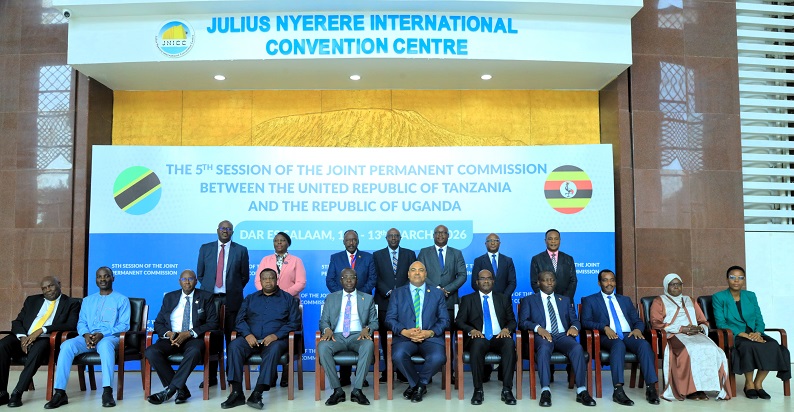
Officials that attended the fifth session of the Joint Permanent Commission in Dar es Salaam, in a group photo
Uganda and Tanzania have agreed to eliminate all outstanding non-tariff barriers, a move intended to fix a trade relationship currently weighed down by a 9 trillion-shilling ($2.4 billion) imbalance.
The mandate emerged from the fifth session of the Joint Permanent Commission on Friday, where both countries resolved to shift focus from diplomatic formalities to the technical removal of bottlenecks hampering essential commodities.
The urgency follows 2025 trade data showing Tanzania exported 10 trillion shillings ($2.7 billion) in goods to Uganda while receiving only 1.1 trillion shillings ($300 million) in return. To address the gap, negotiators are finalizing resolutions on disputed import charges for sugar, milk, steel and electric poles.

Beyond commodity trade, the commission is moving to harmonize the use of national identity cards to allow for the free movement of labor across the border.
The parties reviewed progress on bilateral and regional projects, including the East African Crude Oil Pipeline, or EACOP, and several energy exchange projects. A joint communique dated March 13, 2026, signed by Ugandan Minister of State for Foreign Affairs John Mulimba and Tanzanian Foreign Minister Mahmoud Thabit Kombo, reaffirmed a commitment to building integrated economies.
Mulimba characterized the session as a transition from political vision to economic execution.
The time for action is now, Mulimba said. He added that the responses to the expectations of the people must be demonstrated in real outcomes.
Mulimba noted that while strategic victories in defense and regional integration are notable, they remain secondary to the immediate need for seamless commerce.
Kombo emphasized that the deliberations reflected a strategic scope covering diplomacy, immigration, health and education.
Energy infrastructure remains the centerpiece of the bilateral agenda. Vincent Waiswa Bagiire, the permanent secretary for Uganda’s Ministry of Foreign Affairs, cited the 18.7 trillion shilling ($5 billion) EACOP as a cornerstone of the partnership, noting the project is now 79 percent complete. Technical teams were ordered to resolve final border demarcation issues to meet the July technical start-up and October 2026 export targets.
The partnership is also expanding into new corridors, with agreements for a natural gas pipeline from Tanzania to Uganda and a refined petroleum products pipeline from Uganda to the port of Tanga.
Ambassador Richard Kabonero, Uganda’s head of regional cooperation, urged the delegation to focus on the practical removal of obstacles. Similarly, Uganda’s High Commissioner to Tanzania Fred Mwesigye said continuous engagement through these commissions remains the only viable path to balancing the trade deficit.
Connectivity on Lake Victoria has also entered a new phase with the commissioning of the MV New Mwanza, Africa’s largest freshwater vessel. The ship is expected to reduce transit times and lower logistics costs.
The commission also highlighted infrastructure milestones including the 24-hour operationalization of the Mutukula One Stop Border Post, the harmonization of road user charges at 37,000 shillings ($10) per 100 kilometers and the commissioning of the 14-megawatt Kikagati-Murongo Hydropower Project.
Uganda and Tanzania also formalized the framework for the Isaka-Lusahunga-Murongo Standard Gauge Railway and the establishment of a joint secretariat to oversee pipeline security.
Uganda is scheduled to host the sixth session of the commission in 2028.