

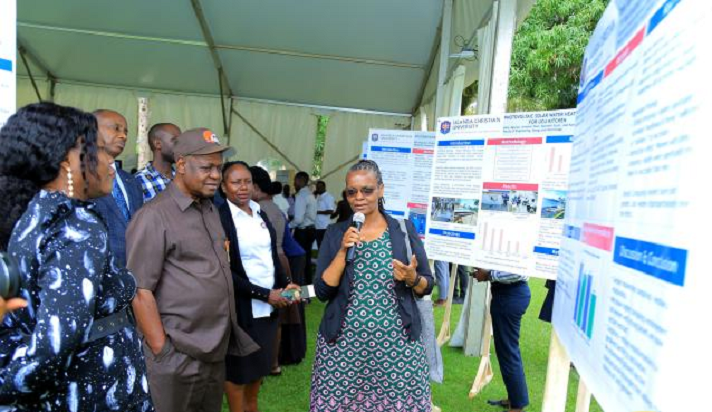
Researchers exhibiting during a two-day research symposium at UCU.
Uganda Christian University (UCU) has come up with an internal grants programme to fund projects across academic disciplines.
The initiative is part of the University’s ambition to strengthen its position as a hub for research and innovation.
The initiative, which began in 2021, aims to build a culture of research, mentorship, and innovation with an impact on national development.
According to Dr. Elizabeth Kizito, Director of Research, Partnerships and Innovation, the university committed funds to support researchers at different levels, enabling them to publish, innovate, and mentor others.
Under the UCU Research Fund, professors receive shillings 150 million to conduct research and mentor junior academics, PhD holders receive shillings 50 million for up to 24 months to build research teams, and master’s students get shillings 15 million to complete and disseminate their theses.
Student innovators also receive between shillings 3 and 4 million to develop new products and ideas.
“The grants are competitive,” Dr. Kizito said. “We use an online grants management system and external reviewers to ensure proposals align with national development goals, the university’s strategic plan, and the Sustainable Development Goals.”
She added that the university has also strengthened its monitoring and evaluation systems to track project outcomes and ensure accountability.
The impact of this initiative was on display at a research and innovation symposium held at UCU, where various schools and faculties showcased their projects.
Among the highlights was Olutindo (The bridge), a card game developed by a team from the School of Journalism, Media and Communication, led by James Kiwanuka-Tondo. The tool is designed to help parents and teenagers talk about sexuality and relationships more openly, addressing the high rates of teenage pregnancy and school dropouts in Uganda.
Other innovations included a mental health counselling app that allows young people to access therapy anonymously, a sanitation model in Mbale City developed through community engagement, a food waste recycling system that turns household waste into animal feed, and a mobile health records platform that allows patients and doctors to access medical histories securely.
UCU’s researchers showcased robotics designed to aid in disaster search and rescue, agricultural innovations, and health and AI-based solutions.
Aaron Mushyengyezi, UCU Vice Chancellor, commended the research directorate for separating postgraduate studies from regular research activities to allow both areas to grow effectively.
He said universities must strengthen the link between research and industrialisation if Uganda is to achieve its development goals.
“If we are to industrialise our country, we must have strong linkages between universities, research institutes, and the industrialisation agenda,” Mushyengyezi said. “Many global industries began as small ideas in university labs.”
The Vice Chancellor also appealed to the government to support such initiatives in both public and private universities to boost national development.
Dr. Kizito noted that the UCU research fund remains open to new applicants. “Wherever you are, you can get better. We are encouraging growth at every academic level,” she said.
The research grants have attracted both internal and external funding, including support from the EU, NORAD, and the Uganda National Council for Science and Technology.
The university says it hopes to scale some of the most promising projects into viable products and businesses that can create jobs and solve real community problems.
-URN