

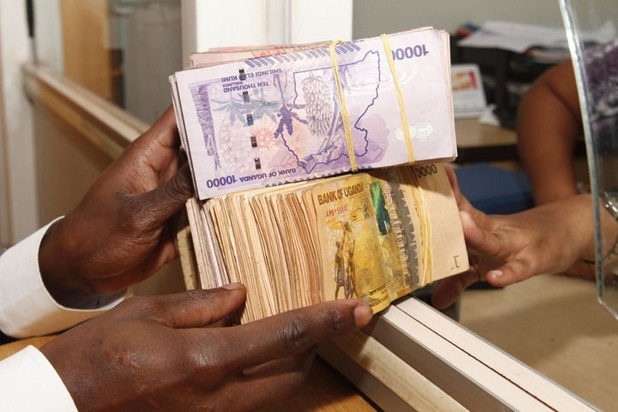
Bank teller: Money exchanges hands
The Ministry of Finance has revealed that in June 2025, Financial Institutions operating in Uganda approved loans for disbursement amounting to Shs1.432Trn against Shs2.335Trn of loan applications they received, thus accounting for an approval rate of 61.3 percent in June 2025, down from 88.7 percent in May 2025.
In the breakdown provided, Personal and Household Loans accounted for the largest share of the credit disbursements, taking up 33.3% (Shs476.86Bn) of the total credit approved in June 2025, while the other major sector recipients of credit included; Trade at 17.1 percent (Shs244.61Bn), Agriculture at 16.8 percent (Shs240.91Bn), Building, Mortgage, Construction & Real Estate at 11.3 percent (Shs162.27Bn) and Business, Community, Social & Other Sectors at 11.3 percent.
The details are contained in the July 2025 Performance of Economy report published by the Ministry of Finance last week which also indicated that the outstanding Private Sector Credit, loans that remain unpaid by the private sector grew by 1.6 percent on a month on-month basis, from Shs23,536Trn in May 2025 to Shs23,901Trn in June 2025.
The Ministry of Finance also revealed that in July 2025, Government raised resources in terms of both taxes and grants amounting to Shs2.537Trn in July 2025, registering a surplus against the target of Shs2.459Trn Government had earmarked to collect.
However, domestic revenues collected by Uganda Revenue Authority amounted to Shs2.369Trn which was slightly below the target of Shs2.665Trn, a drop that was on account of non-tax revenues which were lower than the target, posting a 63.6 percent performance while tax collections were close to target at 99.3 percent performance.
The Ministry further explained that the surplus from total revenue and grants was mainly due to grants worth Shs168.21 billion that were received but initially not included in the plan.
According to the Ministry of Finance, in July 2025, Government spent Shs3.619Trn falling short of the planned expenses for the month by Shs155.02Bn and the lower than planned expenses were partly due to delays in the implementation of requisite budget processes at the beginning of the financial year.