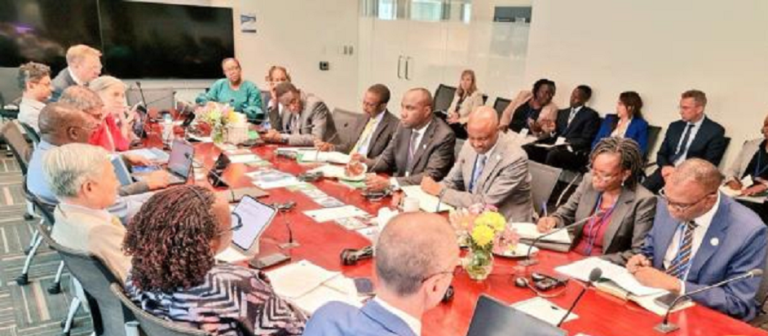


NSSF officials led by Agnes Tibayeita (Centre), Chief Legal Officer at NSSF appearing before Parliament’s Finance Committee during the scrutiny of The Mortgage Refinance Institutions Bill, 2025 on 12th August 2025.
The National Social Security Fund (NSSF) has defended the exorbitant prices charged to acquire its housing units, blaming the cost to the high rate of land, constructing roads to the estates and extension of water and sewerage systems.
The defense was made by Agnes Tibayeita, Chief Legal Officer, National Social Security Fund while appearing before Parliament’s Finance Committee during the scrutiny of The Mortgage Refinance Institutions Bill, 2025 on 12th August 2025.
She explained, “The moment we get land, the cost of the land will be escalated. When we start developing the land, we have to invest in the infrastructure; you will have to build the roads, sewer system etc. By the time you are done with the development, you are definitely outside the bracket of affordable housing, however well-intentioned you were.”
Her remarks were in response to concerns raised by Karim Masaba (Mbale Industrial Division) who complained about the high rates imposed by NSSF on their housing units that ranged between UGX200Million to UGX400Million as these go against the whole essence of the Fund venturing into real estate to reduce on challenge of housing deficit in Uganda.
Masaba remarked, “What we are trying to deal with is to see how to lower the cost of housing. One of the things I notice is that most of your projects are not affordable for most of the Ugandans. Maybe you can enlighten how best you think you can make them much more affordable with this kind of Bill.”
According to the NHCCL Strategic Plan, 2018 – 2022, the country has a national housing shortage estimated at 1.6 million housing units. However, some reports put the housing deficit at 2.1 million housing units.
Presented before Parliament on 11th March 2025, The Mortgage Refinance Institutions Bill, 2025 is intended to regulate the establishment of mortgage refinancing institutions; to provide for the functions of the central bank in relation to mortgage refinance business; to provide for the conduct of mortgage refinance business; to provide for corrective actions and liquidation.
Government defended the enactment of the Bill arguing that currently, there is no law regulating the establishment of mortgage refinance institutions in Uganda. Mortgage refinance institutions play a key role in providing liquidity to financial institutions and micro finance deposit-taking institutions to enable them issue long-term mortgages.
“In the absence of mortgage refinance institutions, primary mortgage lenders have continuously relied on customer deposits and other short term borrowing to finance their mortgages and other long term credit facilities, causing maturity mismatch,” as noted on the Bill.
The Ministry of Finance further argued that due to maturity mismatch, financial institutions and micro finance deposit-taking institutions limit their exposure to longer term loans in favour of short-term loans which has resulted into unfavourable mortgage terms such as; (a) high interest rates; (b) high payment instalments; (c) short payment durations; and (d) requiring borrowers to start repaying loans immediately.