
By Kate Kiiza, Executive Director & Chief of Corporate and Institutional Banking, dfcu Bank
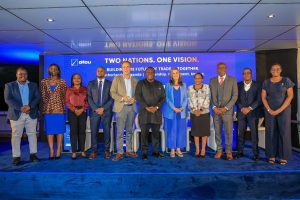
In early March 2026, dfcu Bank convened members of the Netherlands–Uganda Trade and Investment Platform (NUTIP), alongside representatives from the Embassy of the Kingdom of the Netherlands, Rabobank and other partners, at its Head Office in Kampala.
Under the theme “Building the Future of Trade, Together,” the engagement brought business leaders, financiers and policymakers together to explore practical ways of strengthening trade, investment and agribusiness collaboration between Uganda and the Netherlands.
The discussions reflected a relationship that has steadily matured over time.
Uganda exports about USD 184 million in goods annually to the Netherlands, largely agricultural commodities such as cocoa and coffee. Imports from the Netherlands total roughly USD 289 million, including refined petroleum, machinery and agricultural inputs that support production and logistics across Uganda.
The Netherlands also plays another critical role: it serves as an important European distribution hub, positioning it as a gateway for Ugandan exports into wider EU markets.
Yet the significance of this partnership goes far beyond trade flows. At its core, the Uganda–Netherlands relationship reflects a strong alignment between Uganda’s agricultural potential and the Netherlands’ global leadership in agricultural innovation, logistics and agri-finance.
Agriculture remains central to Uganda’s economy, employing more than 70 percent of the population, the majority of whom live in rural areas. In the 2023/24 financial year, the sector contributed approximately 24 percent of national GDP and generated 42 percent of Uganda’s export earnings.
Despite this importance, a significant proportion of agricultural activity remains subsistence based, limiting productivity, incomes and export competitiveness.
Closing the gap between subsistence farming and commercial agriculture therefore represents one of Uganda’s most important economic opportunities.
The Netherlands offers a compelling reference point. Despite its relatively small land size, it has built one of the most productive agricultural systems in the world and is widely recognised as the second largest exporter of agricultural products globally.
For Uganda, the opportunity lies in combining its natural agricultural resources and entrepreneurial energy with the systems, expertise and global market integration that define the Dutch agricultural model.
The depth of this relationship is also visible in investment flows. Since 2023, the Netherlands has been Uganda’s largest source of Foreign Direct Investment, with a significant share of these investments concentrated in agriculture and agribusiness value chains. Dutch companies and institutions have invested across farming, processing, logistics and agricultural services, strengthening the infrastructure required for Uganda’s transition toward commercial agriculture.
This investment pattern reflects a natural alignment: Uganda offers fertile land, favourable climate conditions and growing agribusiness opportunities, while the Netherlands brings world-leading expertise in agricultural technology, food systems, logistics and agri-finance.
Together, these complementary strengths create the conditions for a partnership that goes beyond trade, supporting productivity, value addition and access to international markets. Financial institutions play a key role in translating this collaboration into tangible outcomes.
At dfcu, this is reflected in long standing partnerships with Dutch institutions including Rabobank, the Rabo Foundation and FMO, the Dutch Entrepreneurial Development Bank.
These collaborations support agricultural financing, knowledge exchange and enterprise development across Uganda’s agribusiness sector. Rabobank’s expertise in agricultural banking strengthens frameworks that support commercial farming, while the Rabo Foundation supports initiatives that strengthen farmer organisations and help smallholder farmers participate in formal value chains. FMO’s investment presence in Uganda across financial services, renewable energy and agribusiness has further strengthened the ecosystem required for enterprise growth.
Experience consistently shows that success in agriculture depends on systems: farmer organisation, technical expertise, market access and patient capital working together.
This integrated approach is visible in initiatives such as the Best Farmers programme and the Harvest Money Expo, supported by partners including the Embassy of the Kingdom of the Netherlands, dfcu, Vision Group and KLM.
Since its launch in 2014, the Best Farmers programme has recognised exemplary Ugandan farmers while exposing them to modern agricultural practices through structured study visits to the Netherlands.
Each year, 13 outstanding farmers are recognised nationally, with 10 winners receiving agricultural equipment valued at approximately UGX 150 million, alongside participation in knowledge exchange visits to Dutch farms and agribusinesses.
These engagements provide practical insights into productivity, cooperative models and value addition, reinforcing the idea that farming can be run as a profitable business.
The economic rationale for this shift is clear: value addition alone can increase farmer earnings by more than 40 percent, highlighting the importance of moving beyond raw commodity production into processed, market ready products.
Uganda’s long term fundamentals remain strong: fertile land, favourable climate conditions and a young, increasingly entrepreneurial population provide a solid foundation for agribusiness growth.
Unlocking the sector’s full potential will depend on strengthening value chains, expanding value addition and connecting producers to global markets.
This is where partnerships such as the one between Uganda and the Netherlands become particularly valuable.
The Uganda–Netherlands relationship is best measured not only by trade statistics or investment figures, but by the results already visible across Uganda’s farms, agribusinesses and export corridors.
For institutions such as dfcu, the responsibility is clear: to continue building the financial and institutional bridges that connect Ugandan enterprises to international markets, capital and knowledge.
In doing so, partnerships like this quietly shape the future of Uganda’s agricultural transformation.