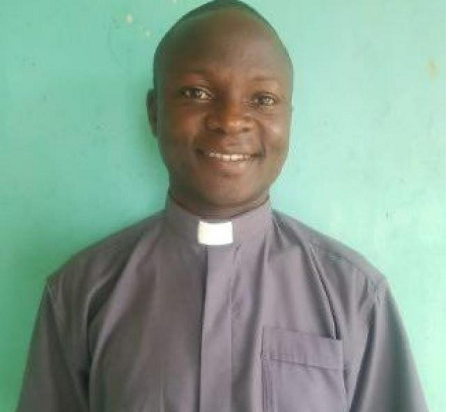
Reverend Father Deusidedit Ssekabira who is missing after he was allegedly kidnapped last week (Courtesy photo)
In a case that has gripped Uganda amid rising pre-election tensions, the detention of Catholic priest Rev. Fr. Deusdedit Ssekabira has taken an intriguing turn.
While the military accuses him of involvement in “violent subversive activities against government” and opposition figures have denounced the arrest as political intimidation, sources close to the family allege that the incident stems from a long-simmering dispute over control of a children’s charity founded by his family members.
Fr. Ssekabira, 46, an assistant parish priest at Bumangi Parish in Kalangala District and former Masaka Diocesan Youth Chaplain, was ‘abducted’ on December 3, 2025, from his office in Masaka City. Eyewitnesses described armed men in military uniforms arriving in a white, numberless van.

He was reportedly seized while working at offices linked to his charitable activities. The Uganda People’s Defence Forces (UPDF) confirmed on December 14 that they were holding the priest in “lawful custody” for alleged involvement in threats to state security, adding that he would be charged in court.
The admission came after nearly two weeks of uncertainty, during which the Masaka Diocese filed a habeas corpus application in the High Court demanding that authorities produce him “dead or alive.”
The incident sparked widespread outrage, with opposition leader Robert Kyagulanyi aka Bobi Wine, whose National Unity Platform is challenging President Yoweri Museveni in the upcoming elections, calling it evidence of state repression.
Human rights groups have highlighted a pattern of enforced disappearances targeting critics and activists as Uganda heads to the general polls in January next year. Yet beneath the political narrative, a quieter story has emerged from family and diocesan sources: a bitter feud over the Uplift Vulnerable Children and Orphans (U.V.C.O.) Foundation, a charity supporting street children and orphans in poverty-stricken homesteads in Nyendo, a suburb of Masaka City.
The foundation was co-founded around 2010 by Fr. Ssekabira’s brother, Dr Joseph Wasswa, now based in Germany, with support from German partners, including FMK Uganda.
The organisation provided school fees, shelter, meals, vocational training, and water projects, initially sponsoring children at existing schools before establishing Uplift Community Primary School in Kiyanja, Masaka District, in the mid-2010s.
The school now serves more than 200 pupils. Sources allege that disputes arose when a sibling, Margaret Namatovu Nakaggwa, assumed control of the foundation and the school, but deviated from agreed governance principles, leading to accusations of financial mismanagement and mounting debts from loans and money lenders.
“While much focus has been on politics, there’s a family feud that many are overlooking,” one source familiar with the matter told reporters.
“Namatovu with influence may have prompted the involvement of security forces, by creating a narrative of subversive activities, prompting swift action by the military,” sources say.
Sources further claim that Namatovu has, on more than two occasions, dragged Fr. Ssekabira to Masaka Police on various allegations, but in all instances, he was released after investigations exonerated him.
Fr. Ssekabira is said to have intervened by securing releases, paying off debts, and taking oversight of the institution in a bid to restore proper management and attract new donors.
In an earlier interview, the priest’s younger brother, Andrew Kabulasoke, told reporters that the family had clues about the events leading to the arrest. However, he declined to share details and urged security agencies to produce their brother in court if they believed he had a case to answer. “We have indications of what triggered this,” Kabulasoke said.
“Our position stays simple. If there is any case, produce him before the court,” he said.
Reverend Father Ronald Ssebyanzi, the Masaka Diocesan communications director, confirmed that the church had received similar information and was engaging the family. “We have received information pointing to internal family disagreements, and once fully confirmed, the diocese will engage the family to seek an internal resolution while pursuing lawful processes,” Ssebyanzi told our reporter.
Unverified WhatsApp messages and a video circulating among diocesan contacts reportedly detail a chronology of events. In one account, a woman narrates how Margaret’s alleged mismanagement of the charity and school led to arrests and nearly resulted in the institution being taken over by debtors. She claims Fr. Ssekabira intervened by settling the debts and assuming management—moves that reportedly drew her disapproval.
It has also emerged that the dispute had already reached court, with an active case challenging the ownership and management of the school. The suit reportedly arises from disagreements among family members over control, governance, and financial obligations linked to the institution.
Neither the UPDF nor the police have linked the detention to any family or charity dispute, and these claims remain unsubstantiated. The diocese has prioritised legal efforts to secure the priest’s production in court, emphasising due process amid concerns over the military handling of civilian matters.
As investigations continue, the case underscores the complex interplay of family dynamics, community service, and national politics in Uganda, where charitable initiatives often intersect with broader societal tensions.
By Tuesday evening, December 16, 2025, the controversy surrounding the detention of Rev. Fr. Deusdedit Ssekabira had attracted criticism from additional quarters. The Uganda Catholic Lawyers Society (UCLS) issued a strongly worded statement condemning the manner of the priest’s arrest, which it described as an abduction by armed men in military uniforms on December 3, and his subsequent unlawful detention by the UPDF.
In the statement, the Catholic lawyers expressed “grave concern and unequivocal condemnation” of what they termed the enforced disappearance and continued holding of Fr. Ssekabira without due process, arguing that it violated Uganda’s Constitution and international human rights standards.
They demanded his immediate production before a competent civilian court, unrestricted access to legal counsel, family members, and church authorities, and full disclosure of the charges, place of detention, and conditions under which he is being held.
Fr. Ssekabira comes from a respected family in Masaka with a long history of public service. His late father, Charles Matovu Kabulasoke, was a stalwart of the National Resistance Movement. He served as an LC III chairperson and earned recognition for grassroots leadership and community service. Beyond parish duties, Fr. Ssekabira holds leadership roles in education. He chairs the board of the International School of Music, Languages, and Polytechnic Studies in Masaka.
The institution was established in 2020 under the initiative of his brother, Dr Joseph Wasswa, who is based in Germany.
The priest also serves as Director of the Masaka branch of Universal Chastity Education (UCE) Uganda. UCE promotes a non-discriminatory message across religious, cultural, and social divides, advocating healthy living through chastity, faithfulness in partnerships, and proper personal hygiene.
This is not the first time a donor-funded charitable organisation in Masaka has been embroiled in internal power struggles, with disputes sometimes fueling allegations of illegal activity.
A notable example occurred around 2013 involving Okoa Refugee, an American-founded Christian nonprofit established in 2000 that operates a foster home for orphans and vulnerable children in Kayirikiti Village, Masaka City. At the time, the organisation faced local scrutiny over claims that it was promoting “strange doctrine,” allegations that were later contested by its management.
-URN