

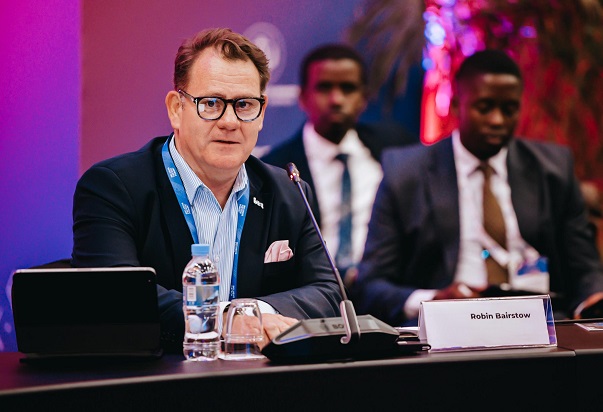
Robin Bairstow - Kigali
Robin Bairstow, the I&M Bank Uganda CEO, speaking at the event in Kigali
The Inclusive FinTech Forum 2026 has concluded successfully at the Kigali Convention Centre, from March 10-12, drawing global attention to Africa’s rapidly evolving digital finance landscape.
The three-day forum brought together leaders from across finance, technology, and public policy, to explore the future of inclusive finance.
Organised by the Kigali International Financial Centre, the event attracted more than 3,000 delegates, including executives, regulators, startup founders, and representatives from development agencies. Running under the theme ‘Shaping the Future of Inclusive Finance. Innovation. Connection,’ the forum spotlighted Africa’s fintech progress, while advancing broader financial access across the continent.
I&M Bank Uganda CEO- Robin Bairstow was one of the panelists at the opening session, and he participated in a roundtable discussion on ‘Regulation, Innovation, and Trust.’
The joint conversation focused on data sovereignty in African Financial Systems, and it had representatives from financial institutions, regulators, fintech leaders, and cloud technology providers, exploring how financial data can be securely governed, as banks increasingly adopt cloud-based core banking platforms.
“Africa’s financial systems are entering a new phase where innovation must move at the same pace as trust. As banks modernise their core platforms and work more closely with fintech and cloud partners, the focus must remain on building resilient systems that regulators, institutions, and customers can all rely on. That balance is what will ultimately determine how successfully digital finance expands across the continent,” said Bairstow.
Using Mambu and Amazon Web Services as practical reference points, participants discussed how African financial systems can balance innovation with regulatory compliance. The conversation focused on critical considerations such as data residency, transparency, and the need to build trust in cloud-enabled financial infrastructure.
Zahidi Mustafa, the CEO I&M Bank Tanzania, joined a panel discussion on the theme ‘Beyond Access: Financing Underserved Communities through Infrastructure-Led Inclusion.’
The session explored how foundational digital infrastructure, including digital identity systems and interoperable payment platforms, can help extend financial services to underserved communities across Africa.
“Innovation is not always about new technology. Sometimes it’s about removing friction. By eliminating transfer charges between bank accounts and mobile wallets, we are encouraging greater financial access and building partnerships across the ecosystem,” Mustafa remarked.
According to I&M Bank Uganda Head of Marketing and Corporate Communications- Annette Nakiyaga, the bank’s participation in the forum reflects its broader commitment to inclusive innovation and regional collaboration.
“Platforms like the Inclusive FinTech Forum provide an opportunity to share practical insights, learn from industry peers, and strengthen partnerships that drive financial inclusion. As a regional bank, we believe sustainable growth in digital finance must be anchored in trust, resilience, and solutions that genuinely respond to customer needs wherever they are,” Nakiyaga said.
The Inclusive FinTech Forum 2026 had similar high-level panels, leadership dialogues, and curated roundtables, aimed at examining the future of digital finance across Africa.
Africa’s digital finance sector continues to expand rapidly, signalling strong momentum across the continent. A report by McKinsey & Company projects that revenues could rise from about US$10 billion today to US$47 billion by 2028. Yet growth has not translated into universal access, as an estimated 300 million adults remain outside the formal banking system, particularly in rural and low-income communities.