
Fine spinners
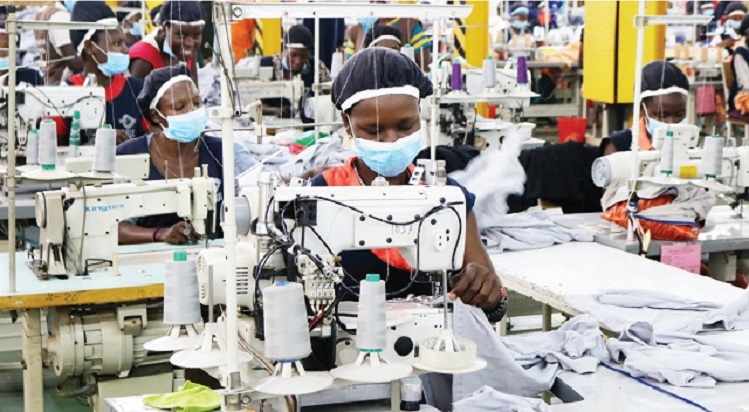
Tailors sewing T-shirts at Fine Spinners Factory in Kampala/Courtesy photo
Government is set to bailout Fine Spinners Uganda Limited with UGX6.1Bn after Parliament approved three supplementary expenditure schedules amounting to UGX 8.1Trn.
This is after the United States blocked Uganda’s access to the African Growth and Opportunity Act (AGOA) market following the passing of the Anti-Homosexuality Act.
Out of the UGX 8.1Trn, the Ministry of Agriculture, Animal Industry and Fisheries (MAAIF) requested UGX10.295Bn, of which UGX6.11bn was required to implement a Cabinet directive for the purchase of 540,000 T-shirts that will later be sold on the domestic market and the money would be repaid in 2years.
“Fine Spinners manufactures T-shirts mainly for the export market including the United States of America (USA). However, following the enactment of the Anti-Homosexuality Act, Fine Spinners Uganda Limited lost the huge USA market. By that time, Fine Spinners had already invested heavily in manufacturing of 540,000 T-shirts for export. They therefore approached Government and requested for support to sell the T shirts on the local market through Uganda Tailors Association (UTA). UTA will pay back Government for the T shirts over a period of 18 – 24 months,” noted Patrick Isiagi, Chairperson, Parliament’s Budget Committee, while presenting the report during the 2nd December 2025 plenary sitting.
However, Ibrahim Ssemujju (Kira Municipality) in his minority report noted that the deal is riddled in favouritism towards Fine Spinners as the supplementary budget is divided in two components, with the first component set to cover the transport of cotton lint for Fine Spinners, while the second will cover the purchase of 540,000 t-shirts.
“This is where the alarm bells ring. We are being asked to believe that Government is going to bulk-buy T-shirts using public money, hand them over to a private association, and then somehow recover the funds. This is the kind of transaction that begins election seasons in a Ministry and ends in a political rally Ugandans have seen enough recognise when something is not adding up,” remarked Ssemujju.
He defended his decision to reject the proposal arguing that cotton farmers in Acholi, Teso, Bukedi and West Nile have waited for real support for decades, but in vain.