
IPOD Executive Director Sserwambala (left) with the Electoral Commission Lawyer Hamidu Lugolobi at the High Court in Kampala.
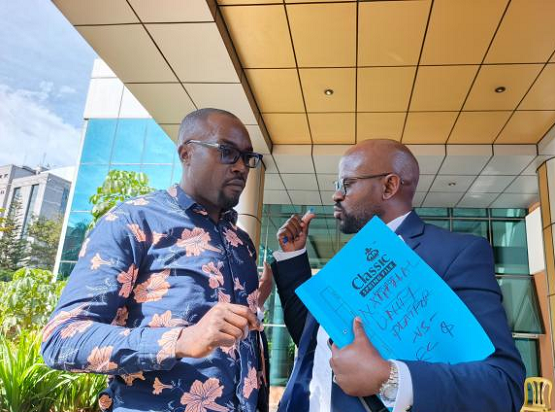
IPOD Executive Director Sserwambala (left) with the Electoral Commission Lawyer Hamidu Lugolobi at the High Court in Kampala.
The High Court in Kampala has set October 29, 2025, as the date for delivering its ruling in a case filed by the National Unity Platform (NUP) challenging its exclusion from statutory political party funding. The ruling date was fixed on Friday following a petition filed by NUP contesting its exclusion from the list of political parties eligible to receive funding.
NUP, through its Secretary General David Lewis Rubongoya, told the Court that recent amendments to the Political Parties and Organisations Act, and a government directive restricting access to public funding to only those political parties that are members of and participate in the Inter-Party Organisation for Dialogue (IPOD), are unlawful. The main contention relates to a directive dated August 25, 2025, from the Minister of Justice and Constitutional Affairs, Norbert Mao—who is also President of the Democratic Party—ordering the Electoral Commission to disburse party funding for the July–September quarter only to six political parties affiliated with IPOD.
NUP, the largest opposition party in Parliament by representation, was not among the beneficiaries, prompting it to petition the Court for judicial review and an interim injunction. Through its lawyers, Elias Nalukoola and Jonathan Erotu, NUP argued that the Minister’s directive was illegal, irrational, and unconstitutional.
The party contended that the amendment to the Political Parties and Organisations Act, passed by Parliament in May and assented to by President Yoweri Kaguta Museveni in June 2025, has not yet taken legal effect due to the absence of a statutory instrument required to operationalise it. As such, NUP, through Secretary General Rubongoya, maintains that any actions taken under the amendment, including the denial of funding, are null and void.
NUP further claims that the new requirement for parties to be IPOD members to access public funds is discriminatory and infringes upon their constitutional rights to freedom of association and equality before the law. The party says it was not consulted during the amendment process and has been deliberately excluded from decisions affecting its operations and entitlements.
When the matter came up for mention before Justice Collins Acellam today, both the Electoral Commission and the Attorney General submitted formal responses opposing the application and seeking its dismissal. In its written submissions, the Electoral Commission raised a preliminary objection, arguing that the application is incompetent, frivolous, and an abuse of court process. The Commission stated that it acted in accordance with a directive from the Minister based on a valid law passed by Parliament.
It further contended that the High Court lacks jurisdiction to suspend or review the implementation of an Act of Parliament unless it has first been declared unconstitutional by the Constitutional Court under Article 137 of the Constitution. The Commission, through its lawyers led by Hamidu Lugolobi, maintained that NUP had failed to demonstrate a prima facie case or any irreparable harm justifying an interim injunction. It argued that any loss NUP may suffer can be compensated with damages, and that the balance of convenience favours implementing the law as passed by Parliament.
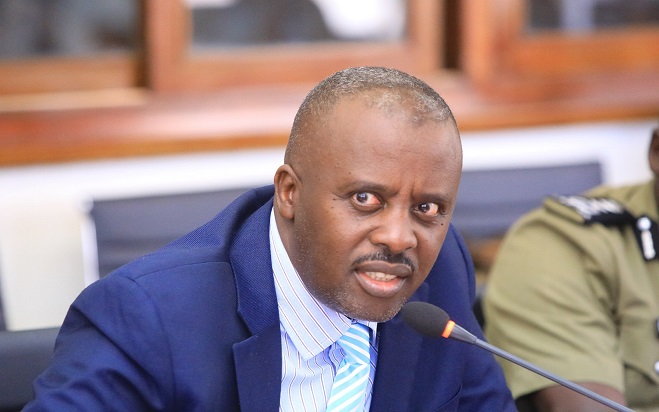
The Commission also accused NUP of acting in bad faith, pointing out that the party had shown no willingness to join IPOD until after the funding directive had already been issued. On the other hand, the Attorney General, defending the government’s position, relied on an affidavit sworn by Lawrence K. Sserwambala, Executive Director of IPOD. In his affidavit, Sserwambala confirmed that NUP has repeatedly declined invitations to join IPOD since 2021 and has consistently distanced itself from its activities, both publicly and privately.
He argued that the amended Act now legally requires that only parties participating in IPOD can access government funding, and that NUP’s exclusion is therefore a result of its own political decisions. Sserwambala also noted that IPOD remains open to any qualifying political party willing to join, and that NUP was given a copy of the new IPOD Memorandum of Understanding in response to a written request dated September 12, 2025.
He further stated that the IPOD summit, chaired by President Yoweri Museveni in his capacity as NRM party chairperson on September 18, expressed a clear readiness to welcome NUP if it chooses to engage with the dialogue framework. Further, Sserwambala brought proof of payment vouchers showing that on September 30, 2025, the Electoral Commission disbursed funds to six parties: the National Resistance Movement (NRM), Forum for Democratic Change (FDC), Uganda People’s Congress (UPC), Democratic Party (DP), Justice Forum (JEEMA), and the People’s Progressive Party (PPP).
Evidence before the Court indicates that the NRM received 8.5 billion shillings, FDC 756 million shillings, UPC 277 million shillings, DP 227 million shillings, while JEEMA and PPP each received 25 million shillings, leaving a balance of 1.1 billion shillings out of the 11 billion shillings allocated. In court, NUP lawyer Nalukoola challenged the legal basis of the directive and the amendment itself, arguing that without a statutory instrument from the Justice Minister, the new provisions of the Political Parties and Organisations Act are not yet legally operational. He noted that the government was prematurely applying a law that has no binding force.
NUP also expressed concerns that funds meant for it may have been reallocated and questioned the urgency behind disbursing money before legal issues surrounding the amendment are resolved. Nalukoola thus asked the Court to restrain the Electoral Commission and government from implementing the directive until the matter is fully adjudicated. Justice Acellam questioned the necessity of the litigation if the funds were indeed allocated for NUP.
“If it’s for NUP, why are we in court. We don’t even need an order if the money is meant for NUP,” said the Judge. The Judge was also suspicious that so much money was left undisbursed and encouraged the lawyers to focus on the legal issues and not politically related questions at hand.
The Judge also asked NUP’s legal team to clarify the purpose of their application in light of their own arguments that the directive lacks legal force. He told the NUP that “at times, even if one has energy, you don’t have to continue fighting, but instead energy can be used to do something else.” In response, another NUP lawyer, Jonathan Erotu, argued that while the Minister’s letter does not directly state that NUP is excluded, it operates to exclude them by only naming parties that are members of IPOD.
“They want us to sign the MoU,” he added, indicating that the condition of signing the IPOD agreement has been turned into a gatekeeping tool for public financing. After hearing submissions from both sides, Justice Acellam fixed October 29 as the date on which he will deliver his ruling via email.
-URN