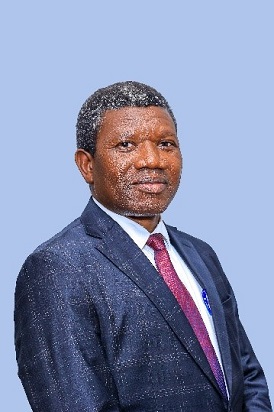

UCC Executive Director, Nyombi Thembo
Government has threatened to revoke licenses of media houses and impose penalties on individuals who will provide live broadcast of election results during and after the January 2026 general elections.
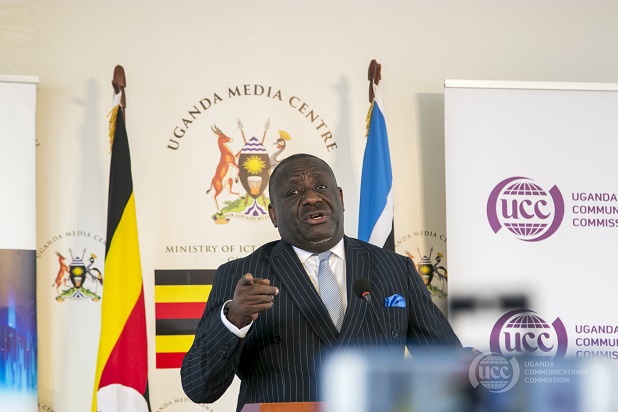
The warning was issued by Nyombi Thembo, Executive Director of Uganda Communications Commission (UCC) and Dr. Amina Zawedde, Permanent Secretary, Ministry of ICT and National Guidance, during a press briefing held on 5th January 2026 at Uganda Media Centre ahead next week’s general elections.
“The declaration of election results is the sole mandate of the Electoral Commission. Unofficial tally centres, premature announcements, or broadcasting unverified results are unlawful. The Commission is closely monitoring broadcast and online activity, and violations will attract appropriate penalties, including suspension or revocation of licences, and prosecution where applicable,” noted Thembo.
Thembo defended his position claiming that the Commission has observed instances where political actors abuse the airwaves to gain undue advantage, where he described such actions as unacceptable and will not be tolerated, adding that the Commission cannot stand by while media platforms are abused in ways that risk inflaming tensions or destabilising the country.
“Live broadcasting or live streaming of riots, unlawful processions, or violent incidents is prohibited. Such coverage risks spreading panic and undermining public order. Incitement, hate speech, and violent content whether broadcast or posted online, are strictly prohibited and will attract immediate enforcement action. Regulation is not intended to stifle journalism. On the contrary, our approach is to foster a supportive, technology-neutral, and predictable regulatory environment that promotes professionalism, accountability, resilience, and editorial independence,” noted Thembo.
During the press briefing, Dr. Aminah Zawedde, Permanent Secretary, Ministry of ICT and National Guidance also dismissed rumours of planned internet shutdown during the general elections, stating that such an order hasn’t been issued.
“We have also seen a rise in misinformation, particularly on digital platforms. One of the most persistent claims currently circulating is that the Government intends to switch off the internet during the elections. Let me state this clearly and without ambiguity: The Government has not announced, directed, or implemented any decision to shut down the internet during the election period. Claims suggesting otherwise are false and misleading. Such misinformation unnecessarily creates fear, undermines public confidence, and risks heightening tension at a critical national moment,” remarked Zawedde.
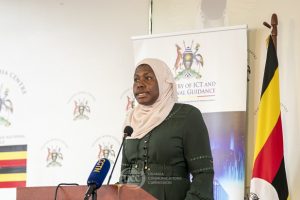
She also defended the ban imposed on the live broadcast of riots and electoral results arguing that the dissemination of inciting, hateful, or violent content is unlawful and attracts enforcement action re-echoing earlier remarks that the declaration of election results remains the sole mandate of the Electoral Commission, and the broadcasting or sharing of unverified or premature results is illegal.
“Digital platforms are not exempt from the law. The Computer Misuse Act applies fully to online conduct, including the spread of false information and offensive communication. Freedom of expression must be exercised responsibly and within the framework of the law,” explained Zawedde.
The Uganda Communications Commission also provided an update on efforts to have United States based internet service provider, Starlink licensed in Uganda, with Thembo blaming Starlink for failing to fulfil the licensing requirements and encouraging the importation of its equipment in Uganda without prior license approval
Thembo explained, “From the outset, the Commission explained these requirements to Starlink. Unfortunately, despite ongoing engagement, the company had not fulfilled all pre-licensing conditions. Under the law, it is an offence to provide telecommunication services in Uganda without a licence. In recent months, the Commission observed that Starlink kits were being imported, sold, installed, and used illegally within Uganda. Starlink had earlier committed to geo-locking its services to prevent spillover from neighbouring countries. However, this commitment was not fully honoured, and services remained accessible in Uganda.”
The Commission explained that following this discovery, 1st January 2026, the Commission issued directives requiring Starlink to immediately stop providing services in Uganda, deactivate all terminals in use, prevent signal spillover, and halt the importation and sale of kits.
“We are pleased to confirm that Starlink responded promptly, expressed regret, and implemented service restrictions. Our technical teams have verified that the previously active terminals are now off. We caution members of the public against attempting to bypass these restrictions. Procuring or using services from unlicensed providers is unlawful and exposes users to legal liability,” remarked Thembo.