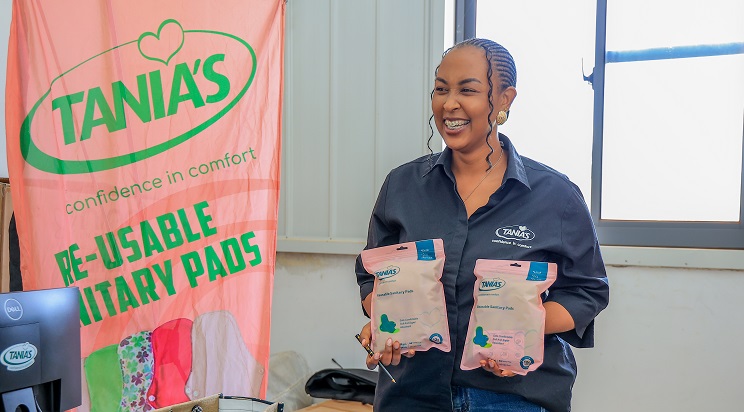

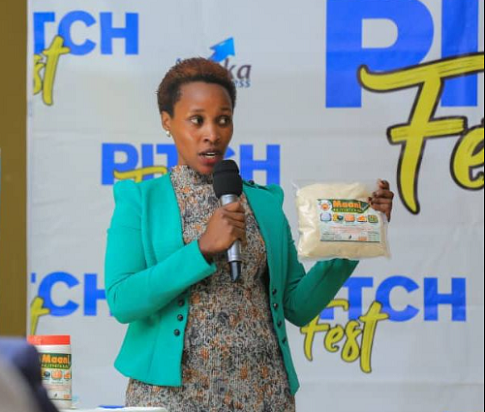
Tusiime marketing her product.
Brenda Tusiime marketing one of her products
Brenda Tusiime is the director of Mema Agro-Organic Processors, a company adding value to pumpkins. In an interview with Business Focus, Tusiime revealed that her value addition journey began after spending days in Kampala without making significant pumpkin sales.
Faced with limited market access, she was forced to abandon some pumpkins at Kalerwe Market—a loss she quickly turned into an opportunity by processing and adding value to her produce. In 2024, Tusiime was recognized among Uganda’s best farmers in the ‘Best Farmers Competition/Awards’ organized by Vision Group and sponsored by dfcu Bank, a financial institution supporting the country’s agricultural transformation.
Excerpts from the interview:
Q: Who is Brenda Tusiime?
A: I am a farmer and a mother. I grow pumpkins and process them into nutritious pumpkin flour. I also sell rice and maize flour.
Q: Tell us about your farming journey.
A: I’m the director of Mema Agro-Organic Processors based in Fort Portal City. We grow and process pumpkins and also offer milling services to the community. I started this business in 2019, growing pumpkins on two acres in Kyegegwa District. Initially, I had no idea about value addition and sold fresh pumpkins in Kampala markets, especially Kalerwe.
Q: Why did you transition into value addition?
A: My journey into value addition began on a very disappointing day. I had transported about three tonnes of pumpkins to Kampala, but after three days, I couldn’t find enough buyers. At the time, I was breastfeeding, which made it even more stressful. I ended up abandoning some of the pumpkins in the market. I wondered how I could prevent such losses, and that’s when the idea of adding value came to me. I lacked knowledge, so I went to the Uganda Industrial Research Institute (UIRI), where they guided me through the process. The first two years were challenging, but with passion and persistence, it worked out.
Q: Did you have a farming background, or did the passion develop along the way?
A: My mother was a farmer, and we grew up eating pumpkins—even the seeds! My children, however, didn’t like them, so I decided to process the pumpkins into flour. They liked it because it tasted like porridge. Pumpkin flour has a natural sweetness, so you don’t need to add sugar. I started with 20 kilograms and sold it to friends, then slowly took orders and never looked back. I didn’t want to be employed, and agriculture seemed the perfect fit. Today, I work with five employees.
Q: Do you have the necessary equipment to transform fresh pumpkins into powder?
A: I still face challenges with machinery. Fort Portal is a cold area, and I rely on solar dryers to dry pumpkins. During cold or rainy seasons, the dryers are not fully effective. I already have a grinding machine and a mill, but drying remains a challenge. My goal is to reach a stage where I don’t rely solely on solar drying.
Q: Do you still grow pumpkins, or do you rely on out growers?
A: I grow pumpkins on a small scale, but most come from out growers. I provide seeds, supervise the farming, and buy the pumpkins from them. It’s a community-driven supply system.
Q: How many value-added products do you have?
A: We currently have three products: MANI, a nutritious pumpkin flour with other ingredients; NEMA maize flour; and MEMA rice flour.
Q: Where can people find your products?
A: I’m still based in Fort Portal, but we receive orders from Kampala, Mbarara, and other parts of Uganda. We have two outlets in Fort Portal City and supply some groceries and a nursery school.
Q: Has dfcu Bank supported your business?
A: They sponsor the Best Farmer Initiative, which helped me gain recognition, but I haven’t received financing from them directly.
Q: How were you recognized in the Best Farmers Competition 2024?
A: I was recognized for value addition in the Western Region and was the first runner-up in that category.
Q: How did you learn about the competition?
A: I attended an exhibition while marketing my products. Journalists interviewed me, asked about my business, and later visited my premises for photos.
Q: Tell us about your experience in the Netherlands.
A: The study tour focused on coffee, poultry, and dairy. My line of business wasn’t covered, so I urge organizers to include a broader range of farmers in future tours. Leisure activities could also be considered.
Q: What message do you have for financial institutions and the government regarding farmer support?
A: Farmers and value addition entrepreneurs need financial support from banks and government. I need a machine, but it’s expensive, even though I have a market for my products. Providing machinery or financing would help us scale. It’s exciting to see my value addition project succeed and be recognized, but also disheartening when support is limited.