
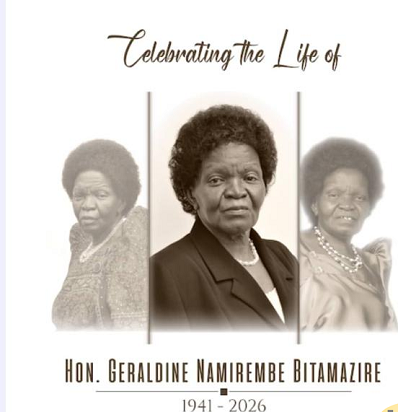
Namirembe Bitamazire
Before the Ministry of Education came under the stewardship of Janet Museveni, there was Geraldine Namirembe Bitamazire — a long-serving education minister fondly christened “Maama UPE” for her pivotal role in ushering in Universal Primary Education (UPE), a policy that opened school doors to millions of Ugandan children.
Affectionately dubbed “Maama UPE” for her unwavering commitment to free primary education, Bitamazire’s decades-long service transformed Uganda’s education landscape, ensuring that children from poor and marginalised communities could access schooling.
The former minister passed away on January 14 at the age of 84. However, news of her death reached many Ugandans days later due to a nationwide internet blackout linked to the 2026 election tensions. Born on July 17, 1941, in Butambala District — then part of Mpigi — Bitamazire rose from humble beginnings. She pursued education with determination, earning a Diploma in Education, a Bachelor of Arts, and a Master of Arts from Makerere University.

Her professional journey began in the classroom, teaching at renowned institutions including Mt. St. Mary’s Namagunga and Tororo Girls School, where she made history as the first African headteacher.
She later rose through key administrative roles, serving as Director at the East African Harbours Corporation (1971–1973), Senior Education Officer in the Ministry of Education (1974–1979), Deputy Chairperson of the Teaching Service Commission (1981–1996), and a member of the Kajubi Education Policy Review Commission.
Her political career was equally distinguished. Bitamazire served as Minister of Education on three occasions — briefly from 1979 to 1980, then as State Minister for Primary Education from 1999 to 2005, and later as full Cabinet Minister from 2005 to 2011. She was also a Woman Member of Parliament for Mpigi District from 2001 to 2011 on the National Resistance Movement (NRM) ticket.
Central to her legacy is Universal Primary Education, launched in 1997 but strongly championed under her leadership. The policy abolished tuition fees for primary schooling, triggering a dramatic surge in enrolment nationwide. “I dedicated my teaching career to this program, and I believe I left an indelible mark on both UPE and USE,” Bitamazire said in a 2024 interview with The Observer, noting that the initiatives helped level opportunities for socio-economically disadvantaged children.
Her influence extended beyond primary education. Prof. Mary Okwakol noted that Bitamazire’s leadership in higher education was equally transformative.
Prof. Okwakol added that Bitamazire was a fierce advocate for girl-child education, pushing for girls’ participation in science and technology fields and dismantling long-held gender stereotypes.
To advance girls’ education, Bitamazire co-founded the Forum for African Women Educationalists (FAWE), served on the United Nations Commission on the Status of Women from 1998 to 2001, and was a founding member of the Uganda Catholic Women’s Guild.
In her later years, she served as Chancellor of the Uganda Management Institute (UMI) from 2013 to 2021, mentoring young leaders and shaping institutional reforms. Prof. James Nkata, Director General of UMI, described her as “a leader of vision,” crediting her with steering UMI into one of Uganda’s leading public management institutions.“We worked together to bring UMI where it is today,” Nkata said.
“As a parent figure, he admired the polished upbringing of her children, and as a Ugandan, he affirmed that her legacy as the pioneering advocate for Universal Primary Education will never be erased.”
Beyond policy, Bitamazire was known for her signature afro hairstyle and aversion to makeup or painted nails — even on her wedding day in the 1970s. This unembellished style became her professional identity. “That’s called branding,” she once joked, reflecting her belief in substance over appearance.
On Tuesday afternoon, mourners filled St. Mary’s Cathedral for her funeral Mass, with the church nearly reaching capacity. In a heartfelt eulogy, her son Prof. Patrick Kyamanywa, Vice Chancellor of Uganda Martyrs University, painted an intimate portrait of his mother.“Many called her by titles — Maama UPE, Honourable — but to us she was Mummy Honourable: gentle, disciplined, a listener, a counsellor, a person of integrity who always lifted others,” he said.
He recalled how her long years in public service earned her the family nickname Maama Honourable, and how she lived by the belief that “a candle loses nothing by lighting another.”
Prof. Kyamanywa also reflected on her resilience — surviving cancer for over 13 years, living with diabetes for two decades, and remaining optimistic about reaching her 100th birthday, before her life was cut short by a sudden heart attack.
President Yoweri Kaguta Museveni accorded Bitamazire an official state burial, recognising her “distinguished service to the nation.”Education Minister Dr. John Chrysostom Muyingo led sectoral tributes, thanking “Maama UPE” for shaping generations of Ugandans.“She has left an indelible legacy that we will all strive to emulate in advancing human capital development in Uganda,” Muyingo said.
The Ministry’s Permanent Secretary, Dr. Kedrace Turyagyenda, described Bitamazire as “a pillar of the education sector whose leadership left a lasting policy and institutional footprint.”URN also learnt that Bitamazire was working on an autobiography during her final year. The manuscript was nearing completion and will be finalised by her family, with plans to publish it on July 7 — the date she would have turned 85.
-URN